
Skip to content

AI: Rise of the Thinking Machine

Dated timeline · 84 events

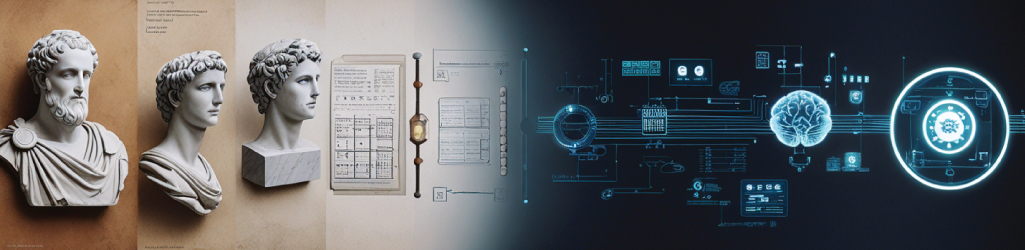
AI: Rise of the Thinking Machine is a visual timeline that shows how artificial intelligence has changed over time—from early machines and simple programs to today’s smart robots and creative tools. It highlights the big moments, important people, and surprising ideas that shaped how we live and work with AI. This timeline helps tell the story of how machines started learning, thinking, and becoming part of our everyday lives.

Order:
  1. 8 June 1637

    René Descartes Proposes Mechanistic Philosophy

    In Discourse on the Method, René Descartes1 suggests that animals—and possibly humans—can be understood as complex machines governed by physical laws. This mechanistic view of the mind influences early ideas about cognition and inspires future thinkers to explore artificial models of intelligence.

    Note:

    1. Descartes was so obsessed with reason that he once locked himself in a room with only a stove for company—just to think. That winter think-cation led to his famous “I think, therefore I am.” Total main-character energy. []
  2. 14 June 1837

    The Analytical Engine

    Charles Babbage1 conceptualizes the Analytical Engine, a mechanical general-purpose computer. Though never built in his lifetime, it introduces key ideas like memory, control flow, and programmability—essential concepts in AI.

    Note:

    1. Charles Babbage so despised street musicians that he waged a public campaign against London’s organ-grinders, claiming they ruined his ability to think and work. []
  3. 1 March 1914

    Leonardo Torres y Quevedo Builds a Chess Automaton

    Spanish engineer Leonardo Torres y Quevedo1 develops one of the first electromechanical machines capable of playing chess endgames. Known as El Ajedrecista, the device could checkmate a human opponent using a mechanical arm and pre-programmed logic, anticipating key ideas in computer-based decision-making.

    Note:

    1. An underrated genius, Torres y Quevedo once said, “Machines can think if we give them a mind.” He wasn’t just tinkering—he was dreaming big. From wireless remote control to early computing ideas, he made tech do magic before most believed it could. []
  4. 1 April 1936

    Alan Turing Introduces the Turing Machine

    Alan Turing1 publishes “On Computable Numbers”, introducing the concept of the Turing Machine—a theoretical device that manipulates symbols on a tape according to a set of rules. This abstract model defines the limits of what can be computed and becomes a foundational concept for both computer science and artificial intelligence.

    Note:

    1. Alan Turing cracked Nazi codes, helped invent modern computing, and casually asked, “Can machines think?” He also ran long-distance for fun and used to chain his mug to a radiator so no one would steal it. Absolute legend. []
  5. 1943

    McCulloch and Pitts Propose the First Neural Network Model

    Neuroscientist Warren McCulloch1 and mathematician Walter Pitts2 publish a model of artificial neurons, showing how simple logical operations could simulate brain-like behavior—laying the groundwork for neural networks.

    Note:

    McCulloch [1] and Pitts [2] met over a shared love of logic and ended up sketching out the first neural network model—in 1943. Pitts was just 20, and homeless at the time. Together, they basically gave AI its first rough brain.

  6. 1 October 1950

    The Imitation Game (Turing Test)

    In his landmark paper “Computing Machinery and Intelligence”, Turing explores the possibility of machine intelligence and proposes the Imitation Game—later known as the Turing Test1—as a way to evaluate it. His work shifts the question from abstract philosophy to practical experimentation, laying the conceptual groundwork for AI.

    Note:

    1. Turing’s Imitation Game asked a simple question: if you can’t tell if you’re chatting with a human or a machine, does it matter? It was the first real test for AI—and it’s still being talked about today. []
  7. 18 June 1956

    Dartmouth Conference: Birth of AI as a Field

    The Dartmouth Summer Research Project on Artificial Intelligence, organized by John McCarthy, Marvin Minsky, Claude Shannon, and Nathaniel Rochester, marks the official launch of AI as an academic discipline. Held at Dartmouth College, the conference brings together leading thinkers to explore the possibility that “every aspect of learning or any other feature of intelligence can in principle be so precisely described that a machine can be made to simulate it.” This bold vision sets the stage for decades of AI research and introduces the term artificial intelligence to the world.

    Note:

    The name “artificial intelligence” was coined just for the conference. John McCarthy wanted something bold and open-ended—so he skipped terms like “cybernetics” or “automata” and gave the future a brand-new name. []

  8. 1 July 1956

    Newell and Simon Demonstrate the Logic Theorist


    At the same time as the Dartmouth Conference, Allen Newell and Herbert A. Simon unveil the Logic Theorist1, often considered the first true AI program. Designed to mimic human problem-solving, it successfully proves mathematical theorems from Principia Mathematica, even finding more elegant proofs than the original authors in some cases. This groundbreaking achievement shows that machines can perform reasoning tasks traditionally seen as uniquely human, launching symbolic AI and influencing cognitive psychology.

    Note:

    Herbert Simon once said the Logic Theorist [1] was like “the birth of a new species.” He wasn’t joking—he believed machines could one day think, decide, even create. He also predicted a computer would win the Nobel Prize. Still waiting on that.

  9. 1958

    John McCarthy Develops Lisp: AI’s Native Language

    John McCarthy, one of AI’s founding figures, creates the Lisp programming language at MIT. Short for LISt Processing, Lisp introduces powerful features like recursion, symbolic expression manipulation, and dynamic memory allocation—making it especially well-suited for AI programming. Lisp quickly becomes the dominant language in AI research for decades, influencing both the development of AI algorithms and the design of future programming languages.

    Note:

    Lisp was created in 1958, and it’s so old-school it’s basically the AI programming grandparent still rocking flip-flops at the family reunion. McCarthy built it to think recursively—and somehow, it’s still teaching machines how to think. []

  10. 1 April 1960

    McCarthy Publishes “Recursive Functions of Symbolic Expressions”

    John McCarthy publishes his seminal paper “Recursive Functions of Symbolic Expressions and Their Computation by Machine”, formally introducing the Lisp programming language to the academic world. The paper lays out the theoretical foundations of symbolic computation using recursion and list structures, offering a new way to represent and process knowledge in machines. This work cements Lisp’s role in AI research and establishes a lasting framework for symbolic reasoning in computing.

    Note:

    McCarthy’s 1960 paper wasn’t just technical—it was rebellious. He published it without asking for permission to create a new programming language. The result? A foundational AI paper and a legendary move in hacker culture. []

  11. 1 September 1961

    Unimate: The First Industrial Robot Enters the Workforce

    Unimate, the first industrial robot, is deployed on a General Motors assembly line in New Jersey. Invented by George Devol and developed by Joseph Engelberger, Unimate performs repetitive and dangerous tasks like welding and handling hot metal parts. Its introduction marks the beginning of robotics in manufacturing and demonstrates how automation can augment human labor—paving the way for future AI-driven machines in industry.

    Note:

    Unimate didn’t talk or think—just moved hot metal with perfect obedience. But that silent factory arm kicked off a robot workforce that now sees, adapts, and sometimes even talks back (politely, of course). []

  12. 1966

    ELIZA: First Natural Language Processing Program

    Developed by Joseph Weizenbaum at MIT, ELIZA is one of the first programs to simulate human conversation using natural language. It famously mimics a Rogerian psychotherapist by reflecting users’ statements back as questions. Though ELIZA uses simple pattern-matching rather than true understanding, users often feel as if they’re interacting with a sentient being. The project highlights both the potential and the limitations of early NLP systems, and sparks debate about the psychological impact and ethical implications of human-computer interaction.

    Note:

    ELIZA had no idea what you were saying—but that didn’t stop people from spilling their hearts to her. She’s the first proof that sounding like you care might be enough to fool a human. AI’s first accidental therapist. []

  13. 1969

    Shakey the Robot: The First Mobile Robot with AI

    Developed at SRI International, Shakey is the first robot capable of perceiving its environment, reasoning about its actions, and navigating a space autonomously. Combining computer vision, natural language processing, and planning algorithms, Shakey could receive commands like “push the block off the platform” and determine a sequence of actions to accomplish the task. It marks a key breakthrough in integrating AI with robotics and inspires decades of research in autonomous agents.

    Note:

    Shakey wasn’t smooth, stylish, or even coordinated—but he could think. He planned, reasoned, and made decisions. Basically, the first robot to get lost on purpose. []

  14. 1970

    SHRDLU Demonstrates Early AI in a Simulated World

    Terry Winograd’s SHRDLU operates in a blocks world, understanding and responding to natural language commands. It demonstrates the potential of symbolic AI to manipulate language and reasoning within limited domains.

    Note:

    SHRDLU lived in a tiny virtual world of blocks and commands—basically a digital sandbox. He couldn’t clean your room, but he could stack shapes while debating linguistics. The ultimate basement-dweller AI. []

  15. 1972

    Prolog: A Language for Logic Programming

    French computer scientist Alain Colmerauer, with Philippe Roussel, develops Prolog (short for “Programming in Logic”), a high-level programming language rooted in formal logic. Designed for symbolic reasoning and knowledge representation, Prolog enables AI systems to infer conclusions from known facts and rules. Its declarative style makes it ideal for expert systems, natural language processing, and theorem proving, securing its place as a foundational tool in AI research through the 1970s and beyond.

    Note:

    Alain Colmerauer didn’t just invent a language—he created a way for machines to argue like philosophers. Prolog doesn’t follow orders; it solves mysteries. Basically, Sherlock Holmes in code form. []

  16. 1973

    WABOT-1: The First Human-Like Robot

    Developed by Waseda University in Japan, WABOT-1 is considered the world’s first full-scale humanoid robot. It features a limb control system, vision system, and conversation capabilities in Japanese, allowing it to interact with its environment and people in a rudimentary human-like way. WABOT-1 marks a key milestone in robotics, blending mechanical engineering with early AI to mimic basic aspects of human motion and communication.

    Note:

    WABOT-1 could walk, talk, and even play the organ—but with the grace of a microwave on stilts. Still, he gets credit: the first robot to say, “I’m not like other robots… I have knees.”

  17. 16 March 1973

    The Lighthill Report Triggers the First AI Winter

    Commissioned by the UK government, the Lighthill Report—authored by Sir James Lighthill—delivers a critical assessment of AI research in Britain. It argues that AI had failed to meet its promises outside narrow domains and casts doubt on its future potential. As a result, funding for AI is significantly reduced in the UK, and the report influences similar skepticism internationally. This marks the start of the first AI winter—a period of stalled progress and diminished support due to unmet expectations.

    Note:

    Though framed as a scientific critique, the Lighthill Report reflected deeper economic and political pressures. At a time of budget cuts, it gave the UK government a reason to pull AI funding—and reshape tech priorities. []

  18. 1 October 1979

    The Stanford Cart: Early Autonomous Navigation

    Developed at Stanford University under Hans Moravec, the Stanford Cart is a pioneering robot capable of navigating a room using cameras and a mechanical vision system. It successfully travels across a cluttered room without human intervention by processing visual input and planning its route. Though slow and limited by today’s standards, the Stanford Cart demonstrates key concepts in computer vision, path planning, and autonomous mobility—laying the groundwork for future self-driving technology.

    Note:

    The Stanford Cart became one of the earliest robots to navigate obstacles autonomously. Though slow, its success marked a key step toward modern robotics and self-driving technology.

  19. 1980

    Rise of Expert Systems (e.g., XCON)

    AI enters the commercial realm with rule-based expert systems like XCON, which configures computer systems at Digital Equipment Corporation. These systems encode expert knowledge to solve complex, domain-specific problems.

    Note:

    XCON quietly became one of the first AI systems to succeed in the business world—saving millions by helping configure computer orders at DEC. Less famous, but all hustle.

  20. 1982

    Japan Launches the Fifth Generation Computing Project (FGCP)

    Japan’s Ministry of International Trade and Industry (MITI) launches the Fifth Generation Computing Project (FGCP) with the ambitious goal of creating computers capable of human-like reasoning and problem-solving. Focused on logic programming, knowledge representation, and parallel computing, the project aims to leap beyond conventional computers and advance artificial intelligence. While it ultimately falls short of its lofty goals, FGCP energizes global interest in AI and spurs significant international investment and research, particularly in response from the U.S. and Europe.

    Note:

    The FGCP wasn’t just about tech—it was Japan’s bold flex in a Cold War-era tech race. Its launch rattled the U.S. so much, it helped trigger a surge in Western AI investment, like an international academic “arms race.”

  21. 9 October 1986

    Backpropagation Revives Neural Networks

    Geoffrey Hinton, David Rumelhart, and Ronald Williams publish a paper that popularizes the backpropagation algorithm—a method for efficiently training multi-layer neural networks. Though the concept existed earlier, their work demonstrates its practical power in enabling neural networks to learn from errors and adjust internal weights. This breakthrough breathes new life into connectionist approaches and sets the stage for the deep learning revolution decades later.

    Note:

    Backpropagation is basically AI’s personal trainer—teaches neural networks how to learn from their mistakes by adjusting their own “muscle weights.” It turned weak, scratchy prototypes into deep learning powerhouses.

  22. 15 July 1995

    Navlab 5 Completes “No-Hands Across America”

    Developed by Carnegie Mellon University, Navlab 5 becomes one of the first autonomous vehicles to drive long distances without human intervention. In a landmark demonstration, the modified minivan travels over 2,800 miles from Pittsburgh to San Diego, with the onboard AI system controlling the steering for 98% of the journey. This achievement showcases early success in computer vision, sensor fusion, and autonomous navigation, making it a foundational moment in the development of self-driving cars.

    Note:

    Navlab 5 had a human co-pilot who only handled city driving—because even in the ’90s, AI already knew city traffic was a nightmare best left to humans.

  23. 11 May 1997

    Deep Blue Defeats Chess Champion Garry Kasparov

    IBM’s Deep Blue makes history by defeating reigning world chess champion Garry Kasparov in a six-game match—marking the first time a computer beats a world champion under standard tournament conditions. Built with custom hardware and capable of evaluating 200 million positions per second, Deep Blue combines brute-force search with chess-specific heuristics and strategic knowledge encoded by grandmasters. The match captivates the public and signals a turning point in AI, demonstrating that machines can challenge—and surpass—humans in complex intellectual tasks. It also raises new philosophical questions about the limits of human cognition in the age of intelligent machines.

    Note:

    After his loss, Kasparov accused IBM of cheating—sparking conspiracy theories and Cold War-era tech paranoia. A Russian grandmaster losing to an American machine? For some, it wasn’t just chess—it was geopolitical drama.

  24. 11 July 2000

    FDA Clears the First AI-Assisted Surgical System

    The U.S. Food and Drug Administration (FDA) approves the da Vinci Surgical System, marking the first time a robotic surgery platform is cleared for general laparoscopic procedures. While not autonomous, the system enhances a surgeon’s precision and control through computer-assisted movements. Over time, AI components—such as motion scaling, tremor reduction, and image-guided navigation—become integrated into surgical robotics. This milestone opens the door for AI in operating rooms, laying the foundation for more advanced, semi-autonomous surgical technologies in the future.

    Note:

    The da Vinci system let surgeons operate using tiny robotic arms while watching on a console—like playing a super delicate video game where the prize is a human life. Surgeons even started practicing with simulators before real surgeries, leveling up like gamers.

  25. 8 October 2005

    Stanford’s Stanley Wins the DARPA Grand Challenge

    In a breakthrough for robotics and AI, Stanford University’s autonomous vehicle Stanley wins the DARPA Grand Challenge, a 132-mile off-road race through the Mojave Desert. Sponsored by the U.S. Defense Advanced Research Projects Agency (DARPA), the competition aims to accelerate the development of self-driving technology. Stanley, equipped with LIDAR, GPS, cameras, and machine learning algorithms, successfully navigates the rugged terrain without human input. This victory demonstrates the real-world potential of autonomous systems and ignites widespread interest in self-driving vehicles across academia and industry.

    Note:

    Stanley didn’t just win the DARPA Grand Challenge—he blazed through 132 miles of rocky desert with no driver, no backup, and probably a few sand-fried circuits. It was the AI equivalent of winning “Top Gear: Apocalypse Edition.”

  26. 30 September 2006

    Geoffrey Hinton Popularizes Deep Learning

    Hinton and colleagues revive interest in neural networks with breakthroughs in deep learning. Their work enables multi-layered networks to learn complex features, reigniting AI progress after years of stagnation.

    Note:

    Geoffrey Hinton once tried to model how the brain works—then accidentally gave birth to modern AI instead. His students went on to run AI at Google, Meta, and beyond. In other words, he’s basically AI’s godfather.

  27. 2010

    AI-Powered Cobots Enter Manufacturing

    The emergence of collaborative robots, or cobots, marks a new phase in industrial automation. Unlike traditional robots that operate in isolation, cobots are designed to work safely alongside human workers. By 2008, companies like Universal Robots begin integrating AI-driven features such as adaptive control, force sensing, and machine learning to enable cobots to assist with precision tasks, learn from demonstration, and respond to dynamic environments. This shift transforms manufacturing, making automation more flexible, scalable, and human-centric.

    Note:

    Cobots (collaborative robots) were designed to work alongside humans safely. Instead of replacing workers, they became helpful teammates on the factory floor—less “terminator,” more “toolbelt buddy.”

  28. 16 February 2011

    IBM Watson Wins on Jeopardy!

    Watson defeats human champions on the quiz show Jeopardy!, showcasing AI’s capabilities in understanding and processing natural language, retrieving vast knowledge, and forming human-like answers in real time.

    Note:

    In 2011, IBM’s Watson didn’t just win Jeopardy!—it demolished two of the game’s greatest champions. The AI was so good at puns and wordplay, some viewers thought it might start hosting the show next.

  29. 4 October 2011

    Siri: The First Widely Used Virtual Assistant

    Apple introduces Siri with the launch of the iPhone 4S, making it the first mainstream virtual assistant powered by AI and natural language processing. Siri can answer questions, send messages, set reminders, and perform basic tasks through voice commands—bringing conversational AI to millions of users. Derived from a DARPA-funded project, Siri combines speech recognition, natural language understanding, and cloud-based search to deliver responsive, human-like interaction. Its success sparks a wave of virtual assistants, including Google Assistant, Alexa, and Cortana, and redefines how people interact with technology.

    Note:

    Launched in 2011, Siri turned millions of phones into personal butlers overnight. Fun fact: her original voice actress didn’t even know she was Siri until she heard herself on TV!

  30. 2012

    AI Transforms Drug Discovery

    Throughout the 2010s, a wave of startups and research initiatives begin applying AI to accelerate drug discovery—a process traditionally measured in decades and billions of dollars. Companies like Atomwise, Insilico Medicine, BenevolentAI, and Recursion use machine learning to predict molecular behavior, identify new drug candidates, and repurpose existing compounds. These AI systems analyze vast datasets of chemical structures, clinical outcomes, and biological pathways to generate insights faster than traditional methods. The field grows rapidly, especially during the COVID-19 pandemic, proving AI’s potential to reshape pharmaceutical innovation.

    Note:

    AI began speeding up drug discovery in the 2010s, helping scientists find new treatments in months instead of years. It’s like having a tireless lab assistant who never sleeps—and reads every research paper ever written.

  31. 2012

    Digital Twin: A Virtual Representation of the Physical World

    The concept of the digital twin—a virtual model of a physical object, system, or process—gains prominence in the 2010s, particularly in manufacturing, healthcare, and smart cities. Enabled by AI, IoT sensors, and real-time data analytics, digital twins allow organizations to simulate, monitor, and optimize real-world systems with unprecedented precision. AI algorithms enhance predictive capabilities, enabling proactive maintenance, performance tuning, and scenario planning. The digital twin becomes a critical tool in bridging physical and digital realms, supporting smarter decision-making and continuous improvement.

    Note:

    A digital twin is a virtual version of a real-world object—like a building, jet engine, or even a city—used to simulate, test, and improve performance. It’s like having a digital clone that takes the risks so the real thing doesn’t have to.

  32. 30 September 2012

    Convolutional Neural Networks Revolutionize Computer Vision

    Although the concept of convolutional neural networks (CNNs) dates back to the 1980s, they achieve a major breakthrough in 2012 when Geoffrey Hinton’s team, led by Alex Krizhevsky, wins the ImageNet Large Scale Visual Recognition Challenge with AlexNet. This deep CNN dramatically outperforms traditional methods in object recognition tasks by automatically learning visual features from raw pixels. The success of CNNs transforms computer vision, enabling advances in facial recognition, autonomous vehicles, medical imaging, and more—marking the beginning of the modern deep learning era.

    Note:

    In 2012, a neural network called AlexNet blew minds by crushing an image recognition contest. It marked the moment AI started “seeing” like humans—with fewer naps and better accuracy.

  33. 17 March 2014

    Facebook’s DeepFace Sets the Standard for AI Facial Recognition

    Facebook releases DeepFace, the first deep learning system to achieve near-human accuracy in facial recognition. Trained on over 4 million labeled faces, DeepFace uses a deep convolutional neural network to align and represent faces in a consistent 3D model, significantly improving recognition across different poses and lighting conditions. Achieving 97.25% accuracy on the Labeled Faces in the Wild (LFW) benchmark, it marks a turning point in computer vision—demonstrating that AI can recognize individuals with unprecedented precision. DeepFace paves the way for widespread adoption of AI-driven facial recognition in social media, smartphones, surveillance, and beyond.

    Note:

    Despite its game-changing accuracy, DeepFace never actually “sees” a face—it maps distances between features like a digital sculptor sketching invisible lines across your cheekbones.

  34. 17 June 2015

    DeepDream: The First AI to Generate Surreal Visual Art

    Google engineers release DeepDream, a convolutional neural network repurposed to visualize and enhance the features it learns during image classification. By feeding images back into the network and amplifying patterns it detects, DeepDream generates dreamlike, hallucinogenic visuals filled with exaggerated shapes and textures. DeepDream ignites interest in AI creativity and paves the way for later developments in generative models like GANs and diffusion networks.

    Note:

    Originally a tool to visualize what neural networks “see,” DeepDream accidentally gave birth to trippy, dreamlike images—making AI the first machine to unintentionally invent psychedelia.

  35. 11 December 2015

    OpenAI Is Founded to Ensure AI Benefits Humanity

    OpenAI is founded by Elon Musk, Sam Altman, Ilya Sutskever, Greg Brockman, and others as a non-profit research organization with a mission to ensure that artificial general intelligence (AGI) benefits all of humanity. Created in response to concerns about the unchecked power of advanced AI, OpenAI commits to open research, collaboration, and the development of “friendly AI.” The organization quickly becomes a major force in the field, contributing foundational work in reinforcement learning, language models, and safety research—ultimately leading to breakthroughs like GPT and DALL·E.

    Note:

    At launch, OpenAI turned heads not just for its mission—but for giving away early research like a generous wizard handing out spellbooks.

  36. 2016

    AI Powers the Rise of Smart Cities

    By 2016, governments and technology companies begin integrating AI into smart city initiatives to enhance urban living through real-time data and automation. Cities like Singapore, Barcelona, and Dubai deploy AI for traffic optimization, energy efficiency, predictive maintenance, and public safety. Machine learning systems analyze data from sensors, cameras, and IoT devices to make cities more responsive and sustainable. From adaptive traffic lights to AI-based waste collection and facial recognition for law enforcement, smart cities become living testbeds for the real-world impact of AI on society.

    Note:

    Did you know? Some smart city technologies can even predict when a trash bin will overflow — making your neighborhood cleaner before the mess happens. AI: taking out the trash, literally.

  37. 15 March 2016

    AlphaGo Defeats Top Human Go Players

    Google DeepMind’s AlphaGo shocks the world by defeating Lee Sedol, one of the best Go players of all time, in a five-game match. Go, with its vast number of possible board states, had long been considered a grand challenge for AI due to its complexity and reliance on intuition. AlphaGo combines deep neural networks with reinforcement learning and Monte Carlo tree search to evaluate positions and plan moves. Its victory marks a major leap in AI’s ability to handle abstract reasoning and strategy, and it reignites global interest in the potential of deep learning.

    Note:

    AlphaGo made a move so unconventional in Game 2 against Lee Sedol that commentators thought it was a mistake — until it changed the entire match. Even AI knows how to throw a curveball.

  38. 2 March 2017

    A New Kind of Composer: AI Creates Original Music

    On August 21, 2017, Amper Music, one of the first AI music composition platforms, releases its debut AI-composed album, I AM AI, in collaboration with singer Taryn Southern. The platform uses machine learning to generate original music in various styles, adjusting melody, tempo, and instrumentation based on user input. This event showcases AI’s emerging role not just as a tool but as a creative collaborator. It also signals the beginning of a broader movement—where AI systems participate in the composition, production, and performance of music, raising questions about creativity, authorship, and the future of art.

  39. 1 April 2017

    Project Maven Brings AI to Military Intelligence

    The U.S. Department of Defense launches Project Maven (officially the Algorithmic Warfare Cross-Functional Team) to integrate AI into military surveillance systems. Its goal is to automate the analysis of drone footage, using computer vision and machine learning to detect objects, track movements, and reduce the burden on human analysts. Project Maven marks one of the first large-scale deployments of AI in active military operations. The project sparks public debate over the ethical use of AI in warfare, especially after internal protests at Google—one of the contractors—lead the company to withdraw from the program.

    Note:

    In 2018, news of Google’s role in Project Maven sparked internal protests, with thousands of employees signing a petition and several resigning. The controversy marked one of the first major ethical standoffs between big tech and military AI use.

  40. 8 May 2018

    Google Duplex Makes Human-Like Phone Calls

    At Google I/O 2018, Google Duplex astonishes the world by making phone calls to schedule hair appointments and restaurant reservations—sounding indistinguishably human. Powered by advanced natural language understanding, speech synthesis, and context-aware dialogue management, Duplex handles interruptions, hesitations, and informal phrasing with remarkable fluency. The demonstration showcases how far conversational AI has come, blurring the line between human and machine interaction. It also sparks immediate ethical debates about transparency, consent, and the need for disclosure when an AI is impersonating a human voice.

  41. 22 May 2018

    AI Enters the Criminal Justice System

    In 2018, AI’s role in criminal justice drew major attention. The Orlando Police Department tested Amazon’s facial-recognition tool Rekognition in May, sparking ethical concerns. By June 22, Amazon employees protested its use in law enforcement. That year also saw the influential “Gender Shades” study reveal racial and gender bias in AI systems. In December, Europe’s first ethical charter on AI in justice was released—marking 2018 as a key year for AI scrutiny in legal systems.

  42. 14 June 2019

    Astrobee: The First AI Robot in Space

    NASA launches Astrobee, a free-flying robotic assistant powered by AI, aboard the International Space Station (ISS). Designed to support astronauts with routine tasks, Astrobee uses autonomous navigation, computer vision, and voice interaction to move through microgravity and perform inspections, inventory checks, and diagnostics. Equipped with cameras and sensors, it can operate independently or under remote control from Earth. Astrobee marks a significant step toward human-robot collaboration in space, laying the groundwork for future missions involving AI-assisted habitats, lunar bases, and deep-space exploration.

  43. 11 June 2020

    GPT-3 Pushes Boundaries of Language Models

    OpenAI releases GPT-3, a massive language model with 175 billion parameters. It demonstrates impressive capabilities in generating coherent text, writing code, and answering questions—reshaping the landscape of NLP.

  44. 15 July 2021

    AlphaFold Solves the Protein Folding Problem

    DeepMind’s AlphaFold achieves a major scientific breakthrough by accurately predicting 3D protein structures from amino acid sequences—a challenge that has baffled biologists for 50 years. In the CASP14 competition, AlphaFold surpasses all previous computational methods, achieving accuracy comparable to experimental techniques like X-ray crystallography. This leap in computational biology revolutionizes drug discovery, disease understanding, and synthetic biology by drastically reducing the time and cost required to determine protein structures. The open release of AlphaFold’s predictions for over 200 million proteins marks one of the most significant contributions of AI to science to date.

  45. 30 September 2021

    Scary Smart: AI and the Future of Humanity

    Former Google X executive Mo Gawdat publishes Scary Smart, a thought-provoking book warning that artificial intelligence will soon surpass human intelligence and act with unpredictable autonomy. Gawdat argues that the best way to ensure AI acts ethically is to treat it with compassion—as if raising a child—and to align it with human values now, while it’s still learning from us. The book gains renewed attention during the 2023 open letter debate, becoming a widely cited manifesto for ethical AI development and the moral responsibilities of its creators.

    Note:

    Mo Gawdat wrote Scary Smart after a deeply personal journey sparked by the sudden loss of his son—an experience that profoundly shaped his views on empathy, consciousness, and our moral duty toward intelligent machines.

  46. 5 January 2022

    Ameca: The Most Realistic Humanoid Robot Unveiled

    UK-based company Engineered Arts unveils Ameca, a humanoid robot praised as the most realistic and expressive to date. Designed as a platform for AI and human-robot interaction, Ameca features incredibly lifelike facial movements, gestures, and micro-expressions powered by advanced robotics and machine learning. While it doesn’t possess general intelligence, Ameca is engineered to simulate natural human-like responses and emotional cues, making it ideal for research, public engagement, and testing AI in social environments. Its debut sparks viral attention and renews discussions about the future of robotics, human-AI coexistence, and the uncanny valley.

    Note:

    Ameca’s face is made from a specially formulated gray rubber to remain neutral across ethnicities, helping avoid unintended biases — and it was designed to be gender-neutral as well.

  47. 3 March 2022

    AI to Save the Planet: UNEP Launches WESR

    The United Nations Environment Programme (UNEP) launches the World Environment Situation Room (WESR) in 2022—an AI-powered data platform designed to monitor the health of the planet in real time. WESR integrates satellite imagery, sensor data, and machine learning to track environmental indicators such as deforestation, pollution, biodiversity loss, and climate change. AI helps detect patterns, forecast ecological risks, and inform policymakers with timely, actionable insights. This initiative exemplifies how AI can support global sustainability efforts and guide evidence-based environmental governance to protect ecosystems and combat the climate crisis.

    Note:

    The WESR platform draws inspiration from science fiction — UNEP insiders nicknamed it “the planetary dashboard,” echoing ideas from The Matrix and Minority Report about real-time global monitoring.

  48. 22 August 2022

    Stable Diffusion & DALL·E Make AI Art Widely Accessible

    Text-to-image models like DALL·E and Stable Diffusion democratize AI-generated art. These tools allow anyone to create detailed images from text prompts, sparking new debates about creativity and authorship.

    Note:

    When DALL·E was first unveiled, users quickly discovered it could generate imaginary creatures like “avocado chairs” and “snail-harp hybrids” — surreal outputs that led to a viral wave of AI-generated memes and digital art showcases.

  49. 22 December 2022

    Uber Launches Fully Autonomous Ride-Hailing Cars

    In 2023, Uber begins deploying fully autonomous vehicles in select cities, marking a milestone in the evolution of self-driving technology. Partnering with companies like Motional and Aurora, Uber integrates Level 4 autonomous vehicles into its ride-hailing platform, enabling passengers to book rides without a human driver. These vehicles use a combination of AI, LiDAR, radar, and computer vision to navigate complex urban environments. While the rollout is gradual and geographically limited, it signals a new era in mobility, reshaping how people move and accelerating the shift toward AI-driven transportation.

    Note:

    During early test rides, some passengers reportedly talked to the empty driver’s seat out of habit—prompting engineers to consider adding friendly voice assistants to reduce the awkward silence.

  50. 17 January 2023

    Getty Images Sues Stability AI Over Copyright Infringement

    Getty Images sues Stability AI, alleging that millions of its copyrighted photos—including those with watermarks—were used without permission to train the Stable Diffusion model. The lawsuit, filed in both the UK and U.S., accuses Stability AI of violating copyright and trademark law. The case, which began trial in London in June 2025, is seen as a landmark legal test that could reshape how AI models are trained and what rights creators retain over their work.

    Note:

    One of Getty’s key exhibits included AI-generated images that eerily mimicked its watermark—an ironic glitch that became a visual symbol of the legal and ethical gray zone surrounding AI training data.

  51. 14 March 2023

    OpenAI Releases GPT-4: A Leap in General Language Understanding

    In March 2023, OpenAI releases GPT-4, a powerful multimodal language model capable of understanding and generating human-like text with unprecedented nuance, reasoning ability, and factual accuracy. Building on the success of GPT-3, GPT-4 demonstrates improved performance on complex tasks such as coding, legal reasoning, creative writing, and standardized testing. It can process both text and image inputs, making it more versatile than its predecessors. GPT-4 becomes widely adopted in education, enterprise tools, and consumer apps, reinforcing the transformative role of large language models in knowledge work, communication, and human–AI collaboration.

    Note:

    Early testers of GPT-4 discovered it could pass the Uniform Bar Exam in the top 10% of test takers—an ironic twist for a model that, technically, isn’t even a person, let alone a law student.

  52. 22 March 2023

    Open Letter Calls for AI Pause

    In March 2023, Elon Musk and hundreds of tech experts sign an open letter urging a six-month pause on training powerful AI systems beyond GPT-4. Citing risks to society and humanity, the letter calls for stronger safety protocols, oversight, and alignment research. Though controversial and met with mixed responses, the letter sparks global debate about AI governance, ethics, and the pace of innovation.

    Note:

    Despite co-signing the pause letter, Elon Musk quietly moved forward with founding xAI just months later—fueling speculation that the “pause” was less about stopping AI and more about leveling the playing field.

  53. 1 November 2023

    Global AI Safety Summit at Bletchley Park

    In November 2023, world leaders, tech executives, and researchers gather at Bletchley Park, UK, for the first Global AI Safety Summit. The event focuses on the risks of frontier AI, including misuse, loss of control, and global instability. Key outcomes include the Bletchley Declaration, a multilateral agreement to collaborate on AI safety research and governance. The summit marks a pivotal moment in international efforts to align AI development with shared human values and security.

    Note:

    Bletchley Park, once home to WWII codebreakers like Alan Turing, was chosen symbolically—linking the birthplace of modern computing with today’s quest to ensure AI doesn’t outsmart its makers.

  54. 13 November 2023

    NVIDIA Launches Next-Gen AI Chips (H200 Series)

    In 2024, NVIDIA releases its H200 chips, the next evolution in high-performance AI hardware. Optimized for training and running massive models, the H200s offer faster memory, improved energy efficiency, and superior performance for generative AI workloads. These chips cement NVIDIA’s role as a critical infrastructure provider for the AI boom, powering everything from cloud services to robotics and advanced research.

    Note:

    The H200’s debut sparked such high demand that tech insiders jokingly called it “AI’s new gold”—with some startups reportedly timing their funding rounds around when they could secure chip access.

  55. 6 December 2023

    Google Launches Gemini: A Powerful Multimodal AI Rival

    In December 2023, Google DeepMind launches Gemini, a next-generation multimodal AI model designed to rival and expand on the capabilities of large language models like GPT-4. Combining strengths from DeepMind’s Alpha series (known for reasoning and planning) with the linguistic versatility of transformer models, Gemini is capable of understanding and generating text, images, code, and more. Gemini emphasizes reasoning, efficiency, and integration across data types, with Google embedding it into products like Search, Bard (later rebranded as Gemini), and Workspace. The launch marks a new chapter in the AI race, with competition driving rapid innovation in multimodal, general-purpose intelligence.

    Note:

    The name “Gemini” isn’t just astrological—it nods to the model’s dual heritage: DeepMind’s logic-heavy Alpha lineage and Google’s language-driven transformers, symbolizing a fusion of reasoning and communication.

  56. 10 January 2024

    U.S. Pushes for AI Oversight Bill

    In 2024, U.S. lawmakers introduce comprehensive legislation aimed at regulating artificial intelligence. The proposed AI Oversight Bill seeks to establish safety standards, transparency requirements, and accountability for advanced AI systems. It emphasizes risk classification, model audits, and protections against bias, misinformation, and misuse. While still debated in Congress, the bill signals growing political momentum to balance innovation with public trust and ethical safeguards.

    Note:

    Early drafts of the bill reportedly referenced Asimov’s Three Laws of Robotics—not as legal text, but as a symbolic reminder of how long humanity has wrestled with the ethics of intelligent machines.

  57. 19 January 2024

    Stability AI Releases Stable LM 2

    In 2024, Stability AI launches Stable LM 2, its second-generation open-source large language model. Designed to compete with leading proprietary models, Stable LM 2 offers improved reasoning, multilingual support, and code generation capabilities. Its release emphasizes transparency and accessibility, supporting the open AI movement by giving developers and researchers greater control over powerful language models.

    Note:

    Stability AI’s commitment to open-source sparked a fanbase that jokingly dubbed Stable LM 2 “the people’s chatbot”—a nod to its DIY spirit and the model’s appearance in countless indie AI projects within weeks of release.

  58. 9 December 2024

    OpenAI Unveils Sora: Text-to-Video Generation AI

    In early 2024, OpenAI introduces Sora, a groundbreaking model that generates high-quality, realistic video from text prompts. Capable of producing coherent scenes, camera movements, and visual storytelling, Sora represents a major leap in multimodal AI. Its release showcases the creative potential—and ethical challenges—of generative video, sparking global discussions about misinformation, media authenticity, and the future of content creation.

    Note:

    “Sora” means “sky” in Japanese—a subtle reference to both the model’s creative reach and the cinematic drone-like shots it can generate, often soaring over AI-generated landscapes with uncanny realism.

  59. 17 January 2025

    Samsung Integrates AI Across Consumer Devices


    Throughout 2025, Samsung expanded the integration of generative and multimodal AI across its consumer device ecosystem, embedding AI capabilities into smartphones, wearables, home appliances, and smart home platforms. Building on partnerships with leading AI model providers, Samsung introduced on-device and cloud-assisted AI features for real-time translation, image and video enhancement, personalized recommendations, and context-aware automation. Notably, AI became a core layer of interaction in everyday appliances—such as refrigerators, TVs, and home hubs—allowing devices to adapt to user habits and coordinate intelligently across the home. This broad rollout marked a shift from AI as a standalone feature to AI as an ambient, always-present interface, signaling how advanced AI models were becoming embedded into daily consumer experiences at global scale.

  60. 20 January 2025

    DeepSeek‑R1: Open‑Source Reasoning Model Breakthrough

    The Chinese startup DeepSeek releases DeepSeek‑R1, a powerful reasoning-focused LLM open-sourced under an MIT license. It rivals models like OpenAI’s o1 and Gemini 2.5 at a fraction of the cost (around $1 per million tokens), surprising the industry and even contributing to a sharp drop in NVIDIA’s stock.

    Note:

    DeepSeek-R1’s surprise release was dubbed “the dragon drop” by market watchers—not just for its impact on NVIDIA’s valuation, but for how it signaled China’s growing influence in the open-source AI arms race.

  61. 23 January 2025

    Executive Order 14179: U.S. AI Leadership Agenda

    President Trump signs Executive Order 14179, entitled “Removing Barriers to American Leadership in Artificial Intelligence.” The order revokes prior safety regulations and directs U.S. agencies to craft a national AI strategy within 180 days, signaling a shift toward prioritizing innovation and competitiveness.

    Note:

    Critics quickly nicknamed the order “AI Unleashed,” drawing parallels to past tech deregulation eras—and sparking debate over whether faster AI development means racing ahead or flying blind.

  62. 6 February 2025

    IASEAI ’25: First Global AI Ethics Conference

    The inaugural conference of the International Association for Safe and Ethical AI (IASEAI) takes place in Paris, bringing together major figures like Geoffrey Hinton, Stuart Russell, Yoshua Bengio, and Anca Dragan. Attendees focus on AI safety, alignment, and governance, culminating in a ten-point “Call to Action” aimed at global cooperation and regulatory standards.

    Note:

    Held just steps from the Eiffel Tower, the conference featured a keynote jokingly titled “Aligning Intelligence Before It Aligns Us”—a nod to both the gravity and irony of trying to control something smarter than ourselves.

  63. 10 February 2025

    AI Action Summit in Paris

    Co-hosted by Presidents Macron and Modi, this international summit gathered over 1,000 participants from 100+ countries. It produced the “InvestAI” initiative—mobilizing €200 billion for AI infrastructure—and the EU AI Champions program pledging €150 billion more.

    Note:

    Behind the scenes, the event was dubbed “the AI Olympics” by organizers—complete with multilingual translation bots, robot guides, and a closing ceremony drone show that spelled out “Invest in Intelligence” over the Seine.

  64. 6 March 2025

    Manus Autonomous AI Agent Launch

    Launched on March 6, 2025, by Chinese startup Monica.im, Manus is a highly touted, fully autonomous general-purpose AI agent designed to execute complex, multi-step tasks—such as financial analysis, coding, and website building—independently without human oversight. It represents a shift toward action-oriented AI, promising to automate workflows across various industries.

    Key Details of the Manus AI Launch:

    • Developer and Origin: Developed by Butterfly Effect Technology (Monica), a Chinese startup, the agent is registered in Singapore to comply with global data laws while leveraging the Chinese AI ecosystem.
    • Core Capabilities: Unlike typical chatbots that provide information, Manus is designed to bridge the gap between “mind” and “hand” by acting as an agent that takes actions. Key capabilities include:
    • Task Automation: Analyzing financial transactions, conducting research, and performing hiring tasks without human interaction.
    • Web/App Development: Capable of building full-stack web applications and 3D games from a single prompt.
    • Autonomous Planning: Independently breaking down high-level goals into actionable sub-tasks.

    Performance and Reception:

    • Positive Reviews: Some users labeled it the “most impressive AI tool” tried, highlighting its “mind-blowing” agentic capabilities.
    • Mixed Results: Other reports suggest that while promising, the agent sometimes makes incorrect assumptions, cuts corners, and may struggle with complex, long-running tasks compared to other models like OpenAI’s Deep Research.
    • Pricing Structure: Manus AI plans include a Basic plan for $19/month, Plus for $39/month, and Pro for $199/month, with team plans starting at $39/member/month.
    • Manus is considered a significant advancement in the push for “agentic” AI, aimed at functioning as an efficient, automated intern.
  65. 18 March 2025

    NVIDIA Unveils Isaac GR00T N1 Robotics Foundation Model

    At GTC 2025, NVIDIA releases Isaac GR00T N1, an open-source generalist AI model designed for humanoid robots. Early adopters include Boston Dynamics and Agility Robotics, signaling the arrival of “generalist robotics.”

    Note:

    Despite the serious acronym—Generalist Robot 00-Training—fans quickly embraced the Marvel pun, flooding forums with memes of tree-like robots saying, “I am GR00T (N1).”

  66. 10 April 2025

    South Korea Launches K‑Humanoid Alliance

    On April 10, South Korea’s Ministry of Trade, Industry, and Energy spearheads the K‑Humanoid Alliance, uniting universities and robotics firms like LG, Doosan, and SK On. Their goal? A shared humanoid platform by 2028 and commercial humanoid robots capable of lifting 20 kg, weighing <60 kg, and moving at 2.5 m/s.

    Note:

    South Korean media playfully nicknamed the project “K-Pop Mech” after a demo robot waved like a boy band idol—blending the country’s tech ambitions with its pop culture flair.

  67. 7 May 2025

    Amazon Launches Agentic AI for Warehouse Robots

    Amazon forms a new R&D arm dedicated to agentic AI, which empowers robots to interpret natural language and autonomously perform complex tasks. This marks a shift from static automation to adaptable, multi-step robotic intelligence.

    Note:

    Internally, engineers dubbed the project “Alexa with arms”—a tongue-in-cheek way to describe their vision of voice-commanded bots that can tidy your home and restock the fridge.

  68. 19 May 2025

    U.S. Enacts TAKE IT DOWN Act Against AI Deepfakes

    The U.S. Congress passes the TAKE IT DOWN Act, mandating removal of non-consensual deepfake and intimate AI-generated content. Enacted overwhelmingly (409–2), it reflects growing legislative efforts to curb AI-facilitated abuse

    Note:

    The bill’s name doubles as both an acronym and a literal command—so catchy that one congressperson quipped, “It practically wrote its own campaign ad.”

  69. 20 May 2025

    Google Debuts AI Mode in Search

    In March 2025, Google began rolling out AI Mode in Search, a new search experience that integrated advanced generative AI directly into how users ask questions and explore information. Unlike traditional keyword-based search, AI Mode enabled multi-part, conversational queries, allowing users to ask complex questions, refine them iteratively, and receive synthesized answers that combined text, images, and contextual explanations. The feature also supported follow-up questions without restarting the search, effectively turning Google Search into an interactive reasoning interface. AI Mode signaled a major shift in web search—from retrieving links toward AI-assisted understanding and exploration—and marked one of the most visible deployments of large-scale generative AI into a core consumer product used by billions of people.

  70. 25 June 2025

    DeepMind Launches AlphaGenome

    On June 25, 2025, Google DeepMind unveiled AlphaGenome, a groundbreaking artificial intelligence system designed to decode the human genome’s regulatory code. Unlike previous tools that could only handle short DNA sequences or lacked fine resolution, AlphaGenome can process up to one million DNA base pairs at a time and produce high-resolution predictions of how genetic variants influence gene regulation, splicing, chromatin structure, and other molecular properties at single-letter precision. This capability helps researchers understand how even tiny mutations in non-coding “dark matter” DNA—which makes up the vast majority of the genome—can affect gene expression and potentially contribute to diseases such as cancer and rare disorders. DeepMind released AlphaGenome in preview via an API for non-commercial research, aiming to accelerate genomic discovery and deepen scientific understanding of complex biological systems.

  71. 29 July 2025

    NSF AI Research Expansion at UT Austin

    On July 29, 2025, the National Science Foundation (NSF) announced a major expansion of federally funded AI research at the University of Texas at Austin, aimed at improving the accuracy, reliability, and trustworthiness of artificial intelligence systems. The initiative supported interdisciplinary research combining AI, engineering, natural sciences, and workforce development, with applications spanning drug discovery, materials science, healthcare, and advanced manufacturing. By emphasizing robustness and real-world reliability over raw performance alone, the NSF-backed expansion highlighted a broader shift in AI research priorities—from building ever-larger models toward ensuring AI systems can be safely and effectively deployed in critical scientific and societal domains.

  72. 7 August 2025

    OpenAI Releases GPT-5

    On August 7, 2025, OpenAI released GPT-5, its next-generation foundation model marking a major leap in general-purpose artificial intelligence. GPT-5 delivered significant improvements in reasoning depth, factual accuracy, multimodal understanding, and long-horizon task performance, enabling it to handle complex workflows, advanced coding, scientific analysis, and real-world problem solving with greater reliability. The model unified fast responses with stronger “thinking” capabilities, narrowing the gap between conversational AI and agent-like systems, and became the core intelligence behind ChatGPT and OpenAI’s enterprise offerings. GPT-5’s release signaled a maturation of large language models from fluent text generators into broadly capable reasoning engines suitable for professional, creative, and technical use.

  73. 4 September 2025

    AI Transforms Scientific Workflows at Berkeley Lab

    On September 4, 2025, the Lawrence Berkeley National Laboratory detailed how artificial intelligence and automation were being integrated across its scientific workflows to dramatically accelerate discovery. By combining AI models with high-performance computing, robotics, and automated laboratories, Berkeley Lab enabled researchers to design experiments, analyze massive datasets, and iterate on results far more rapidly than traditional methods allowed. These AI-driven workflows were applied across fields such as energy research, materials science, chemistry, and physics, reducing the time from hypothesis to insight. The initiative illustrated a broader shift in science toward AI-augmented discovery, where machine intelligence becomes a core collaborator in experimental and computational research rather than a standalone analytical tool.

  74. 24 September 2025

    AI-Powered Smart Bandage & Quantum Advances

    On September 24, 2025, researchers unveiled a new generation of AI-powered smart bandages, integrating sensors, bioelectronics, and machine learning to monitor wounds in real time and actively accelerate healing. These systems used AI models to analyze data such as moisture levels, temperature, and tissue condition, dynamically adjusting treatment and alerting clinicians to complications before they became visible. Around the same period, researchers also reported significant quantum computing advances, including larger and more stable qubit arrays, strengthening the foundation for future AI-accelerated scientific computing. Together, these developments illustrated how AI was moving beyond software into physical and scientific systems, blending machine intelligence with biology and next-generation hardware to enable new forms of medical treatment and discovery.

  75. 10 October 2025

    Tesla Optimus Robot Advancement

    On October 10, 2025, Tesla showcased significant advancements in its Optimus humanoid robot, demonstrating improved physical dexterity, balance, visual perception, and task execution in real-world environments. Powered by Tesla’s in-house AI systems—drawing on the same vision and neural network stack used in its autonomous driving technology—Optimus showed the ability to manipulate objects, navigate complex spaces, and perform repetitive tasks suited for factories and warehouses. These improvements marked a key step toward embodied AI, where artificial intelligence is no longer confined to software but operates through physical machines, signaling Tesla’s ambition to deploy general-purpose robots as part of future industrial and commercial workflows.

  76. 18 November 2025

    Google Introduces Gemini 3 Series

    In November 2025, Google unveiled the Gemini 3 family, its most advanced generation of multimodal AI models to date. The Gemini 3 series—spanning variants such as Gemini 3 Pro, Gemini 3 Flash, and Gemini 3 Deep Think—delivered major gains in reasoning accuracy, multimodal understanding, and efficiency across text, image, audio, and tool-based tasks. Designed to scale from low-latency consumer applications to deep analytical workloads, Gemini 3 strengthened Google’s AI ecosystem across Search, Workspace, Android, and developer platforms. The release highlighted Google’s strategy of tightly integrating frontier AI models into everyday products, positioning Gemini 3 as both a research milestone and a practical engine for real-world AI deployment.

  77. 6 December 2025

    Helium AI Launches Business Tools Mantis & Prism

    In 2025, Helium AI introduced Mantis and Prism, two AI-powered business tools aimed at automating and accelerating professional content and marketing workflows. Mantis focused on structured content creation, enabling teams to generate presentations, reports, and strategic documents with consistent tone and branding, while Prism emphasized marketing intelligence and campaign generation, helping businesses transform data and briefs into targeted messaging across channels. Together, the tools showcased a shift in enterprise AI from general chat interfaces toward purpose-built systems optimized for specific business outcomes, highlighting how generative AI was being productized for day-to-day corporate use rather than experimentation alone.

  78. 11 December 2025

    OpenAI Releases GPT-5.2

    On December 11, 2025, OpenAI released GPT‑5.2, an enhanced iteration of its flagship foundation model focused on more reliable reasoning, greater controllability, and workflow-ready performance. GPT-5.2 introduced multiple operating modes—ranging from fast, lightweight responses to deeper, deliberative reasoning—allowing users and organizations to balance speed, cost, and analytical depth. The release emphasized stability, instruction adherence, and long-context planning, making the model better suited for enterprise use, complex research tasks, and multi-step problem solving. GPT-5.2 marked a shift from headline capability jumps toward refinement and trustworthiness, signaling OpenAI’s move to harden frontier models for sustained real-world deployment rather than pure benchmark gains.

  79. 15 January 2026

    Emergence of Agentic AI Systems


    In mid-January 2026, major AI developers including OpenAI, Google DeepMind, and Anthropic began rolling out more advanced “agentic” capabilities in their systems. These AI agents were designed to go beyond simple question answering, enabling them to plan, execute, and refine multi-step tasks autonomously. Users could delegate complex workflows—such as research, coding, and data analysis—to AI systems that could use tools, browse information, and maintain context across steps. This marked a shift from reactive chatbots to proactive digital collaborators.

    Reference: https://en.wikipedia.org/wiki/AI_agent

  80. 10 February 2026

    Multimodal AI Becomes Standard


    By February 2026, multimodal capabilities had become a default expectation across leading AI platforms. Systems developed by OpenAI and Google demonstrated seamless integration of text, images, and audio, with early support for video understanding and generation. Users could interact with AI using voice, share images for analysis, and receive rich, context-aware responses in real time. This convergence of modalities significantly expanded the practical use cases of AI, from education and design to accessibility and communication.

    Reference: https://en.wikipedia.org/wiki/Multimodal_learning

  81. 5 March 2026

    Persistent AI Assistants Gain Traction


    In early March 2026, AI assistants evolved into more persistent and personalized systems capable of maintaining long-term memory and adapting to individual users. Rather than starting each interaction from scratch, these assistants could recall preferences, ongoing tasks, and prior conversations. Companies like Microsoft and Google integrated these capabilities into productivity ecosystems, allowing AI to function as a continuous assistant across documents, communications, and workflows. This development signaled a move toward AI systems that operate more like personal collaborators than tools.

    Reference: https://www.persistent.com/ai/

  82. 28 March 2026

    Enterprise AI Integration Accelerates


    By late March 2026, enterprise adoption of AI reached a new level of maturity. Organizations increasingly embedded AI into core business operations, from customer support automation to internal knowledge management and software development. Platforms powered by companies such as Microsoft and Google enabled businesses to deploy AI securely at scale, integrating with existing tools and data systems. This period marked a transition from experimental AI usage to mission-critical deployment across industries.

    Reference: https://www.ibm.com/think/topics/enterprise-ai

  83. 12 April 2026

    Global Focus on AI Safety and Regulation Intensifies


    In April 2026, discussions around AI safety, alignment, and governance became more prominent worldwide. Governments, research institutions, and companies like Anthropic emphasized the importance of transparency, interpretability, and risk mitigation in increasingly powerful AI systems. New frameworks and guidelines were proposed to evaluate model behavior and ensure responsible deployment. This growing focus reflected rising awareness of both the opportunities and risks associated with advanced AI technologies.

    Reference: https://en.wikipedia.org/wiki/AI_safety

  84. 25 April 2026

    Rise of Efficient On-Device AI Models

    By late April 2026, the development of smaller, more efficient AI models capable of running on personal devices gained significant momentum. Companies such as Apple and Qualcomm advanced hardware and software solutions that allowed AI processing to occur locally on smartphones and laptops. This shift improved privacy, reduced latency, and expanded access to AI capabilities without constant reliance on cloud infrastructure, signaling an important evolution in how AI is delivered and experienced.

    Reference: https://semiconductor.samsung.com/news-events/tech-blog/on-device-ai-next-generation-of-deep-learning-technology/