
Skip to content

Qantas: Australia in the Skies

Dated timeline · 59 events

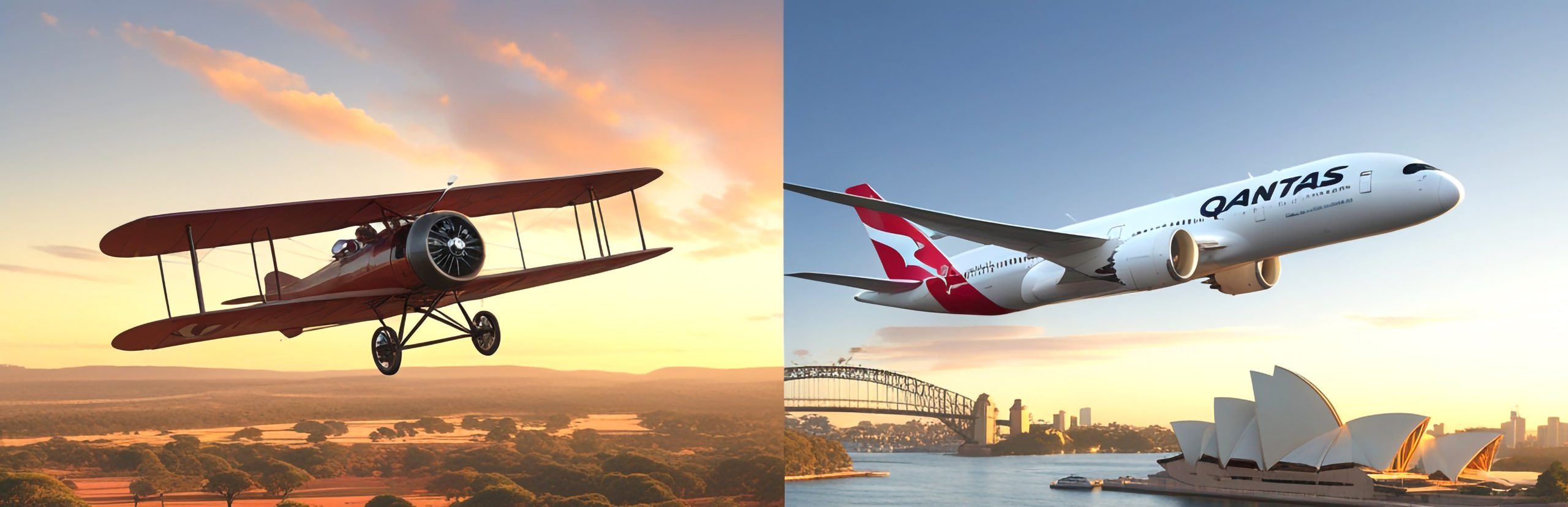
This timeline showcases the remarkable journey of Australia’s flag carrier, Qantas Airways, from its humble beginnings in 1920 as a regional air service in Queensland to becoming one of the world’s leading long-distance airlines. It highlights key milestones in aviation history, groundbreaking innovations, and the airline’s pivotal role during wartime and in global travel.

Order:
  1. 16 November 1920

    The Foundation of the Flying Kangaroo

    Qantas, originally known as Queensland and Northern Territory Aerial Services Limited, was founded in Winton, Queensland by World War I veterans Paul McGinness1 and Hudson Fysh2, along with businessman Fergus McMaster and mechanic Wilfred Baird3. Initially, the airline focused on government-subsidized airmail services across western Queensland. Their first aircraft was an Avro 5044, assembled in Sydney and registered as G-AUBG. It was delivered in January 1921, damaged in August, and repaired by November.


    Note:

    1. Paul McGinness was an Australian flying ace of the First World War, credited with seven aerial victories. []
    2. Hudson Fysh was an observer and gunner to Paul McGinness in the AFC. He was awarded a Distinguished Flying Cross during the aftermath of the war for his services to aerial warfare. []
    3. Wilfred Baird served in the Australian Flying Corps and, on loan, in the Royal Flying Corps. He developed a reputation for solving difficult technical problems for which he was awarded the Meritorious Service Medal. []
    4. Qantas began with one Avro 504K, part of nine assembled under license in Sydney—a modest start to a historic airline. []
  2. 1921

    Qantas Built Their First Hangar

    Qantas’ first hangar was built near the showgrounds in 1921, but with the expanding mail contract, a larger facility was needed. A contract for a new hangar was awarded to Stewart and Lloyd of Sydney in March 1922. The new hangar was completed in August 1922 at a site east of Longreach, at the newly established aerodrome.


    Note:

    The hangar built in 1922 at the new aerodrome site was later converted into the Qantas Founders Outback Museum. []

  3. 1922

    The Pioneering Flight

    Note: Qantas began operations with two biplanes, an Avro 504K and a Royal Aircraft Factory B.E.21, but the first passenger service was conducted by an Armstrong Whitworth F.K.8 (G-AUDE)2 on November 2, 1922. Piloted by Wilmot Hudson Fysh and supported by engineer W. Arthur Baird, the flight was between Longreach and Cloncurry in Queensland. Despite initial delays, the aircraft flew at a maximum speed of 95 mph and a ceiling of 13,000 ft.

    Notes:

    1. The Royal Aircraft Factory B.E.2 was a British biplane used during World War I, known for its stable flight characteristics and early reconnaissance and bombing roles. []
    2. The Armstrong Whitworth F.K.8 (G-AUDE) was a British two-seat biplane designed for reconnaissance and bombing during World War I, notable for its robustness and durability in the field. []


  4. 1924

    Prime Minister S.M. Bruce Flew with Qantas

    S.M. Bruce1, serving as Australia’s Prime Minister, became the first to use an aircraft for official government travel when severe storms rendered roads impassable. He boarded a Qantas aircraft for a flight from Winton to Longreach, marking a historic moment in both political and aviation history as the first time an Australian Prime Minister relied on air travel to fulfill official duties.


    Note:

    1. Before entering politics, S.M. Bruce was seriously wounded at Gallipoli in World War I, yet went on to become Australia’s first Prime Minister with a military decoration—he was awarded the Military Cross for bravery. []
  5. 1926

    Building Their Own Aircraft

    In 1926, with strong support from Prime Minister Stanley Bruce following the Imperial Conference in London, Qantas began building its own aircraft under license from de Havilland. Production of the DH501 model commenced in the Longreach hangar, marking a major step in local aviation development and reflecting growing national investment in civil aviation. The production of these aircraft not only marked a significant step in Qantas’s development but also contributed to local employment and the growth of the aviation industry in the region.


    Note:

    1. The de Havilland DH50 was a biplane designed for both passenger and mail transport, featuring a 220-horsepower engine and a capacity for up to 8 passengers, making it a significant step forward in aviation at the time. []
  6. 1927

    Qantas Established its First Training Program

    In 1927, Arthur Baird began training apprentices at Qantas in Longreach and oversaw the construction of a hangar at Brisbane’s Eagle Farm airfield. While often referred to as a flying school, Qantas did not formally open one—instead, Baird established a training program. Among those he trained was Dorothy Reis, who became the first woman in Queensland to qualify as a pilot. That same year, Qantas launched its first regular service between Cloncurry and Normanton, transporting fresh fish to market. Dorothy’s father, Thomas Bishop, later used her image to promote driving lessons for young women, though few photographs of her remain.

    Note:

    Back in 1927, becoming a pilot often meant just a few hours of flying experience—Qantas trained its early aviators in-house, long before formal licenses and flight schools became standard. []

  7. 1928

    The First Flying Doctors

    The Royal Flying Doctor Service (RFDS)1 was established in 1928, inspired by Rev. John Flynn to provide emergency medical care to remote Australian communities. Its first flight, using a De Havilland DH.50 supplied by Qantas, took off from Cloncurry to Julia Creek on 17 May 1928, marking the start of the world’s first comprehensive air ambulance service. In its first year, it flew 20,000 miles over 50 flights, quickly becoming a lifeline for isolated areas. The RFDS has since grown into a national network offering emergency flights, telemedicine, and outreach, and remains a vital part of Australia’s healthcare system.


    Note:

    1. Founded in 1928, the RFDS remains operational today, delivering vital aeromedical care to remote communities across Australia. []
  8. 17 April 1929

    Expanding the Network

    On April 17, 1929, Qantas introduced the De Havilland DH611 on its new 710-kilometer Charleville–Brisbane route—its first direct link to the coast. The DH61 featured an enclosed cabin for 6 to 8 passengers and an open cockpit for the pilot at the rear, helping expand the airline’s total network to nearly 2,380 kilometers.

    Note:

    1. The De Havilland DH61, though designed for passenger transport, proved versatile—its spacious cabin allowed it to serve as one of the first aircraft used in air ambulance roles across the Australian outback. []
  9. 1930

    Event 9

    By the time Qantas flew its first one million miles (1.6 million kilometers), it had become a pioneering force in Australian aviation, marked by reliability and innovation. The milestone coincided with the airline’s move to a new headquarters in Brisbane and the establishment of a major operational base at Archerfield, signaling its transition from a small regional carrier to a professionally managed airline ready for international growth.

  10. 10 December 1934

    First International Test Flight

    On 10 December 1934, Qantas made a test flight from Brisbane to Singapore using the de Havilland DH-861, a four-engine, twin-tail aircraft. This flight was part of an effort to establish a regular international service in partnership with Imperial Airways. While the flight was a test, it paved the way for Qantas’s first regular international route, which would begin in 1935.

    Note:

    1. de Havilland DH-86 – A sleek four-engine biplane built for long hauls, the DH-86 helped Qantas leap into international skies. Fast, reliable, and made for the rugged Australia–Asia route, it was the workhorse of their early overseas service. []


  11. 10 February 1935

    First Official International Service

    On 10 February 1935, Qantas officially launched its first scheduled international service between Brisbane and Singapore. This service used the de Havilland DH-861 aircraft, marking the beginning of Qantas’s regular international operations. The route was a vital part of the Qantas-Imperial Airways partnership, connecting Australia to Asia and Europe. This milestone set the foundation for Qantas’s future expansion as a global airline.


    Note:

    1. The DH-86 was Qantas’s first aircraft with an enclosed cabin, offering improved comfort for both passengers and pilots during long flights in 1935! []
  12. 24 December 1937

    Centaurus Touched Down

    In December 1937, the majestic flying boat Centaurus1 made a historic landing at Sydney’s Rose Bay, drawing an estimated crowd of 50,000 spectators. This event marked a significant milestone in aviation history, symbolizing the dawn of luxurious intercontinental air travel. The Centaurus, a Short Empire flying boat, was renowned for its comfort and range, capable of long-haul flights across oceans. Its arrival captivated the public imagination, heralding a new era where the vast distances between continents could be traversed with unprecedented speed and elegance.

    Note:

    1. Centaurus – A Short Empire flying boat, the Centaurus featured four Bristol Pegasus engines and could carry up to 22 passengers. It was designed for long-range flights, capable of landing on water and cruising at speeds of 160 mph (257 km/h), making it perfect for the Australia–England route. []
  13. September 1939

    Outbreak of War: Qantas Joins the Fight

    When World War II began in September 1939, Qantas was quickly drawn into the war effort. The Australian government requisitioned parts of its fleet, and Qantas shifted from civilian operations to support Allied military logistics. Its aircraft and crews flew vital missions across northern Australia and into Southeast Asia, carrying troops, medical supplies, military equipment, and urgent mail.

    Despite being a civilian airline, Qantas planes often flew into conflict zones with little or no protection, relying on stealth and skill. The war disrupted its commercial routes, especially the key Singapore service, but Qantas adapted by opening new connections that supported the Allied advance and evacuation efforts as the Japanese threat grew.


    Note:

    During WWII, the Australian government requisitioned most of Qantas’s ten aircraft to support military operations. These planes were used for transport and communications in the Pacific and Southeast Asia.

  14. 1942

    Aircraft Losses and Retreat from Asia

    As Japanese forces pushed through Southeast Asia, Qantas operations became increasingly perilous. Flying boats that once linked Australia with Singapore were targeted during missions, with several aircraft shot down or destroyed. The airline lost seven aircraft and many brave crew members during this period.

    The advancing war front forced Qantas to abandon some of its key international routes, including the critical Singapore service. These losses didn’t just cripple operations—they underscored the extreme risks civilian crews took to support the war effort. Despite the dangers, Qantas remained committed to maintaining communication and supply lines wherever possible.


    Note:

    When the Empire route was severed, Qantas pilots ferried stranded aircraft back to Australia through perilous detours—sometimes flying unfamiliar routes over India and Africa. These improvised journeys helped preserve the fleet and kept vital aviation experience alive during the crisis.

  15. 1943

    The “Double Sunrise” Flights Begin

    In one of its most heroic wartime efforts, Qantas joined forces with BOAC to launch the “Double Sunrise” service between Perth and Ceylon (now Sri Lanka). Using modified Catalina flying boats, the flights spanned a nonstop 5,600 km journey over open ocean, often lasting 28 to 32 hours.

    These secret missions flew in total radio silence and complete darkness to avoid Japanese detection. The name “Double Sunrise” came from the fact that passengers would see the sun rise twice during the flight. With only three passengers and mail onboard to conserve weight, these flights set a record for the longest nonstop commercial route at the time—and are remembered as a symbol of endurance, ingenuity, and quiet bravery.


    Note:

    To reduce detection risk on the 32-hour Double Sunrise flights, Qantas crews flew Catalina flying boats without lights, at low altitudes, and navigated by dead reckoning over open ocean. Pilots often flew barefoot to better feel engine vibrations—an old flying boat tradition that helped detect mechanical issues early.

  16. 1944

    Expanding Wartime Routes

    As the Allies began to push back in the Pacific, Qantas expanded its reach again—resuming and extending long-range connections to India and beyond. Though the risks remained high, Qantas played a key role in maintaining vital communications between Australia and its allies.

    New aircraft and increased coordination with BOAC allowed Qantas to bridge continents even as the war raged. These wartime services helped lay the groundwork for the airline’s post-war international ambitions.


    Note:

    During the war, Qantas crews faced extreme isolation and fatigue, often spending weeks away from home on long, dangerous missions. The airline’s role as a lifeline for Allied forces made Qantas pilots some of the most experienced in the world, with many going on to become pioneers in post-war civil aviation.

  17. 2 September 1945

    War Ends, Qantas Rebuilds

    By the end of WWII, Qantas had suffered heavy losses—half its fleet destroyed, many personnel gone—but emerged with a legacy of courage and service. The experience transformed Qantas into an airline with global capability and a new identity as Australia’s international carrier.

    The war’s end brought a sense of renewal. Qantas moved quickly to restore routes and acquire new aircraft, including the Lockheed Constellation1, setting the stage for a new era of post-war aviation.


    Note:

    1. The Lockheed Constellation, with its four radial engines and pressurized cabin, enabled Qantas to fly longer distances at faster speeds, improving efficiency and passenger comfort. []
  18. 1947

    Qantas Passed in to Public Ownership

    In 1947, the Australian government purchased a 55% majority stake in Qantas from the British government, making the airline a government-owned corporation. This move ensured Qantas’s alignment with national interests and provided the financial backing needed to expand its fleet and services. As Australia’s national carrier, Qantas was now positioned for global growth in the post-war era.


    Note:

    The 1947 government takeover of Qantas wasn’t just about ownership—it laid the foundation for Australia’s aviation policy. For decades, Qantas operated as both a commercial airline and a strategic arm of the state, influencing everything from trade routes to diplomatic ties.

  19. February 1949

    The First Flight Attendants

    Qantas introduced its first group of female flight attendants in February 1949 aboard the Lockheed Constellation on the Sydney–London “Kangaroo Route”. These nine pioneering women brought a new level of comfort and care to international travel, marking the beginning of a more passenger-focused era in Qantas service.


    Note:

    Kangaroo Route – Nicknamed for its many “hops” between Australia and the UK, the Kangaroo Route began in 1947 and became one of the world’s most iconic long-haul services. Early journeys took four days, with multiple stopovers, making it both an adventure and a milestone in global air travel.

  20. 1954

    First Tourist Class Travel

    In 1954, Qantas launched its first tourist class service on the famous Kangaroo Route between Sydney and London. Until then, long-haul flights were a luxury few could afford. By cutting fares nearly in half, Qantas opened the skies to a broader range of travelers—teachers, nurses, students, and families. The aircraft were modified for higher seating capacity, making air travel more accessible while maintaining Qantas’s safety and reliability. This marked a turning point in aviation, as flying became a realistic option for the middle class, not just the elite.

  21. 1959

    Arrival of the Boeing 707

    Qantas entered the jet age with the delivery of its first Boeing 7071 in 1959, becoming the first non-U.S. airline to operate the aircraft. The sleek, four-engine jet dramatically reduced flight times—cutting the Sydney to London journey from 48 hours to around 27—and introduced passengers to smoother, faster, and quieter air travel. Qantas’s version, the Boeing 707-138, was specially modified for ultra-long-haul routes and could carry up to 116 passengers in a two-class layout. The aircraft flew higher and faster than its predecessors, cruising at 35,000 feet and over 960 km/h, firmly positioning Qantas as a global aviation leader.


    Note:

    1. The Boeing 707 revolutionized air travel, bringing Australia closer to the world. Its long range and increased capacity helped Qantas lead the jet age, cutting travel time from Sydney to London by nearly half and boosting the airline’s global reach. []
  22. 11 April 1965

    First Non-stop Flight

    In 1965, Qantas made aviation history by operating the first non-stop commercial flight from Los Angeles to Sydney. The Boeing 707-338C1, specially configured for this long-haul route, completed the 12,000 km journey in around 19 hours. This flight revolutionized travel between the USA and Australia, marking the beginning of non-stop long-haul commercial air travel and cementing Qantas’s place at the forefront of global aviation.

    Note:

    1. The Boeing 707-338C used for the 1965 non-stop USA–Australia flight was a convertible freighter-passenger variant with extra fuel capacity and stronger engines, enabling it to cover ultra-long distances without refueling—an impressive feat for its time. []
  23. 31 May 1965

    Operation Skippy Squadron: Qantas’s First Vietnam Troop Flight

    On 31 May 1965, Qantas began its troop transport service to Vietnam with a Boeing 707 flight from RAAF Base Richmond to Saigon via Manila. From 1965 to 1972, the airline flew over 600 charter missions, avoiding combat zones to maintain its civilian status. Nicknamed the “Skippy Squadron,” these red-tailed aircraft became a symbol of home for many soldiers, also flying medevac missions with onboard medical staff.


    Note:

    Skippy Squadron crews often painted discreet kangaroo symbols near the cockpit windows—one for each completed Vietnam mission—turning the aircraft into quiet tributes to their service.

  24. 1966

    Qantas Goes All Jet: The Dawn of a New Era

    In 1966, Qantas became the world’s first airline to operate an all-jet fleet, retiring its last propeller aircraft in favor of Boeing 707s. This move improved speed, efficiency, and comfort on long-haul routes and paved the way for future innovations like the Boeing 747.


    Note:

    As a government-owned airline in the 1960s, Qantas had the financial backing to transition to an all-jet fleet, helping it stays competitive on the global stage.

  25. August 1967

    A New Name for a New Era

    In 1967, Qantas changed its name from Qantas Empire Airways to Qantas Airways Limited, removing “Empire” to reflect Australia’s move away from its colonial past. The new name signaled the airline’s shift toward a modern, globally focused identity, in line with the nation’s evolving role on the world stage.


    Note:

    Despite the name change in 1967, Qantas kept its iconic flying kangaroo logo—a symbol that remained untouched even as the airline redefined its identity.

  26. 16 November 1970

    Qantas Turns 50: From Outback Origins to Global Carrier

    In November 1970, Qantas marked its 50th anniversary, celebrating its growth from a small bush airline in 1920 to one of the world’s leading international carriers. By then, it controlled 47% of Australia’s international air traffic and had just won the England-to-Australia air race with a Qantas HS125 jet1, reinforcing its reputation for excellence amid rising global competition.

    Note:

    1. The Qantas HS125 jet wasn’t just a racer—it also served as a high-speed training and corporate aircraft, reflecting the airline’s investment in versatility and pilot development. []
  27. 1971

    Opening the Skies: Qantas Launches Low International Fares

    In 1971, Qantas cut international airfares dramatically, reducing a one-way London–Sydney ticket from £276 to £169. This fare drop, enabled by the high-capacity Boeing 7471, made global travel more affordable and boosted passenger numbers. Despite initial pushback from the British government, the move proved a success and helped democratize air travel.


    Note:

    1. The introduction of the Boeing 747 in Qantas’s fleet in 1971, with a seating capacity of up to 366 passengers, was a game-changer. It allowed the airline to offer more seats at lower fares, making long-haul travel more affordable and accessible to a wider range of passengers. []
  28. 6 April 1974

    End of an Era: The Passing of Sir Hudson Fysh

    In 1974, Qantas mourned the loss of Sir Hudson Fysh1, a founding father whose leadership helped shape the airline from a small outback service into a global carrier. As managing director and later chairman, Fysh left a lasting legacy that defined Qantas’s early success.


    Note:

    1. Sir Hudson Fysh was not only a co-founder of Qantas but also its first managing director, steering the airline through its early years and laying the foundation for its global success. []
  29. 26 December 1974

    Wings of Relief: Qantas Aids Darwin After Cyclone Tracy

    In December 24, 1974, Cyclone Tracy devastated the city of Darwin, leaving widespread destruction and displacing thousands of residents. Qantas swiftly responded by deploying its aircraft and crew to assist with one of the largest airlifts in Australian history. The airline played a vital role in evacuating more than 4,000 people from the disaster zone, operating around the clock over the holiday season. This humanitarian mission showcased Qantas’s logistical strength and deep national commitment, cementing its role not just as an airline, but as a lifeline in times of crisis.


    Note:

    On December 28, 1974, a Qantas Boeing 747-238B (VH-EBB) made history by airlifting a record 673 evacuees from Darwin in a single flight.

  30. September 1979

    Pioneering Comfort: Qantas Introduces Business Class

    In 1979, Qantas became the first airline in the world to officially introduce a separate Business Class cabin, setting a new benchmark in passenger service. Recognizing the growing needs of business travelers who desired more comfort than Economy but didn’t require the luxury of First Class, Qantas created a new travel category that soon became a standard across the global airline industry. This innovation reflected Qantas’s ongoing commitment to customer experience and helped solidify its reputation as an industry leader in long-haul travel.


    Note:

    Before launching Business Class in 1979, Qantas tested the idea by reserving a section of Economy with added space and service—an experiment that paved the way for a global travel standard.

  31. 10 February 1985

    50th Anniversary of International Service

    In 1985, Qantas celebrated the 50th anniversary of its first international flight, which had launched on 10 February 1935 from Brisbane to Singapore. Over the decades, the airline had grown from operating a single international route to becoming a global leader in aviation, with an expanding network connecting Australia to the world. This milestone was a reflection of Qantas’s long-standing commitment to excellence in international air travel.


    Notation:

    In 1935, Qantas’s fleet consisted of just seven aircraft, but by 1985, the airline had expanded to a fleet of over 80 aircraft, reflecting its remarkable growth over 50 years of international service.

  32. February 1992

    Qantas Merges with Australian Airlines

    In 1992, Qantas officially merged with Australian Airlines, a subsidiary that had previously operated as a domestic carrier in Australia. This strategic move allowed Qantas to expand and strengthen its domestic network, offering more services and routes across Australia. It also helped streamline operations, as Qantas absorbed Australian Airlines’ fleet and resources, improving efficiency and cost-effectiveness. The merger allowed Qantas to further enhance its competitive position both in the domestic market and on international routes, positioning the airline for future growth in an increasingly globalized aviation industry.


    Note:

    Despite the merger in 1992, Qantas and Australian Airlines operated under separate brands for several years before fully integrating operations and uniforms in the mid-1990s.

  33. 25 March 1993

    British Airways Buys 25% Stake in Qantas

    On March 25, 1993, British Airways acquired a 25% stake in Qantas for A$665 million, marking the first major step in Qantas’s journey toward full privatization. This strategic investment not only infused capital into the airline but also forged a powerful partnership between two of the world’s most recognized carriers. The deal aimed to strengthen Qantas’s global competitiveness and position it for growth in an increasingly deregulated and international aviation industry.


    Note:

    1. The deal gave British Airways a seat on the Qantas board and laid the foundation for a long-standing alliance that later contributed to the formation of the oneworld Airline Alliance in 1999.
  34. 1994

    Qantas Launches Its Official Website

    In 1994, Qantas launched qantas.com1, becoming one of the first airlines in the world to establish a presence on the internet. Initially designed as an informational site, the launch marked Qantas’s early move into digital innovation and modern customer engagement. Over time, the website evolved into a fully functional booking platform, transforming the way passengers planned and purchased their travel.


    Note:

    1. At the time of its launch, qantas.com featured only basic flight information and corporate news—no online booking yet. []
  35. July 1995

    Qantas Fully Privatized

    In 1995, Qantas completed its full privatization, marking a major turning point in the airline’s history. Following a series of steps that began in 1993, the Australian government sold its remaining stake in the airline through a public float, allowing Qantas to become a fully privately owned company. The privatization opened new doors for Qantas, enabling it to enter international partnerships and adopt modern business practices, which were essential for competing in the increasingly globalized airline industry.


    Note:

    With the privatization, Qantas’s shares were listed on the Australian Stock Exchange, and British Airways retained its 25% stake, becoming a key partner in shaping Qantas’s international strategies for years to come.

  36. 1998

    Qantas Joins the oneworld Alliance

    In September 1998, Qantas became a founding member of the oneworld Alliance1, a global network of leading airlines that aimed to offer seamless international travel across continents. This strategic move linked Qantas with partners such as British Airways, American Airlines, and Cathay Pacific, providing customers with greater flexibility, access to more destinations, and shared benefits like lounge access and frequent flyer perks. The alliance positioned Qantas as a key player in the global aviation market.


    Note:

    1. The airline alliance is officially styled as “oneworld”—intentionally written in all lowercase as part of its global branding strategy. []
  37. 1999

    Qantas Establishes Qantas Defence Services (QDS)

    In 1999, Qantas expanded beyond commercial aviation by establishing Qantas Defence Services (QDS)1, a wholly owned subsidiary focused on providing maintenance and engineering support to the Australian Defence Force (ADF). Over the next 14 years, QDS delivered a broad range of services, including aircraft modifications, propulsion systems maintenance, and logistics management. Notably, QDS supported aircraft such as the Lockheed C-130 Hercules, P-3 Orion, and the Airbus A330 Multi Role Tanker Transport (KC-30A), as well as maintaining the Australian government’s VIP fleet, including Boeing Business Jets.


    Note:

    1. Qantas Defence Services was one of the few airline-owned entities in the world trusted to maintain military aircraft—blending commercial aviation efficiency with defense-grade precision. []
  38. 2000

    Qantas Pioneers FANS Technology on the Silk Road Route

    In 2000, Qantas became the first airline to operate a commercial flight entirely dependent on the Future Air Navigation System (FANS) technology. This groundbreaking flight traversed the Silk Road Route over Tibet, an area lacking traditional radar coverage. By utilizing FANS, which enabled real-time aircraft position updates and text communication between pilots and air traffic controllers, Qantas ensured safe and efficient operations in these challenging airspaces. This innovation marked a significant advancement in aviation navigation and communication systems.


    Note:

    The Silk Road isn’t just a historical trade route—it’s a network of pathways that connected East Asia with the Mediterranean for over 1,000 years, facilitating not only goods like silk and spices but also the exchange of ideas, culture, and technology.

  39. May 2001

    QantasLink Officially Launched

    In May 2001, Qantas consolidated its regional operations under the unified brand QantasLink1, streamlining services previously operated by subsidiaries such as Sunstate Airlines, Eastern Australia Airlines, and National Jet Systems. This strategic move aimed to enhance operational efficiency and brand consistency across Qantas’s regional network.


    Note:

    1. The formation of QantasLink unified regional carriers under one brand, using smaller aircraft to connect previously underserved destinations across Australia. []
  40. May 2004

    Jetstar Takes Off – Qantas Launches Its Budget Carrier

    In May 2004, Qantas officially launched Jetstar Airways1, a low-cost airline created to directly challenge Virgin Blue in Australia’s booming budget travel market. With a lean, no-frills business model, Jetstar focused on affordability and efficiency, initially flying Boeing 717s before shifting to Airbus A320s. The new airline offered domestic routes such as Melbourne–Sydney and Melbourne–Hobart, signaling Qantas’ strategic move to capture price-sensitive travelers without compromising its main brand.


    Note:

    1. Jetstar sold its first tickets online—and they sold out in just 3 hours, proving Australians were more than ready for low-cost flying. []
  41. August 2008

    Qantas Welcomes the Airbus A380

    In August 2008, Qantas received its first Airbus A3801, becoming the third airline in the world (after Singapore Airlines and Emirates) to operate the world’s largest passenger aircraft. The arrival marked a new era of long-haul luxury and efficiency for the airline. Configured with four cabin classes—First, Business, Premium Economy, and Economy—the Qantas A380 could carry up to 450 passengers. The aircraft made its commercial debut on the Melbourne to Los Angeles route in October 2008, featuring the innovative First Suites and redesigned Business Skybeds.


    Note:

    1. Qantas named its first A380 “Nancy-Bird Walton,” after Australia’s pioneering female aviator—making it both a technical and symbolic milestone. []
  42. 4 November 2010

    QF32 – Mid-Air Engine Explosion Tests Qantas' Safety Legacy

    On November 4, 2010, Qantas Flight 32, operated by an Airbus A380 en route from Singapore to Sydney, suffered a catastrophic engine failure shortly after takeoff. One of the aircraft’s Rolls-Royce Trent 900 engines exploded mid-air, causing significant damage to the wing and onboard systems. Despite the severity of the failure, Captain Richard de Crespigny and his crew managed a safe emergency landing back in Singapore after nearly two tense hours in the air. The 469 people on board—433 passengers and 26 crew—were unharmed.

    The incident prompted Qantas to temporarily ground its entire A380 fleet, and investigations revealed manufacturing defects in the engine’s oil feed pipe. The airline’s decision to ground the fleet and the crew’s exemplary handling of the situation earned Qantas widespread praise for its safety culture.


    Note:

    The pilots received multiple international aviation safety awards, and Captain de Crespigny later became a bestselling author with his book “QF32.”

  43. March 2013

    Qantas and Emirates Team Up for Global Reach

    In March 2013, Qantas and Emirates formed a major partnership to boost their international services. Through this deal, Qantas could now connect to Emirates’ network across Europe, the Middle East, and Africa. Qantas also shifted its European flights from Singapore to Dubai, using it as a new hub. The two airlines worked together on marketing and services, with Qantas passengers gaining access to Emirates’ luxurious First Class. This partnership helped Qantas compete with other big airlines and improve its international business.


    Note:

    Emirates was established in 1985, much later than Qantas, which was founded in 1920. Despite its younger start, Emirates has quickly grown to operate over 270 aircraft, while Qantas, with a longer history, has a fleet of around 130 aircraft.

  44. 29 September 2014

    Qantas Launches World's Longest A380 Route

    On September 29, 2014, Qantas launched its first non-stop flight from Sydney to Dallas/Fort Worth using the Airbus A380, covering 13,804 km (8,578 miles)—then the world’s longest commercial flight by distance. The A380 enabled a direct return without a Brisbane stopover and carried 484 passengers across four classes. This move strengthened Qantas’ U.S. network and its partnership with American Airlines.


    Note:

    This route was so extensive that it spanned over a third of the Earth’s circumference, highlighting the A380’s impressive range and Qantas’ commitment to long-haul travel.

  45. 27 August 2015

    Qantas Returns to Profit After Record Loss

    On August 27, 2015, Qantas announced a $557 million AUD net profit for the 2014–15 financial year, marking a dramatic turnaround from the $2.8 billion AUD loss just a year earlier. This comeback was the result of CEO Alan Joyce’s aggressive transformation program that included cost-cutting, improved efficiency, and fleet optimization. The airline also benefited from lower fuel prices and strong performance from its domestic and loyalty divisions.


    Note:

    In just one year, Qantas turned around by over $3 billion AUD—one of the most dramatic comebacks in Australian corporate history.

  46. 24 March 2018

    First Non-Stop Flight from Australia to Europe Takes Off

    On March 24, 2018, Qantas made aviation history by launching the first non-stop commercial flight between Australia and Europe. Flight QF9 departed from Perth and landed in London Heathrow, covering approximately 14,498 km (9,009 miles) in about 17 hours. Operated by a Boeing 787-9 Dreamliner, the aircraft had a passenger capacity of 236, specially configured for long-haul comfort. This ultra-long-haul route drastically cut travel time by eliminating stopovers and was a major leap in connecting Australia directly with Europe.


    Note:

    This flight was so long that the sun set and rose again during the journey—passengers literally experienced time flying.

  47. March 2020

    Qantas Grounds 90% of Fleet Amid Pandemic

    In March 2020, as the COVID-19 pandemic escalated, Qantas was forced to ground 90% of its fleet due to a dramatic drop in global travel demand. With international borders closing and domestic restrictions in place, the airline suspended most of its flights. This included the grounding of its iconic Airbus A380s, the Boeing 747s, and various other aircraft. Qantas also announced job cuts and began implementing cost-saving measures to navigate the unprecedented crisis.


    Note:

    At its peak, Qantas’ operations were reduced to a mere 5% of its regular flights, focusing on essential services and repatriation flights.

  48. 29 November 2021

    Qantas Resumes International Flights

    On November 29, 2021, Qantas officially resumed international flights after a 19-month hiatus due to the COVID-19 pandemic. The airline launched the Sydney to Los Angeles route, marking the return of the Flying Kangaroo to international skies. This flight was the first Qantas international flight since the pandemic restrictions began, signaling a major step towards the airline’s recovery. The airline celebrated the event with a special “welcome home” ceremony at Sydney Airport. The route used a Boeing 787-9 Dreamliner, offering passengers a direct connection to the United States.


    Note:

    The return of Qantas international flights lifted national morale, symbolizing hope, reconnection, and the first real step toward normal life after lockdowns.

  49. June 2022

    Qantas Orders 12 Airbus A350-1000s for Project Sunrise

    In June 2022, Qantas announced an order for 12 Airbus A350-10001 aircraft as part of its ambitious Project Sunrise—a plan to launch non-stop ultra-long-haul flights from Australia to destinations like London and New York. These aircraft were chosen for their efficiency and ability to fly more than 20 hours non-stop, setting the stage for a new era in long-distance air travel. The flights are set to begin in late 2025, offering new levels of comfort and redefining what’s possible in commercial aviation.


    Note:

    1. The Airbus A350-1000 is the largest version of the A350 family and can seat up to 410 passengers, making it a favorite for long-range routes among top global airlines. []
  50. May 2023

    Qantas Unveils New First and Business Class Cabins for Project Sunrise

    In May 2023, Qantas revealed the cabin designs for its upcoming Project Sunrise flights. The new Airbus A350-1000 aircraft will feature six first-class suites with a flat bed, lounge chair, wardrobe, and even a sliding door for privacy. The business class section will have 52 suites, each with direct aisle access, a reclining bed, and personal storage. The aircraft will also include a dedicated Wellbeing Zone in the center—designed for stretching, movement, and healthy snacks—catering to passenger comfort on flights that will exceed 20 hours.


    Note:

    Qantas’ Project Sunrise cabins are tailored for wellness and privacy, making ultra-long-haul travel feel more like a luxury hotel stay at 35,000 feet.

  51. August 2023

    Qantas Announces Landmark Fleet Renewal with Airbus Order

    In August 2023, Qantas revealed a major fleet renewal plan by confirming orders for 24 new aircraft—12 Airbus A350s1 for international long-haul routes and 12 Airbus A330neos2 for domestic and regional operations. This move is part of Qantas’ broader effort to modernize its fleet, improve fuel efficiency, and reduce carbon emissions. The newer aircraft offer greater range, better passenger comfort, and environmental benefits compared to the aging planes they will replace.


    Note:

    1. The Airbus A350s combines fuel efficiency, advanced cabin comfort, and ultra-long-range capability, making it Qantas’s choice for Project Sunrise. []
    2. The A330neo burns 25% less fuel than older models, helping Qantas move closer to its net-zero emissions goal by 2050. []
  52. November 2023

    QantasLink Takes Delivery of First Airbus A220

    In November 2023, QantasLink, the regional arm of Qantas, received its first Airbus A2201 aircraft. This marks the beginning of replacing its aging Boeing 717 fleet. The A220 is known for its quiet operation, improved fuel efficiency, and a range of up to 6,390 km, making it ideal for both short and longer regional routes. The aircraft seats around 137 passengers and features wider seats, larger windows, and improved cabin comfort—aligning with Qantas’ goal to modernize its regional services.


    Note:

    1. The Airbus A220 was originally developed by Bombardier and called the C Series before Airbus took over the program in 2018. []
  53. 26 March 2024

    Qantas Flight Lands Safely After Engine Shutdown

    On March 25, 2024, Qantas Flight QF781, an Airbus A330-200 traveling from Melbourne to Perth, experienced an engine issue during its descent into Perth. Following standard procedures, the pilots manually shut down one engine and requested a priority landing. The aircraft landed safely and taxied to the gate under its own power. Passengers reported hearing a loud noise and experiencing a shudder from the left side of the plane. Qantas engineers inspected the aircraft upon arrival. The airline confirmed that the aircraft is designed to operate safely with one engine.


    Note:

    This incident highlights the rigorous training and preparedness of Qantas pilots, who are trained to handle such rare situations, ensuring passenger safety.

  54. 7 May 2025

    Qantas and American Airlines Expand U.S.-Australia Services

    On May 7, 2025, Qantas and American Airlines announced expanded transpacific services. Starting December 2025, American will begin LAX–Brisbane flights, while Qantas adds daily DFW–Melbourne service and upgrades DFW–Sydney flights to A380s. These changes aim to boost U.S.–Australia connectivity during peak travel season.


    Note:

    American Airlines was the first airline to offer non-stop flights from the U.S. to Australia back in 1986, way before this partnership with Qantas.

  55. 30 June 2025

    Qantas Detects Major Cybersecurity Incident

    On June 30, 2025, Qantas detected unusual activity on a third-party contact-centre platform that compromised personal data associated with millions of customer records. The airline moved quickly to contain the breach and secure its systems, notifying affected customers and launching investigations. The incident marked one of the largest data security challenges in Qantas’s history and highlighted rising cybersecurity risks facing major airlines in an increasingly digital operational environment.

    Watch a video here.

  56. 27 August 2025

    Qantas Reports Strong Financial Performance

    On August 27, 2025, Qantas announced a 28 % increase in net profit to A$1.6 billion for its latest financial year, driven by strong demand for both domestic and international travel. The airline also declared a final dividend and a special dividend for shareholders, underscoring renewed financial momentum as travel rebounded. The results followed continued investment in fleet renewal and network expansion, even as the company dealt with regulatory penalties and operational challenges.

    Watch a video here.

  57. 28 August 2025

    Qantas Expands Fleet with Additional A321XLR Orders

    On August 28, 2025, Qantas confirmed an order for 20 additional aircraft, further expanding its largest-ever fleet renewal programme. These new aircraft are planned to serve domestic and regional routes with improved efficiency and greater passenger comfort, and some will feature lie-flat Business-class seating — the first such amenity for Qantas’s narrow-body fleet. This order reflected the airline’s ongoing strategy to modernise its network and improve fuel efficiency.

  58. 10 September 2025

    Qantas Announces First International Airbus A220 Service

    On September 10, 2025, Qantas unveiled a major trans-Tasman expansion that includes its first international Airbus A220 service. Beginning February 2026, the A220 will operate between Brisbane and Wellington, providing enhanced comfort and efficiency on this key regional route. The announcement also included broader network capacity increases between Australia and New Zealand and new routes for sister carrier Jetstar.

  59. 7 November 2025

    Qantas Project Sunrise A350-1000 Takes Shape

    On November 7, 2025, reports from Toulouse indicated that Qantas’s first Airbus A350-1000ULR aircraft, destined for its Project Sunrise ultra-long-haul programme, was progressing through final assembly ahead of delivery. The airline plans to launch these flights in early 2027, linking Australia non-stop to major global hubs like London and New York under its vision of world-record distance routes. This development marked a key step toward Qantas redefining global commercial flying.