
Skip to content

Sky Warriors: The Story of the Flying Tigers

Dated timeline · 48 events

The story of the Flying Tigers, the American volunteer pilots who flew for China against Japan, in 48 dated entries running from the early years of military aviation in 1911 to the group’s disbandment in July 1942.

Order:
  1. October 1911

    The Hsinhai Revolution

    The Hsinhai Revolution, led by revolutionary leader Sun Yat-sen and supported by nationalist groups like the Tongmenghui, brought an end to the Qing Dynasty1 after over two thousand years of imperial rule. Triggered by the Wuchang Uprising, the revolution quickly spread across China. Sun Yat-sen became the provisional president of the newly established Republic of China, marking the start of a modern, republican government. The revolution also set the stage for efforts to modernize China’s military, laying early foundations for the eventual development of its air force.

    Note:

    1. The last emperor of the Qing Dynasty was Puyi. He ascended the throne as a child in 1908 and officially abdicated in 1912 following the success of the Hsinhai Revolution. []
  2. November 1911

    Chiang Kai-shek Returned to China

    In November 1911, Chiang Kai-shek1, a young military officer trained in Japan and influenced by revolutionary ideals, returned to China amid the ongoing Hsinhai Revolution. He quickly aligned himself with the Nationalist Party (Kuomintang) and began building his military career. Chiang’s return marked the start of his rise as a key leader in the effort to unify and modernize China under the new Republic.

    Note:

    1. Born in Zhejiang province, China, Chiang studied at the Baoding Military Academy before furthering his military education in Japan. []
  3. 29 December 1911

    First Provisional Presidential Election of China

    On December 29, 1911, the newly formed Republic of China elected Dr. Sun Yat-sen as its first provisional president. Chosen unanimously by representatives of the revolutionary provinces, Sun was tasked with leading the transition from imperial rule to republican governance. He was formally inaugurated on 1 January 1912, symbolizing the birth of modern China. His presidency was always intended to be temporary, as part of a broader agreement to unify the country and gain the support of powerful military leaders like Yuan Shikai.

    Note:

    Known as the “Father of Modern China,” Sun was a revolutionary leader who founded the Kuomintang (Nationalist Party) and played a key role in overthrowing the Qing Dynasty. []

  4. 1912

    The Soong Sisters Step onto the Political Stage

    In 1912, the Soong sisters1 — Ai-ling, Ching-ling, and Mei-ling — began their rise in China’s political scene. Educated in the United States and daughters of wealthy Methodist publisher Charlie Soong, they returned as the Republic was formed. The eldest, Soong Ai-ling, worked as secretary to Sun Yat-sen and married influential Nationalist official H. H. Kung. Soong Ching-ling married Sun Yat-sen and, following his death, became a prominent supporter of the Communist Party, eventually serving as Honorary President of the People’s Republic of China. The youngest, Soong Mei-ling, married Chiang Kai-shek, leader of the Nationalist government. Through their marriages and political roles, the sisters deeply influenced both Nationalist and Communist China, reflecting the complex divisions in the country’s modern history.

    Note:

    1. Daughters of a wealthy Chinese businessman educated in the U.S., Soong Ai-ling, Soong Ching-ling, and Soong Mei-ling became politically influential through their marriages and personal involvement in China’s revolutionary and nationalist movements. []
  5. 12 February 1912

    Sun Yat-sen resigned as the Provisional President

    To promote national unity and prevent a potential civil war, Sun Yat-sen voluntarily resigned as the provisional president of the Republic of China. His resignation was part of a strategic political compromise to appease Yuan Shikai1, a powerful general and military leader who commanded the majority of China’s armed forces. Yuan’s support was crucial for the survival of the new Republic, so Sun stepped down to allow Yuan to assume the presidency. This move was intended to stabilize the fragile political situation and consolidate power under Yuan’s leadership, though it also marked the beginning of significant challenges to the Republic’s democratic ideals.

    Note:

    1. A former Qing Dynasty general and official, Yuan was known for his military skill and political ambition. After the fall of the Qing, he negotiated with revolutionaries to become president but later tried to declare himself emperor, leading to widespread opposition. []
  6. 1913

    Chiang Kai-shek was exiled

    Chiang Kai-shek, a rising military officer and close ally of Sun Yat-sen, played a key role in supporting Sun’s revolutionary efforts and the Nationalist Party (Kuomintang)1. As commander of the revolutionary forces in southern China, Chiang helped consolidate Sun’s power after the 1911 revolution. However, by January 1913, political rivalries and struggles within the fragile Republic led to Chiang’s brief exile to Japan. There, he sought refuge from political persecution and planned his return to continue his involvement with the Nationalist movement.

    Note:

    1. Also known as the Nationalist Party of China, the Kuomintang was founded by Sun Yat-sen in 1912 to promote the overthrow of the Qing Dynasty and establish a republican government. It played a central role in Chinese politics throughout the early 20th century, opposing both warlords and later the Chinese Communist Party. []
  7. 15 December 1915

    Yuan Restored the Monarchy

    In December 1915, Yuan Shikai declared himself Emperor of a new Chinese Empire, aiming to restore the monarchy and consolidate his power. This move sparked widespread opposition from republican forces, provincial leaders, and foreign powers, who saw it as a betrayal of the Republic. Yuan’s self-proclamation led to rebellion and political chaos, and he was forced to abandon the throne less than a year later, weakening his rule significantly.

    Yuan’s declaration as emperor triggered immediate backlash from provinces across China, leading to the National Protection War where several provinces declared independence. The move alienated many supporters and foreign powers, forcing Yuan to abandon his throne in March 1916. He died shortly after, leaving China fragmented and vulnerable to warlordism.

  8. 16 May 1916

    Chiang Kai-shek became the leader of the Revolutionary Party

    Following the declining health and death of Huang Xing1, a key revolutionary leader, Chiang Kai-shek was appointed leader of the Revolutionary Party on May 18, 1916. This marked a crucial step in Chiang’s rise as a military and political figure. Under his leadership, the party worked to unify China, strengthen the Nationalist cause, and oppose warlordism, setting the stage for future conflicts and the establishment of the Nationalist government.

    Note:

    1. A key revolutionary leader and close ally of Sun Yat-sen, Huang Xing played a major role in the 1911 revolution. He died in 1916 from illness after years of struggle for China’s republic. []
  9. 1918

    Chiang Kai-shek joined the Kuomintang

    In 1918, Chiang Kai-shek formally joined the Kuomintang (KMT), the political party founded by Sun Yat-sen. Already a trusted military aide and loyal supporter of Sun, Chiang’s enlistment marked the beginning of his deeper involvement in shaping the party’s military strategy. His dedication and organizational skill quickly elevated him within the ranks, laying the foundation for his future leadership of the Nationalist movement.

  10. 2 September 1923

    Chiang Kai-shek to Soviet Union

    On this date, Chiang Kai-shek was sent to the Soviet Union by Sun Yat-sen as part of efforts to strengthen ties between the Kuomintang (KMT) and Soviet advisers. His mission was to study Soviet military and political organization, particularly the structure of the Red Army and the Communist Party. While in Moscow, Chiang observed firsthand the Soviet model of party control over the military—an idea he would later apply in forming the Whampoa Military Academy. The visit marked a key turning point in his rise as a military strategist and future leader of the KMT.

  11. 12 March 1925

    The Death of Sun Yat-sen

    Sun Yat-sen, revered as the “Father of Modern China,” died of liver cancer in Beijing at the age of 58. His death marked the end of an era for the Chinese revolutionary movement. As the founding leader of the Kuomintang (KMT) and a key figure in the overthrow of the Qing Dynasty, Sun had worked tirelessly to unify China under a republican government. His passing left a leadership vacuum within the KMT, setting the stage for an internal power struggle—one that would eventually be won by Chiang Kai-shek.

  12. 26 June 1926

    The rise of Chiang Kai-shek

    On this date, Chiang Kai-shek was formally appointed commander-in-chief of the National Revolutionary Army, marking his emergence as the dominant figure in the Kuomintang (KMT). Backed by Soviet advisers and the recently established Whampoa Military Academy, which he led, Chiang prepared to launch the Northern Expedition—a campaign aimed at defeating warlords and reunifying China. His rise signaled a shift in the KMT’s direction, consolidating both military and political power in his hands.

    Note:

    The NRA was the military arm of the Kuomintang (KMT), established in the mid-1920s to unify China and end warlord rule. []

  13. December 1927

    Chiang Kai-shek married Soong Mei-ling

    Chiang Kai-shek married Soong Mei-ling, the youngest of the influential Soong sisters, in a high-profile union that blended political strategy with personal alliance. Mei-ling, educated in the United States and fluent in English, played a crucial role in improving Chiang’s image, especially among Western allies. The marriage strengthened Chiang’s ties to powerful business and political circles, as the Soong family was deeply connected to both the Kuomintang and major financial institutions in China.

  14. 10 October 1928

    Chiang became the Generalissimo

    On this date, Chiang Kai-shek was officially appointed Generalissimo of the National Revolutionary Army, cementing his leadership over both the military and the Nationalist government. This marked the formal unification of China under the Kuomintang after the Northern Expedition. The date coincided with the anniversary of the Wuchang Uprising, linking Chiang’s rise to power with the revolutionary spirit that began the fall of the Qing Dynasty.

  15. October 1930

    Chiang Kai-shek became a Christian

    Chiang Kai-shek was baptized as a Christian, influenced largely by his wife Soong Mei-ling, a devout Methodist. His conversion was seen both as a personal commitment and a political gesture to align more closely with Western powers and Christian communities in China. Though questions remained about the depth of his faith, it played a role in shaping his public image and relationship with key supporters.

  16. 18 September 1931

    Manchuria Taken by the Japanese

    The Japanese Kwantung Army staged the Mukden Incident1 as a pretext to invade Manchuria, launching a full-scale occupation without approval from the Japanese government. Within months, Japan had seized control of the region and established the puppet state of Manchukuo. Chiang Kai-shek, facing internal conflicts, chose non-resistance—focusing instead on consolidating power within China. The incident marked the beginning of Japan’s aggressive expansion in East Asia.

    Note:

    1. A staged explosion by the Japanese military near the South Manchuria Railway on 18 September 1931. Though minor, it was blamed on Chinese forces and used as justification for Japan’s invasion of Manchuria. []
  17. 24 February 1933

    Japan's withdrawal from the League of Nations

    After Japan’s invasion and occupation of Manchuria in 1931, the League of Nations1 launched an investigation, resulting in the Lytton Report, which concluded that Japan’s actions were unjustified and recommended Manchuria be returned to Chinese sovereignty. In response, Japan’s delegate dramatically walked out of the League assembly, and Japan formally withdrew from the League shortly after. This move marked Japan’s growing isolation from the international community and its turn toward militarism and expansionism in Asia.

    Note:

    1. The League of Nations was an international organization founded in 1920 after World War I to maintain peace and prevent future conflicts. []
  18. December 1936

    Chiang Kai-shek was Seized

    Chiang Kai-shek was kidnapped in the city of Xi’an by his own generals, Zhang Xueliang and Yang Hucheng, in what became known as the Xi’an Incident1. The generals, frustrated with Chiang’s focus on fighting communists rather than resisting Japanese aggression, demanded he form a united front with the Chinese Communist Party. The incident ended peacefully after negotiations, with Chiang agreeing to a temporary alliance with the communists against Japan.

    Note:

    1. The Xi’an Incident led to a temporary KMT-CCP alliance. []
  19. May 1937

    Chennault set off to China

    American aviator Claire Lee Chennault1 traveled to China in May 1937 at the invitation of Madame Chiang Kai-shek. Initially serving as an aviation advisor to the Chinese Nationalist government, Chennault assessed China’s air capabilities and began laying the groundwork for a modernized air force. His presence would later be pivotal in the formation of the American Volunteer Group—better known as the Flying Tigers—during World War II.

    Note:

    1. Before going to China, Chennault was a retired U.S. Army Air Corps officer known for his strong advocacy of pursuit (fighter) aviation over bombers, which put him at odds with mainstream military doctrine of the time. []
  20. 7 July 1937

    The Marco Polo Bridge Incident

    The Marco Polo Bridge Incident began as a nighttime military exercise by Japanese troops stationed near the bridge, just outside Beijing. When a Japanese soldier was reported missing, tensions rose, and shots were exchanged between Japanese and Chinese forces. Although the soldier was later found unharmed, Japan used the clash as a pretext to demand control over nearby Chinese territories. China refused, and the situation quickly escalated into open warfare.

    This incident marked the beginning of the Second Sino-Japanese War, a brutal and prolonged conflict that would see widespread atrocities, including the Nanjing Massacre, and millions of casualties. The war also drew international attention and would eventually merge into the broader conflict of World War II.


    Note:

    1. The Marco Polo Bridge, also known as Lugou Bridge, was famous long before the 1937 incident—Marco Polo himself wrote about its beauty during his travels in the 13th century. []
  21. 13 August 1937

    Chennault was Included in Chiang’s War Council

    As tensions escalated into full-scale war with Japan, Chiang Kai-shek brought in Claire Lee Chennault, a retired U.S. Army Air Corps officer, to advise on air strategy. On August 13, 1937, Chennault was officially included in Chiang’s War Council. Appointed as Chief Air Advisor to Generalissimo Chiang Kai-shek, he was tasked with assessing and improving China’s air capabilities. Chennault began laying the groundwork for a stronger air force that could help counter Japanese aerial superiority, a role that would evolve into commanding the famed Flying Tigers later in the war.

  22. September 1937

    Chennault Became the De Facto Chinese Air Force Commander

    By September 1937, Claire Lee Chennault had effectively assumed command of China’s fragmented and struggling air force. Though not officially titled as commander, his expertise and close relationship with Chiang Kai-shek gave him significant control over air operations. Chennault reorganized air strategies, trained Chinese pilots, and implemented tactics that focused on defending key cities and disrupting Japanese bombing raids. His influence during this period laid the foundation for the later creation of the American Volunteer Group, also known as the Flying Tigers.

  23. October 1937

    Soviet Withdraws Support to China

    As Japan’s invasion intensified, China’s military struggled to hold its ground amid severe shortages of weapons and aircraft. Earlier, the Soviet Union had provided crucial military aid and advisors, but by late 1937, Soviet support began to wane due to shifting political priorities and international pressures. Facing dwindling external assistance, China urgently sought new allies and resources to continue resisting Japanese aggression, turning increasingly to Western countries for help.

  24. 27 September 1940

    Tripartite Pact (The Berlin Pact)

    The Tripartite Pact1 was a military alliance signed by Germany, Italy, and Japan, formally creating the Axis Powers during World War II. The pact pledged mutual support if any of the signatories were attacked by a country not already involved in the war, specifically targeting the United States. This alliance intensified global tensions and had major implications for China, as Japan’s war efforts in Asia received stronger backing from its powerful allies.

    Note:

    1. Although Japan signed the Tripartite Pact with Germany and Italy, its main strategic focus remained on expanding its influence in Asia and the Pacific, which directly impacted China’s ongoing war. []
  25. 15 April 1941

    A Presidential Directive from President Roosevelt

    On 15 April 1941, President Franklin D. Roosevelt issued a confidential presidential directive authorizing military and logistical support to China in its war against Japan. This directive marked a turning point in U.S.–China relations, laying the groundwork for the American Volunteer Group (AVG), famously known as the “Flying Tigers.” The directive allowed retired U.S. Army Air Corps officer Claire Lee Chennault to begin recruiting American pilots and ground crew to serve under the Chinese government. This support was vital to sustaining China’s resistance, especially as the conflict escalated into full-scale global war.

  26. 22 June 1941

    Soviet Union was invaded by Germany

    On 22 June 1941, Nazi Germany launched Operation Barbarossa, a massive invasion of the Soviet Union. This sudden betrayal ended the Nazi-Soviet Non-Aggression Pact and brought the USSR into World War II on the side of the Allies. For China, the impact was significant—prior to this, the Soviet Union had been one of Chiang Kai-shek’s few reliable allies, supplying weapons and military advisors. With the Soviet Union now focused on its own survival, Chinese Nationalist forces lost a key source of support, further straining their war effort against Japan.

  27. 4 July 1941

    The Birth of the "Flying Tigers"

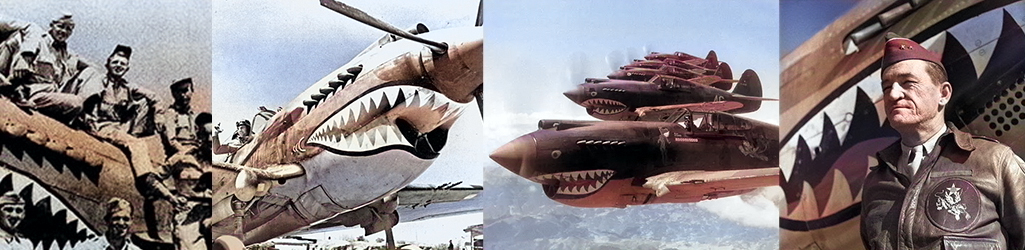
    On 4 July 1941, the American Volunteer Group (AVG)1—later known as the “Flying Tigers”—was officially established. Composed of volunteer pilots and ground crew from the United States, the group operated under the leadership of Claire Lee Chennault and served with the Chinese Air Force. Their formation was a covert move supported by the U.S. government to assist China in its struggle against Japanese aggression before America’s formal entry into World War II. Flying shark-faced Curtiss P-40 fighters, the Flying Tigers quickly earned a reputation for their daring tactics and effectiveness in air combat, becoming legendary symbols of resistance and U.S.–China cooperation.

    Note:

    1. The Flying Tigers were formed before the U.S. entered WWII and were technically civilian contractors, not official U.S. military personnel. []
  28. 10 July 1941

    First batch to Rangoon

    The first group of American Volunteer Group (AVG) pilots and ground crew—later known as the Flying Tigers—arrived in Rangoon, Burma, on July 10, 1941. This marked the beginning of their journey to China, where they would train and prepare for aerial combat against Japanese forces. These recruits, operating covertly under civilian guise due to America’s then-neutral stance, were part of a secret initiative backed by the U.S. government to aid China in its fight against Japanese aggression.

    Note:

    1. Rangoon served as a key staging area for the AVG before they moved into China’s interior. []
  29. August 1941

    The 1st American Volunteer Group began training

    On August 1, 1941, the 1st American Volunteer Group (AVG), famously known as the Flying Tigers, began their official training in Burma. Composed of volunteer pilots and support personnel from the U.S. Army, Navy, and Marine Corps, the AVG trained with Curtiss P-40 Warhawk1 aircraft under the leadership of Claire Lee Chennault. The training focused on tactics suited for air combat against Japanese forces, including hit-and-run attacks and low-altitude flying—strategies that would later prove effective in battle.

    Note:

    1. The Curtiss P-40 Warhawk was a rugged American fighter aircraft known for its durability and firepower. Though not as agile as some adversaries, its speed in a dive and ability to absorb damage made it well-suited for the Flying Tigers’ hit-and-run tactics. []
  30. 24 September 1941

    Second batch to Rangoon

    The second batch of American pilots and ground crew recruited for the 1st American Volunteer Group (AVG) arrived in Rangoon, Burma. Their journey marked a continued effort by the United States—still officially neutral—to bolster China’s resistance against Japanese aggression. These recruits would soon begin training and preparing for aerial combat using Curtiss P-40 Warhawks, forming the backbone of the AVG’s operations in China and Burma.

  31. November 1941

    Curtiss P-40 Got That Wicked Shark Grin

    In November 1941, the American Volunteer Group (AVG), later famously known as the Flying Tigers, painted the now-iconic shark mouth design on the noses of their Curtiss P-40 Warhawks. Inspired by similar markings used by British RAF units in North Africa, the fierce artwork gave the planes a menacing, aggressive look that struck fear into enemy pilots. The shark grin became an enduring symbol of the Flying Tigers’ spirit and remains one of the most recognizable images in aviation history.

  32. 7 December 1941

    Japan's Attack on Pearl Harbor and the Pacific

    On December 7, 1941, Japan launched a surprise military strike on the U.S. naval base at Pearl Harbor1 in Hawaii. The attack destroyed or damaged much of the Pacific Fleet and led to the deaths of over 2,400 Americans. Simultaneously, Japan moved against American, British, and Dutch territories across the Pacific. The attack brought the United States into World War II, fundamentally shifting the balance of global conflict. The next day, the U.S. declared war on Japan, marking its full entry into the Second World War.

    Note:

    1. Pearl Harbor is a deep-water naval base located on the island of Oʻahu, Hawaii. Long used as a strategic anchorage, it became the headquarters of the U.S. Pacific Fleet in the early 20th century. []
  33. 20 December 1941

    The First Combat

    The American Volunteer Group (AVG) engaged in its first aerial combat on December 20, 1941, near Kunming, China. Japanese forces sent a formation of Kawasaki Ki-481 twin-engine light bombers to attack the city. The AVG, flying Curtiss P-40 Warhawks, intercepted the bombers and managed to shoot down several without suffering any losses. This decisive action marked a turning point in aerial defense for China and showcased the effectiveness of the AVG’s training, tactics, and aircraft.

    Note:

    1. The Kawasaki Ki-48, also known as the “Lily” by Allied forces, was designed for speed and agility but was lightly armored, making it vulnerable to fighter attacks. The Ki-48 played a key role in early Japanese bombing campaigns in China and Southeast Asia. []
  34. 23 December 1941

    The Battle of Kunming

    On 25 December 1941, Japanese forces attacked Kunming with 63 bombers and 25 fighters, including Ki-21s1 and Ki-43s2 from elite units like Colonel Kato’s 64th Sentai. AVG’s 3rd Squadron and RAF’s 67 Squadron intercepted, downing 35 enemy aircraft while losing two pilots and five P-40s. Despite the success, Mingaladon Airfield was damaged and eight Buffalos were lost on the ground. The 2nd Squadron “Panda Bears” then took over, striking back at Japanese airbases in Thailand, as Japan launched counterattacks from nearby units.

    Note:

    The Mitsubishi Ki-21 “Sally” [1] was a twin-engine heavy bomber, while the Nakajima Ki-43 “Oscar” [2] was a nimble fighter known for its agility. Both were key aircraft of the Japanese Army Air Force in early World War II.

  35. 12 January 1942

    The Burma Campaign

    On 12 January 1942, the Burma Campaign1 began as Japanese forces advanced into British-held Burma. This campaign was crucial for control of supply routes into China and for defending India. Allied forces, including British, Indian, Chinese, and American troops, faced severe logistical challenges, dense jungle terrain, and aggressive Japanese offensives.

    Note:

    1. The Burma Campaign was a major WWII operation in Southeast Asia, involving fierce jungle warfare and multinational Allied forces attempting to halt Japan’s advance toward India and maintain China’s supply line. []
  36. 24 January 1942

    Mingaladon was Attacked

    On 24 January 1942, Japanese forces launched another major air assault on Mingaladon Airfield1 near Rangoon, Burma. The attack aimed to cripple Allied air capabilities and secure Japanese dominance in the region. Despite intense bombing, AVG pilots and Allied defenses managed to resist the offensive, though the airfield suffered significant damage.

    Note:

    1. Mingaladon airfield, near Rangoon, was a key Allied base repeatedly targeted by Japanese bombers to weaken Allied resistance during the early Burma Campaign. []
  37. 28 January 1942

    A fighter sweeps of 37 Ki-27s

    On 28 January 1942, a formation of 37 Japanese Nakajima Ki-271 fighters conducted a sweeping raid over the skies near Rangoon. This aggressive maneuver was part of Japan’s continued efforts to dominate the air war in Burma. Allied pilots, including those from the American Volunteer Group (AVG), scrambled to intercept the attackers in a series of intense dogfights.

    Note:

    1. The Nakajima Ki-27, known as “Nate” by the Allies, was Japan’s main fighter early in WWII—light, agile, but increasingly outclassed by newer Allied aircraft. []
  38. 29 January 1942

    Another sweep

    On 29 January 1942, the Japanese launched another fighter sweep over the Rangoon area. This follow-up to the previous day’s raid aimed to keep pressure on Allied air defenses. Despite fewer aircraft involved, the encounter led to further skirmishes with AVG and RAF pilots, who continued to defend the skies with determination.

  39. 27 February 1942

    The AVG Withdrew to Bases in Northern Burma

    On 27 February 1942, the American Volunteer Group (AVG), famously known as the Flying Tigers, withdrew from their forward airfields in southern Burma, including Rangoon and Mingaladon, to more secure bases in northern Burma. The decision came in response to increasing Japanese aerial assaults, heavy casualties, and the deteriorating situation on the ground. With Rangoon nearly surrounded and constant bombings making operations unsustainable, the AVG retreated to positions such as Toungoo and Loiwing, where they could regroup, repair aircraft, and continue to defend China and Burma from the advancing Japanese forces. This strategic withdrawal was crucial for preserving the effectiveness of the unit during the critical early months of the Burma Campaign.

  40. 28 February 1942

    AVG Relocated to Magwe

    Following their withdrawal from southern Burma, the American Volunteer Group (AVG) repositioned to Magwe1 on 28 February 1942. Located further north and inland, Magwe offered a safer and more defensible location for continued operations. From this base, the Flying Tigers could still launch sorties against Japanese forces while reducing their vulnerability to constant air attacks. This relocation was part of the strategic realignment aimed at sustaining air support during the intensifying Burma Campaign.

    Note:

    1. Magwe became a key airbase for the AVG after retreating from Rangoon, allowing continued resistance with less exposure to enemy attacks. []
  41. 21 March 1942

    Magwe was Continuously Bombed

    By late March 1942, the Japanese intensified their bombing campaign against Magwe, recognizing it as a critical base for the American Volunteer Group (AVG) and remaining Allied air operations in Burma. On 21 March, waves of Japanese bombers relentlessly struck the airfield, damaging runways, fuel supplies, and aircraft. Despite mounting losses, the AVG attempted to maintain defensive operations, but the increasing frequency and severity of the attacks made it increasingly difficult to continue from this location.

  42. 23 March 1942

    Only Four Aircraft Left

    Following the intense and repeated Japanese air raids on Magwe, the American Volunteer Group (AVG) faced devastating losses. By 23 March 1942, only four operational P-40 fighters remained. The bombing had destroyed many aircraft on the ground, and the continuous assaults made resupply and maintenance nearly impossible. This critical depletion marked a low point for the AVG and underscored the deteriorating Allied air position in Burma.

  43. 8 April 1942

    Strength from reinforcements

    By 8 April 1942, the AVG had restored its strength with new P-40E “Kittyhawks” and expertly repaired aircraft, allowing 12 P-40s to be stationed at Loiwing. That day, 12 Ki-43 “Oscars” from Japan’s 64th Sentai launched an attack. In the air battles that followed, four Oscars were shot down, with only one P-40 lost on the ground. Around this time, Chennault faced pressure from Chinese and American commanders to carry out “morale missions”—ground attacks meant to boost Chinese troop spirits. These risky sorties stirred deep frustration among AVG pilots, leading to the brief “Pilot’s Revolt” in mid-April. Chennault ultimately quashed the dissent and ordered the missions to continue, even as the Allied position in Burma worsened.

  44. 29 April 1942

    AVG Evacuated

    As Japanese advances threatened their position, the American Volunteer Group (AVG) was ordered to evacuate from their base at Loiwing. Under increasing pressure and dwindling resources, Chennault directed the withdrawal to preserve what was left of the group. This marked the beginning of the end of the AVG’s operations in Burma.

  45. 4 May 1942

    Japanese Burma Offensive was Winding Down

    By 4 May, the Japanese offensive in Burma had largely concluded, with only clean-up operations remaining. One such effort—a push by a regiment of the Japanese 56th Division toward Kunming—was thwarted by Chinese forces, bolstered by strong air support from the AVG.

  46. 7 May 1942

    Holding the Line at the Salween Gorge

    The Japanese Army began constructing a pontoon bridge over the upper Salween River to move troops and supplies into China for an advance toward Kunming. In response, 2nd Squadron Leader David Lee “Tex” Hill led four new P-40Es in bombing and strafing runs into the mile-deep Salween River Gorge. Over the next four days, AVG pilots flew relentless missions that effectively halted the Japanese advance. As a result, the enemy never crossed beyond the west bank of the upper Salween. Claire Chennault later remarked, “The American Volunteer Group had staved off China’s collapse on the Salween.” Though largely on the defensive after this, the AVG continued striking Japanese airbases in Vietnam.

  47. June 1942

    Chennault redeployed his squadrons

    With the Burma campaign concluded, Chennault repositioned AVG squadrons to defend China’s airspace. In response to the Doolittle Raid, Japan launched an offensive aimed at capturing airfields that could support further attacks on its homeland. By 1 June, the first personnel of the USAAF’s 23rd Fighter Group—formed to replace the AVG—began arriving. Among the AVG’s final missions were defensive operations over Guilin, where they faced Japanese Nates, Lilys, and the newer twin-engine Kawasaki Ki-45 Toryu (“Nick”) heavy fighters.

  48. 4 July 1942

    The End of the Flying Tigers

    After a year of intense and heroic service, the American Volunteer Group (AVG), famously known as the “Flying Tigers,” was officially disbanded on 4 July 1942. The group was absorbed into the United States Army Air Forces (USAAF) as the 23rd Fighter Group under the newly formed China Air Task Force, still led by Claire Chennault. While many AVG pilots returned home or sought other opportunities, some chose to stay and continue the fight under the USAAF. Though short-lived, the Flying Tigers left a lasting legacy of daring missions, strategic impact, and fierce resistance against the Japanese in China and Burma.