
Skip to content

The Kennedy Assassination

Dated timeline · 80 events

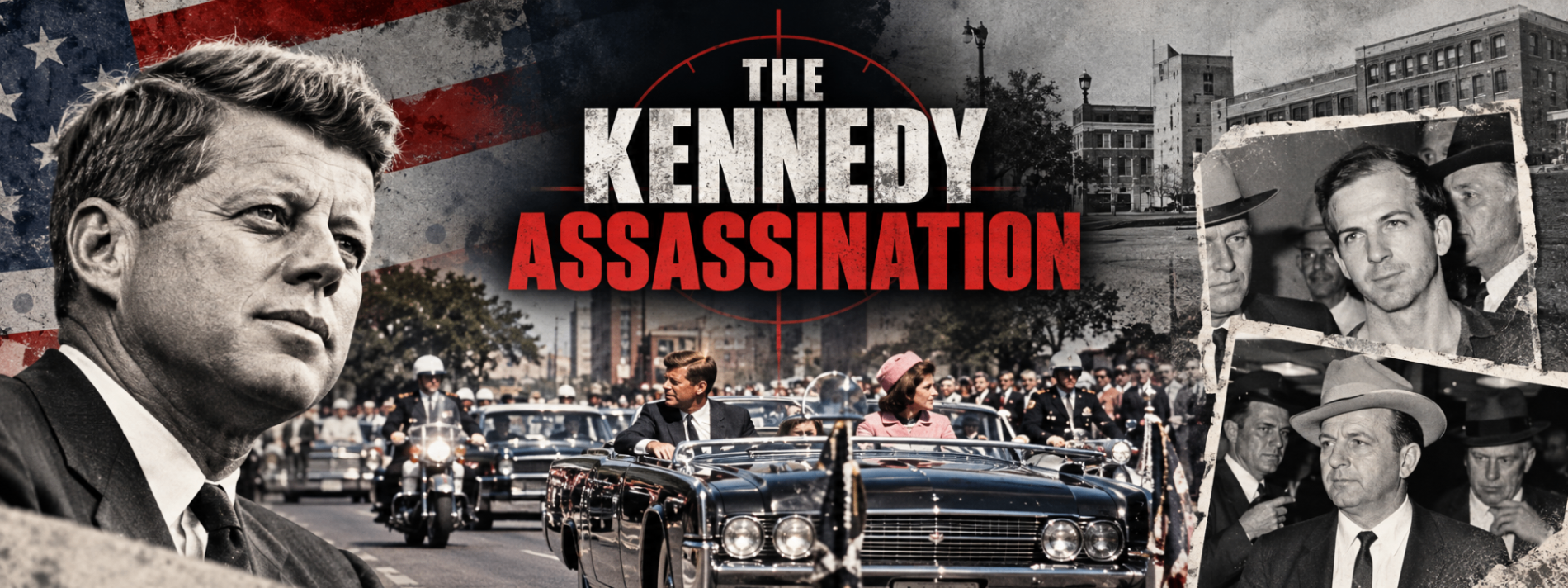
On 22 November 1963, President John F. Kennedy was shot and killed as his motorcade passed through Dealey Plaza in Dallas. Within two days, the man accused of killing him, Lee Harvey Oswald, had himself been shot dead by Jack Ruby. Oswald never stood trial, and questions about what happened that weekend have lasted for decades.

Order:
  1. 17 April 1961

    The Bay of Pigs Invasion

    17–19 April 1961

    About 1,400 Cuban exiles of Brigade 2506, trained and equipped by the CIA, landed at the Bay of Pigs on Cuba's southern coast in an attempt to overthrow Fidel Castro. President John F. Kennedy, who had inherited the plan from the Eisenhower administration, refused to commit U.S. forces openly, and the landing collapsed within three days. More than 100 invaders were killed and nearly 1,200 captured. The failure humiliated the new administration and left lasting bitterness between Kennedy, the CIA, and the Cuban exile community.

    Captured members of Brigade 2506, April 1961. Photo: Miguel Viñas. Public domain, via Wikimedia Commons.
    Captured members of Brigade 2506, April 1961. Photo: Miguel Viñas. Public domain, via Wikimedia Commons.

  2. 29 November 1961

    Allen Dulles leaves the CIA

    Allen Dulles, Director of Central Intelligence since 1953, left office and was succeeded by John McCone. Kennedy had decided to replace him in the wake of the Bay of Pigs, and Deputy Director for Plans Richard Bissell followed him out of the agency in early 1962. Dulles would return to the case in 1963 as a member of the Warren Commission.

    Allen Dulles, Director of Central Intelligence from 1953 to 1961. U.S. Government. Public domain, via Wikimedia Commons.
    Allen Dulles, Director of Central Intelligence from 1953 to 1961. U.S. Government. Public domain, via Wikimedia Commons.

  3. 13 June 1962

    Oswald returns from the Soviet Union

    Former U.S. Marine Lee Harvey Oswald, who had defected to the Soviet Union in October 1959 and spent most of his time there working in a radio factory in Minsk, arrived back in the United States at Hoboken, New Jersey, aboard the liner SS Maasdam. With him were his Russian wife, Marina, and their infant daughter, June. The family soon settled in the Dallas–Fort Worth area.

    Marina Oswald in Minsk, 1961. Photographer unknown. Public domain, via Wikimedia Commons.
    Marina Oswald in Minsk, 1961. Photographer unknown. Public domain, via Wikimedia Commons.

  4. 16 October 1962

    The Cuban Missile Crisis

    16–28 October 1962

    U-2 reconnaissance photographs revealed Soviet medium-range ballistic missile sites under construction in Cuba. For thirteen days Kennedy and Soviet leader Nikita Khrushchev confronted each other in the most dangerous standoff of the Cold War, until Khrushchev agreed to withdraw the missiles in exchange for a U.S. pledge not to invade Cuba and a secret agreement to remove American missiles from Turkey.

    U-2 reconnaissance photograph of a Soviet missile site in Cuba, October 1962. U.S. Air Force. Public domain, via Wikimedia Commons.
    U-2 reconnaissance photograph of a Soviet missile site in Cuba, October 1962. U.S. Air Force. Public domain, via Wikimedia Commons.

  5. 12 March 1963

    A rifle is ordered by mail

    Using the alias "A. Hidell," Oswald mailed an order to Klein's Sporting Goods in Chicago for a 6.5 mm Italian Carcano rifle with a telescopic sight, priced at $19.95 plus postage. The rifle was shipped on 20 March to a Dallas post-office box rented by Oswald. The same day, a Los Angeles mail-order firm shipped him the .38 revolver he had ordered in January under the same alias.

  6. 31 March 1963

    The backyard photographs

    In the backyard of the family's rented home on West Neely Street in Dallas, Marina Oswald photographed her husband holding the rifle and two left-wing newspapers, with a pistol on his hip. When shown the pictures after his arrest, Oswald insisted they were fakes. The House Select Committee on Assassinations photographic panel later examined the photographs and the camera and concluded they were genuine.

    Commission Exhibit 133-A, one of the backyard photographs taken by Marina Oswald. Warren Commission exhibit. Public domain, via Wikimedia Commons.
    Commission Exhibit 133-A, one of the backyard photographs taken by Marina Oswald. Warren Commission exhibit. Public domain, via Wikimedia Commons.

  7. 10 April 1963, 21:00

    Shot fired at General Walker

    10 April 1963, about 9:00 p.m.

    A rifle bullet was fired through a window of the Dallas home of retired Major General Edwin Walker, a prominent right-wing activist, narrowly missing him as he sat at his desk. The case went unsolved until after the assassination, when Marina Oswald told investigators her husband had admitted the shooting. The Warren Commission concluded that Oswald fired the shot.

    Major General Edwin A. Walker in uniform. U.S. Army. Public domain, via Wikimedia Commons.
    Major General Edwin A. Walker in uniform. U.S. Army. Public domain, via Wikimedia Commons.

  8. 24 April 1963

    Oswald moves to New Orleans

    Oswald left Dallas by bus for his native New Orleans. Marina and June joined him in May, driven there by Ruth Paine, a Quaker acquaintance from the Dallas area who had befriended Marina. On 10 May Oswald began work oiling machinery at the Reily Coffee Company; he was fired in July.

  9. 5 June 1963

    The Texas trip is agreed

    Kennedy, Vice President Lyndon B. Johnson, and Texas Governor John Connally met at the Cortez Hotel in El Paso and agreed that the President would make a political trip to Texas later in the year, partly to raise funds and to heal a feud within the state's Democratic Party.

    John Connally, photographed while Secretary of the Navy (1961), before he became Governor of Texas. U.S. Navy. Public domain, via Wikimedia Commons.
    John Connally, photographed while Secretary of the Navy (1961), before he became Governor of Texas. U.S. Navy. Public domain, via Wikimedia Commons.

  10. 10 June 1963

    The "peace speech"

    In a commencement address at American University in Washington, Kennedy called for a re-examination of Cold War attitudes toward the Soviet Union and announced talks on a nuclear test ban. The Partial Nuclear Test Ban Treaty was signed in Moscow less than two months later.

    President Kennedy delivers the commencement address at American University, Washington, 10 June 1963. Photo: Cecil Stoughton, White House. Public domain, via Wikimedia Commons.
    President Kennedy delivers the commencement address at American University, Washington, 10 June 1963. Photo: Cecil Stoughton, White House. Public domain, via Wikimedia Commons.

  11. 9 August 1963

    Oswald's public stand for Castro

    9–21 August 1963

    Handing out leaflets for the pro-Castro Fair Play for Cuba Committee in New Orleans, Oswald got into a street scuffle on 9 August with anti-Castro exile Carlos Bringuier, whose group he had approached days earlier offering his help. Both were arrested. Oswald leafleted again on 16 August, and on 21 August he debated Bringuier on the local radio station WDSU, where his earlier defection to the Soviet Union was made public. Oswald was the chapter's only known member.

    Oswald (right) hands out Fair Play for Cuba leaflets in New Orleans, 16 August 1963. Photographer not credited; Warren Commission exhibit. Public domain, via Wikimedia Commons.
    Oswald (right) hands out Fair Play for Cuba leaflets in New Orleans, 16 August 1963. Photographer not credited; Warren Commission exhibit. Public domain, via Wikimedia Commons.

  12. August 1963

    The "Maurice Bishop" claim (disputed)

    Late August – early September 1963

    Antonio Veciana, leader of the anti-Castro group Alpha 66, later claimed that around this time he saw his CIA handler, a man he knew as "Maurice Bishop," talking with Oswald in the lobby of a Dallas office building. Investigators for the House Select Committee on Assassinations could not corroborate the meeting. When shown David Atlee Phillips, a senior CIA officer in the Western Hemisphere division, Veciana said he was not Bishop; decades later, in 2013, Veciana said publicly that he was.

  13. September 1963

    Silvia Odio's visitors (disputed)

    Late September 1963

    Cuban exile Silvia Odio said that three men came to her Dallas apartment seeking help for the anti-Castro cause, and that one of them was introduced as "Leon Oswald." A day later, she said, one of the men called her and described "Leon" as a former Marine who thought Kennedy should have been shot after the Bay of Pigs. The Warren Commission concluded that Oswald was on his way to Mexico at the time and that she was mistaken; the House Select Committee found her account credible.

  14. 27 September 1963

    Oswald in Mexico City

    27 September – 2 October 1963

    Oswald travelled by bus to Mexico City, where he visited the Cuban consulate and the Soviet embassy trying to obtain a visa to travel to Cuba, apparently as a route back to the Soviet Union. Both requests stalled, and he argued angrily with consular staff. His visits were picked up by CIA surveillance of the two diplomatic posts. He returned to Dallas on 3 October.

  15. 3 October 1963

    Krock's column on the CIA

    In The New York Times, columnist Arthur Krock repeated a report from Saigon in which a "very high American official" likened the CIA's growth to "a malignancy" that he was not sure even the White House could still control, and warned that any attempt at a coup in the United States would come from the CIA rather than the Pentagon. The column reflected sharp tensions within the administration over policy in South Vietnam.

    Arthur Krock of The New York Times, 1939. Photo: Harris & Ewing, Library of Congress. Public domain, via Wikimedia Commons.
    Arthur Krock of The New York Times, 1939. Photo: Harris & Ewing, Library of Congress. Public domain, via Wikimedia Commons.

  16. 11 October 1963

    NSAM 263

    Kennedy approved National Security Action Memorandum 263, which endorsed plans to withdraw 1,000 U.S. military personnel from Vietnam by the end of 1963. Historians still debate whether it signalled a firm intention to disengage from Vietnam or a conditional drawdown tied to the war's progress.

  17. 16 October 1963

    A job at the Texas School Book Depository

    Oswald started work as an order filler at the Texas School Book Depository, a textbook warehouse at the corner of Elm and Houston Streets overlooking Dealey Plaza. Ruth Paine, with whom Marina was now living in suburban Irving, had learned of the opening from a neighbour whose brother, Buell Wesley Frazier, worked there. During the week Oswald rented a room in the Oak Cliff neighbourhood of Dallas under the name "O. H. Lee."

    The Texas School Book Depository seen from Houston Street (Commission Exhibit 360). Warren Commission exhibit. Public domain, via Wikimedia Commons.
    The Texas School Book Depository seen from Houston Street (Commission Exhibit 360). Warren Commission exhibit. Public domain, via Wikimedia Commons.

  18. 1 November 1963

    Coup in Saigon

    1–2 November 1963

    South Vietnamese generals, having been assured the United States would not intervene, overthrew President Ngo Dinh Diem. Diem and his brother Ngo Dinh Nhu were killed on 2 November after surrendering. Kennedy was reported to be badly shaken by the news of the killings.

    Ngo Dinh Diem, President of the Republic of Vietnam. Embassy of the Republic of Vietnam press office. Public domain, via Wikimedia Commons.
    Ngo Dinh Diem, President of the Republic of Vietnam. Embassy of the Republic of Vietnam press office. Public domain, via Wikimedia Commons.

  19. November 1963

    Oswald's note to the FBI

    Early to mid-November 1963

    FBI agent James Hosty visited Ruth Paine's home twice in early November while trying to locate Oswald. Some days later Oswald left a note for Hosty at the Dallas FBI office, reportedly telling him to stop bothering his wife. After Oswald was killed, Hosty destroyed the note, he said on the orders of his superior, Gordon Shanklin, who denied it. The destruction was kept from the Warren Commission and became public only in 1975.

  20. 19 November 1963

    The motorcade route is published

    The Dallas Times Herald published the planned route of the presidential motorcade from Love Field to the Trade Mart, where the President was to speak at a luncheon. It included the turn from Main Street onto Houston Street and then onto Elm Street, which took the motorcade directly past the Book Depository.

    Aerial view of Dealey Plaza, with the Book Depository at upper left (Commission Exhibit 876). Warren Commission exhibit. Public domain, via Wikimedia Commons.
    Aerial view of Dealey Plaza, with the Book Depository at upper left (Commission Exhibit 876). Warren Commission exhibit. Public domain, via Wikimedia Commons.

  21. 20 November 1963

    Rose Cheramie's warning (disputed)

    Rose Cheramie, a woman found injured beside a highway near Eunice, Louisiana, reportedly told a state police officer and hospital staff that Kennedy would be killed in Dallas. Her statements were only recalled after the assassination and were never tied to any identified person or plot; she died in a road accident in 1965.

  22. 21 November 1963

    A draft of NSAM 273

    National Security Adviser McGeorge Bundy prepared a draft of what would become National Security Action Memorandum 273, following a policy conference on Vietnam in Honolulu the previous day. Kennedy never saw it. President Johnson signed an amended version on 26 November.

    McGeorge Bundy, National Security Adviser to Presidents Kennedy and Johnson. Photo: Yoichi Okamoto, White House (1967). Public domain, via Wikimedia Commons.
    McGeorge Bundy, National Security Adviser to Presidents Kennedy and Johnson. Photo: Yoichi Okamoto, White House (1967). Public domain, via Wikimedia Commons.

  23. 21 November 1963

    The Texas trip begins

    President Kennedy and First Lady Jacqueline Kennedy flew to Texas, making stops in San Antonio and Houston before arriving late at night in Fort Worth, where they stayed at the Hotel Texas.

    President and Mrs. Kennedy arrive at San Antonio International Airport, 21 November 1963. Photo: Cecil Stoughton, White House. Public domain, via Wikimedia Commons.
    President and Mrs. Kennedy arrive at San Antonio International Airport, 21 November 1963. Photo: Cecil Stoughton, White House. Public domain, via Wikimedia Commons.

  24. 21 November 1963

    Oswald goes to Irving on a Thursday

    21 November 1963, afternoon

    Oswald asked Buell Wesley Frazier for a ride to Irving after work, explaining that he wanted to pick up some curtain rods for his room. It was the first time he had gone there on a Thursday rather than for the weekend. Marina later said they had quarrelled that evening after she refused to move back to Dallas with him.

  25. 22 November 1963, 07:20

    Oswald leaves with a long package

    22 November 1963, about 7:20 a.m.

    Oswald left the Paine home before his family was up, leaving behind his wedding ring in a teacup and $170 in a dresser drawer. Frazier and his sister saw him carrying a long package wrapped in brown paper, which he put in the back seat of Frazier's car and said contained curtain rods. The Warren Commission concluded the package held the disassembled rifle, which Marina had seen kept wrapped in a blanket in the Paines' garage.

  26. 22 November 1963, 08:45

    Kennedy speaks in the rain in Fort Worth

    22 November 1963, about 8:45 a.m.

    Kennedy spoke to a crowd of several thousand in a parking lot outside the Hotel Texas, then addressed a Fort Worth Chamber of Commerce breakfast inside the hotel.

    The President greets the crowd in Fort Worth on the morning of 22 November 1963. Photo: Cecil Stoughton, White House. Public domain, via Wikimedia Commons.
    The President greets the crowd in Fort Worth on the morning of 22 November 1963. Photo: Cecil Stoughton, White House. Public domain, via Wikimedia Commons.

  27. 22 November 1963, 10:50

    Julia Ann Mercer's account (disputed)

    22 November 1963, about 10:50 a.m.

    Motorist Julia Ann Mercer said that while stuck in traffic on Elm Street near the triple underpass she saw a young man take what looked like a gun case from a parked pickup truck and walk up the grassy slope. She later claimed the truck's driver was Jack Ruby and that her statements had been misrecorded. Police did note a disabled truck in the area that morning, but her identification of Ruby was never corroborated.

  28. 22 November 1963, 11:40

    Air Force One lands at Love Field

    After a short flight from Carswell Air Force Base in Fort Worth, Air Force One landed at Love Field in Dallas. Jacqueline Kennedy was given a bouquet of red roses, and the President spent several minutes shaking hands along the airport fence.

    President and Mrs. Kennedy arrive at Love Field, Dallas. Photo: Cecil Stoughton, White House. Public domain, via Wikimedia Commons.
    President and Mrs. Kennedy arrive at Love Field, Dallas. Photo: Cecil Stoughton, White House. Public domain, via Wikimedia Commons.

  29. 22 November 1963, 11:52

    The motorcade leaves Love Field

    22 November 1963, shortly after 11:50 a.m.

    The motorcade set off on its roughly ten-mile route through Dallas. The President and Mrs. Kennedy rode in the back of an open Lincoln limousine, with Governor Connally and his wife, Nellie, in the jump seats in front of them and Secret Service agents William Greer and Roy Kellerman in front. Vice President Johnson rode two cars behind. Large, friendly crowds lined the downtown streets.

    The motorcade route from Love Field to Dealey Plaza, and the planned continuation to the Trade Mart. Map drawn for this timeline.
    The motorcade route from Love Field to Dealey Plaza, and the planned continuation to the Trade Mart. Map drawn for this timeline.

  30. 22 November 1963, 11:55

    Oswald on the sixth floor

    22 November 1963, about 11:55 a.m.

    Depository employees who had been laying new flooring on the sixth floor raced the building's two freight elevators down for their lunch break. They heard Oswald call to them from upstairs to send an elevator back up. Co-worker Charles Givens testified that he went back up a few minutes later to fetch his cigarettes and saw Oswald on the sixth floor. It is the last confirmed sighting of Oswald before the shooting.

  31. 22 November 1963, 12:15

    A man with a rifle in the window

    22 November 1963, about 12:15 p.m.

    Waiting for the motorcade on Houston Street, spectator Arnold Rowland told his wife he could see a man holding a rifle in an upper window at the west end of the Depository, and assumed he was a Secret Service agent. By the time his wife looked, the man had gone. The Warren Commission accepted that he saw someone but doubted parts of his later testimony.

  32. 22 November 1963, 12:29

    "You can't say Dallas doesn't love you"

    22 November 1963, about 12:29 p.m.

    As the limousine turned from Main Street onto Houston Street at the edge of Dealey Plaza, Nellie Connally turned to the President and said, "Mr. President, you can't say Dallas doesn't love you." The car then made the sharp left turn onto Elm Street, slowing as it passed below the Depository.

    The President's limousine in the Dallas motorcade shortly before the shooting. Photo: Walt Cisco, Dallas Morning News. Public domain, via Wikimedia Commons.
    The President's limousine in the Dallas motorcade shortly before the shooting. Photo: Walt Cisco, Dallas Morning News. Public domain, via Wikimedia Commons.

  33. 22 November 1963, 12:30

    Shots in Dealey Plaza

    Shots rang out as the limousine moved down Elm Street. Kennedy was hit in the upper back, with the bullet exiting his throat, and then fatally in the head; Governor Connally was seriously wounded. Most witnesses heard three shots. Dress manufacturer Abraham Zapruder captured the shooting on his home-movie camera — the Zapruder film. Many bystanders ran toward the grassy knoll and the railroad yard behind it, while others, including steamfitter Howard Brennan, said they had seen a gunman in the Depository's southeast sixth-floor window.

    Dealey Plaza: the motorcade's path, the Book Depository, and the grassy knoll (schematic). Map drawn for this timeline.
    Dealey Plaza: the motorcade's path, the Book Depository, and the grassy knoll (schematic). Map drawn for this timeline.

  34. 22 November 1963, 12:31

    An officer meets Oswald in the lunchroom

    22 November 1963, about 12:31 p.m.

    Motorcycle officer Marrion Baker ran into the Depository with building superintendent Roy Truly. About 90 seconds after the shots, on the second floor, Baker stopped Oswald at gunpoint in the employees' lunchroom. Truly vouched for him as an employee, and Baker moved on up the stairs.

  35. 22 November 1963, 12:33

    Oswald leaves the Depository

    22 November 1963, about 12:33 p.m.

    Oswald walked out of the building, apparently through the front entrance, before police sealed it. He was one of several employees who left, but the only one who did not return. He headed east along Elm Street, away from Dealey Plaza.

    Oswald's movements from the Depository to the Texas Theatre, 12:33–1:50 p.m. (schematic). Map drawn for this timeline.
    Oswald's movements from the Depository to the Texas Theatre, 12:33–1:50 p.m. (schematic). Map drawn for this timeline.

  36. 22 November 1963, 12:36

    The limousine reaches Parkland

    22 November 1963, about 12:36 p.m.

    The limousine raced to Parkland Memorial Hospital, about four miles away. The President was carried into Trauma Room One, where doctors began efforts to save him that they quickly realised were hopeless; Governor Connally was taken to Trauma Room Two and survived.

    Police gather around the presidential limousine outside Parkland Hospital. Photo: Cecil Stoughton, White House. Public domain, via Wikimedia Commons.
    Police gather around the presidential limousine outside Parkland Hospital. Photo: Cecil Stoughton, White House. Public domain, via Wikimedia Commons.

  37. 22 November 1963, 12:40

    Oswald boards a bus

    22 November 1963, about 12:40 p.m.

    Seven blocks east of the Depository, Oswald boarded a city bus heading back west toward Oak Cliff. One of the passengers, Mary Bledsoe, was his former landlady and recognised him. With the bus stuck in traffic caused by the shooting, Oswald asked driver Cecil McWatters for a transfer and got off after about four minutes.

  38. 22 November 1963, 12:45

    A description goes out on police radio

    Dallas police broadcast a description of the suspected gunman — a slender white male, about 30, 5 feet 10 inches tall and 165 pounds — based mainly on Howard Brennan's account. At about the same time the dispatcher sent patrolman J. D. Tippit and another officer into central Oak Cliff.

    Howard Brennan, photographed for the Warren Commission on 20 March 1964, seated where he watched the motorcade across from the Book Depository. Public domain, via Wikimedia Commons.
    Howard Brennan, photographed for the Warren Commission on 20 March 1964, seated where he watched the motorcade across from the Book Depository. Public domain, via Wikimedia Commons.

  39. 22 November 1963, 12:46

    Roger Craig's station wagon (disputed)

    22 November 1963, about 12:45 p.m.

    Deputy Sheriff Roger Craig said that about 15 minutes after the shots he saw a young white man run down the grassy slope from the direction of the Depository and get into a light-coloured station wagon on Elm Street. That evening, he said, he identified Oswald at police headquarters as the man. Captain Will Fritz denied that Craig had identified Oswald in his office, and the account cannot be reconciled with the evidence that Oswald was on a bus and then in a taxi at the time.

  40. 22 November 1963, 12:47

    Oswald takes a taxi

    22 November 1963, about 12:47 p.m.

    After walking to the Greyhound bus station, Oswald got into a taxi driven by William Whaley, first offering it to an elderly woman who was also waiting. He asked to be taken to the 500 block of North Beckley Avenue in Oak Cliff, and got out a few blocks beyond his rooming house at 1026 North Beckley, walking back.

  41. 22 November 1963, 12:59

    Oswald at his rooming house

    22 November 1963, about 1:00 p.m.

    Housekeeper Earlene Roberts saw Oswald hurry in and go to his room. While he was inside, a police car stopped in front of the house and sounded its horn twice before moving on; the officers were never conclusively identified. Oswald left a few minutes later wearing a jacket, and at about 1:03 p.m. Roberts saw him standing at a bus stop across the street. The Warren Commission concluded he had collected his revolver.

  42. 22 November 1963, 13:12

    The sniper's nest is found

    22 November 1963, about 1:12 p.m.

    On the sixth floor of the Depository, Deputy Sheriff Luke Mooney found three spent cartridge cases beneath the southeast corner window, partly shielded by stacked book cartons. Investigators called it the "sniper's nest."

  43. 22 November 1963, 13:15

    Officer Tippit is killed

    22 November 1963, about 1:15 p.m.

    On East 10th Street near Patton Avenue in Oak Cliff, Officer J. D. Tippit pulled alongside a man walking on the sidewalk and spoke to him through the car window. When Tippit got out, the man shot him several times with a revolver, killing him, then walked away, emptying the spent cartridge cases into some bushes. Several witnesses later identified Oswald as the gunman.

    Officer J. D. Tippit. Dallas Police Department photograph, 1963. Public domain, via Wikimedia Commons.
    Officer J. D. Tippit. Dallas Police Department photograph, 1963. Public domain, via Wikimedia Commons.

  44. 22 November 1963, 13:16

    "We've had a shooting out here"

    22 November 1963, about 1:16 p.m.

    Passing motorist T. F. Bowley used the radio in Tippit's patrol car to tell the police dispatcher that an officer had been shot, after another witness, Domingo Benavides, had tried and failed to work it.

  45. 22 November 1963, 13:22

    A rifle is found

    22 November 1963, about 1:22 p.m.

    Deputies Eugene Boone and Seymour Weitzman found a bolt-action rifle with a telescopic sight hidden between boxes near the sixth floor's northwest stairway. Weitzman initially described it as a 7.65 mm Mauser; it was the 6.5 mm Carcano that the FBI traced to Oswald's mail-order purchase.

    The Carcano rifle found in the Depository (Commission Exhibit 139). National Archives. Public domain, via Wikimedia Commons.
    The Carcano rifle found in the Depository (Commission Exhibit 139). National Archives. Public domain, via Wikimedia Commons.

  46. 22 November 1963

    A bullet on a stretcher

    22 November 1963, early afternoon

    At Parkland, senior engineer Darrell Tomlinson found a nearly intact bullet on a stretcher in a corridor and turned it over to the hospital's security chief, who passed it to the Secret Service. The Warren Commission concluded that this bullet, Commission Exhibit 399, had passed through Kennedy and Connally. Critics dubbed it the "magic bullet" (see the single-bullet theory), and its condition and chain of custody remain among the most debated points of the case.

  47. 22 November 1963, 13:40

    A man ducks into a theatre

    22 November 1963, about 1:40 p.m.

    On West Jefferson Boulevard, shoe-store manager Johnny Brewer noticed a man step into his store's entrance as police cars passed, then walk into the Texas Theatre without buying a ticket. Brewer alerted the cashier, Julia Postal, who called the police.

  48. 22 November 1963, 13:50

    Oswald is arrested

    22 November 1963, about 1:50 p.m.

    Police entered the darkened theatre and, when the house lights came up, Brewer pointed out the man. As Officer Nick McDonald approached, Oswald struck him and drew a revolver; after a struggle he was disarmed and arrested, reportedly saying, "Well, it is all over now." He was taken to police headquarters as a suspect in Tippit's killing.

    The Texas Theatre in Oak Cliff, where Oswald was arrested. Public domain, via Wikimedia Commons.
    The Texas Theatre in Oak Cliff, where Oswald was arrested. Public domain, via Wikimedia Commons.

  49. 22 November 1963, 14:05

    The body leaves Parkland

    22 November 1963, about 2:05 p.m.

    Kennedy's body left Parkland in a bronze casket after a confrontation between the President's aides and Dallas County medical examiner Earl Rose, who insisted that Texas law required an autopsy in Dallas. The aides and Secret Service agents pushed past him and took the casket to Air Force One at Love Field.

  50. 22 November 1963

    The first interrogation

    22 November 1963, afternoon

    At Dallas police headquarters, homicide captain Will Fritz began the first of several interrogations of Oswald, with FBI and Secret Service agents at times present. Oswald denied shooting anyone. No recording or stenographic record was made of any of the sessions, a failure the Warren Commission criticised.

  51. 22 November 1963, 14:38

    Johnson takes the oath

    Aboard Air Force One at Love Field, Lyndon B. Johnson was sworn in as the 36th President by federal judge Sarah T. Hughes, with Lady Bird Johnson on one side and Jacqueline Kennedy, still in her blood-stained suit, on the other. White House photographer Cecil Stoughton took the only photographs. The plane left for Washington minutes later.

    Lyndon B. Johnson takes the oath of office aboard Air Force One. Photo: Cecil Stoughton, White House. Public domain, via Wikimedia Commons.
    Lyndon B. Johnson takes the oath of office aboard Air Force One. Photo: Cecil Stoughton, White House. Public domain, via Wikimedia Commons.

  52. 22 November 1963

    The autopsy at Bethesda

    22 November 1963, evening

    Navy pathologists led by Commander James Humes performed the autopsy at Bethesda Naval Hospital. It concluded that Kennedy had been struck by two bullets fired from above and behind. The inexperience of the doctors in gunshot cases, the restrictions placed on them, and later disputes over missing materials, X-rays and photographs made the autopsy a lasting source of controversy.

  53. 22 November 1963, 19:10

    Charged with Tippit's murder

    22 November 1963, about 7:10 p.m.

    Oswald was formally charged with the murder of Officer J. D. Tippit. Led through a corridor crowded with reporters between interrogations and lineups, he insisted he had not shot anyone and called out, "I'm just a patsy."

  54. 22 November 1963

    The midnight press conference

    22–23 November 1963, around midnight

    Late on the night of the 22nd Oswald was charged with the murder of President Kennedy, and he was brought briefly before reporters in the police assembly room, where he denied the killing. After he was taken out, District Attorney Henry Wade told the press that Oswald belonged to the "Free Cuba Committee"; nightclub owner Jack Ruby, standing at the back of the room, called out to correct him: the Fair Play for Cuba Committee. Oswald was arraigned for the President's murder at about 1:30 a.m.

    Lee Harvey Oswald's Dallas police arrest photograph. Dallas Police Department; Warren Commission. Public domain, via Wikimedia Commons.
    Lee Harvey Oswald's Dallas police arrest photograph. Dallas Police Department; Warren Commission. Public domain, via Wikimedia Commons.

  55. 23 November 1963, 03:30

    The President returns to the White House

    23 November 1963, about 3:30 a.m.

    Kennedy's flag-draped casket was carried into the East Room of the White House, where it lay in repose for the day as family, officials and staff paid their respects.

  56. 23 November 1963

    The rifle is traced

    Working overnight, the FBI traced the rifle's serial number to Klein's Sporting Goods, whose records showed it had been shipped to "A. Hidell" at Oswald's Dallas post-office box. Oswald had a forged identity card in the name of Alek James Hidell in his wallet when arrested, and FBI handwriting experts matched the order form to his writing.

  57. 23 November 1963

    Oswald asks for a lawyer

    23 November 1963, afternoon

    Oswald was visited by his mother, Marguerite, Marina and his brother, Robert. He telephoned Ruth Paine to ask her to contact John Abt, a New York lawyer known for defending Communist Party leaders, to represent him. Abt could not be reached that weekend, and Oswald never had a lawyer.

    Marguerite Oswald, Lee Harvey Oswald's mother, in 1964. AP photo. Public domain, via Wikimedia Commons.
    Marguerite Oswald, Lee Harvey Oswald's mother, in 1964. AP photo. Public domain, via Wikimedia Commons.

  58. 24 November 1963

    Warnings of a threat

    24 November 1963, early morning

    In the early hours of Sunday the Dallas FBI office and the Dallas County sheriff's office each received an anonymous telephone call warning that Oswald would be killed during his transfer to the county jail later that morning. The FBI passed the warning to the Dallas police. Police lieutenant Billy Grammer later said he had received a similar call and came to believe the caller had been Jack Ruby; this has never been confirmed.

  59. 24 November 1963, 11:17

    Ruby at the Western Union office

    Jack Ruby wired $25 to one of his nightclub dancers from a Western Union office on Main Street, about a block from police headquarters. The time-stamped receipt later became central to the argument that Ruby's arrival in the basement minutes later was a matter of chance rather than planning.

  60. 24 November 1963, 11:21

    Ruby shoots Oswald

    As detectives led Oswald through the police basement to a waiting car, Ruby stepped out from the crowd of reporters and shot him once in the abdomen with a .38 revolver. The shooting was broadcast live on national television. Oswald was taken to Parkland Memorial Hospital, where he died at 1:07 p.m.

    Jack Ruby's Dallas police arrest photograph, 24 November 1963. Dallas Police Department. Public domain, via Wikimedia Commons.
    Jack Ruby's Dallas police arrest photograph, 24 November 1963. Dallas Police Department. Public domain, via Wikimedia Commons.

  61. 24 November 1963

    Lying in state

    24 November 1963, from about noon

    Kennedy's casket was carried on a horse-drawn caisson to the U.S. Capitol, where it lay in state in the rotunda. Some 250,000 mourners filed past through the night, many waiting for hours in the cold.

    President Kennedy's casket lying in state in the Capitol rotunda. Photo: Abbie Rowe, National Park Service. Public domain, via Wikimedia Commons.
    President Kennedy's casket lying in state in the Capitol rotunda. Photo: Abbie Rowe, National Park Service. Public domain, via Wikimedia Commons.

  62. 25 November 1963

    Two funerals

    After a funeral mass at St. Matthew's Cathedral, attended by leaders from around the world, Kennedy was buried at Arlington National Cemetery, where Jacqueline Kennedy lit an eternal flame. It was the third birthday of his son, John Jr., who saluted the casket as it passed. The same afternoon, Oswald was buried at Rose Hill Cemetery in Fort Worth; reporters had to serve as pallbearers.

    President Kennedy's burial at Arlington National Cemetery. Photo: Abbie Rowe, National Park Service. Public domain, via Wikimedia Commons.
    President Kennedy's burial at Arlington National Cemetery. Photo: Abbie Rowe, National Park Service. Public domain, via Wikimedia Commons.

  63. 29 November 1963

    The Warren Commission is created

    Johnson signed Executive Order 11130 establishing the President's Commission on the Assassination of President Kennedy, chaired by Chief Justice Earl Warren. Its members included Allen Dulles, former CIA director, and Representative Gerald Ford.

    Chief Justice Earl Warren, chairman of the Warren Commission. Photo: Harris & Ewing. Public domain, via Wikimedia Commons.
    Chief Justice Earl Warren, chairman of the Warren Commission. Photo: Harris & Ewing. Public domain, via Wikimedia Commons.

  64. 14 March 1964

    Ruby is convicted

    A Dallas jury convicted Jack Ruby of murder with malice and sentenced him to death. His lawyer, Melvin Belli, had argued that Ruby suffered from a form of epilepsy and was not responsible for his actions.

    Melvin Belli, Jack Ruby's defence lawyer, in 1967. Photographer unknown. Public domain, via Wikimedia Commons.
    Melvin Belli, Jack Ruby's defence lawyer, in 1967. Photographer unknown. Public domain, via Wikimedia Commons.

  65. 8 May 1964

    Hoover exempted from retirement

    President Johnson signed Executive Order 11154 exempting FBI Director J. Edgar Hoover, who would turn 70 on 1 January 1965, from compulsory retirement. Hoover remained director until his death in 1972.

    FBI Director J. Edgar Hoover, 1961. Photo: Marion S. Trikosko, Library of Congress. Public domain, via Wikimedia Commons.
    FBI Director J. Edgar Hoover, 1961. Photo: Marion S. Trikosko, Library of Congress. Public domain, via Wikimedia Commons.

  66. 14 May 1964

    Hoover testifies

    Hoover appeared before the Warren Commission and testified that there was no evidence of a conspiracy, foreign or domestic, and that Oswald had never been an FBI informant. He did not disclose the destruction of Oswald's note to Agent Hosty.

  67. 7 June 1964

    Ruby speaks to the Commission

    Chief Justice Warren and Gerald Ford interviewed Ruby in the Dallas County jail. Ruby repeatedly asked to be taken to Washington, saying he could not speak freely in Dallas and feared for his life and his family's. The request was not granted.

    Gerald Ford, a member of the Warren Commission, in his 1974 presidential portrait. Photo: David Hume Kennerly, White House. Public domain, via Wikimedia Commons.
    Gerald Ford, a member of the Warren Commission, in his 1974 presidential portrait. Photo: David Hume Kennerly, White House. Public domain, via Wikimedia Commons.

  68. 24 September 1964

    The Warren Report

    The Commission delivered its 888-page report to President Johnson; it was made public on 27 September. It concluded that Oswald, acting alone, fired three shots from the sixth floor of the Depository, that one bullet had passed through both Kennedy and Connally, and that Ruby had also acted alone. It found no evidence of a conspiracy.

    The Warren Commission presents its report to President Johnson. Photo: Cecil Stoughton, White House. Public domain, via Wikimedia Commons.
    The Warren Commission presents its report to President Johnson. Photo: Cecil Stoughton, White House. Public domain, via Wikimedia Commons.

  69. 3 January 1967

    Jack Ruby dies

    On 5 October 1966 the Texas Court of Criminal Appeals had overturned Ruby's conviction, ruling that some of his statements to police should not have been admitted and that the trial should have been moved out of Dallas. Admitted to Parkland Hospital on 9 December 1966 with what was thought to be pneumonia, Ruby was found to have advanced cancer. He died of a pulmonary embolism before his retrial, set for Wichita Falls, could begin.

  70. 1 March 1967

    Garrison arrests Clay Shaw

    New Orleans District Attorney Jim Garrison, whose investigation had become public a few weeks earlier, arrested businessman Clay Shaw and charged him with conspiring to kill the President. Garrison's other main suspect, former pilot David Ferrie, who had known Oswald in the Civil Air Patrol in the 1950s, had been found dead in his apartment on 22 February.

    New Orleans District Attorney Jim Garrison, February 1967. Photographer unknown. Public domain, via Wikimedia Commons.
    New Orleans District Attorney Jim Garrison, February 1967. Photographer unknown. Public domain, via Wikimedia Commons.

  71. 1 March 1969

    Clay Shaw is acquitted

    After a trial lasting more than a month, a jury took less than an hour to acquit Shaw. The trial was the first time the Zapruder film was shown in public, and it remains the only criminal trial ever held over the assassination.

    Clay Shaw, about 1960. Photographer unknown. Public domain, via Wikimedia Commons.
    Clay Shaw, about 1960. Photographer unknown. Public domain, via Wikimedia Commons.

  72. 6 March 1975

    The Zapruder film on television

    The Zapruder film was shown on national television for the first time, on ABC's late-night programme Good Night America, hosted by Geraldo Rivera. The sight of Kennedy's head snapping backwards fuelled public demand for a new investigation.

    Geraldo Rivera in 2011. Photo: Mark Taylor, CC BY 2.0, via Wikimedia Commons.
    Geraldo Rivera in 2011. Photo: Mark Taylor, CC BY 2.0, via Wikimedia Commons.

  73. 1975

    The Church Committee

    1975–1976

    The Senate's Church Committee, chaired by Frank Church, revealed that the CIA had plotted to assassinate Fidel Castro, including in partnership with Mafia figures, and that neither the CIA nor the FBI had told the Warren Commission. Its 1976 report criticised both agencies' handling of the Kennedy investigation. In 1975 the FBI's destruction of Oswald's note to Agent Hosty had also become public.

    Senator Frank Church of Idaho, chairman of the Church Committee. U.S. Senate. Public domain, via Wikimedia Commons.
    Senator Frank Church of Idaho, chairman of the Church Committee. U.S. Senate. Public domain, via Wikimedia Commons.

  74. September 1976

    The House Select Committee is formed

    The House of Representatives established the House Select Committee on Assassinations to reinvestigate the killings of Kennedy and Martin Luther King Jr.. It was later chaired by Louis Stokes, with G. Robert Blakey as chief counsel. Phillips was among the former CIA officers questioned about Oswald's Mexico City visit and the "Maurice Bishop" allegation.

    Representative Louis Stokes of Ohio, chairman of the House Select Committee on Assassinations. U.S. Congress. Public domain, via Wikimedia Commons.
    Representative Louis Stokes of Ohio, chairman of the House Select Committee on Assassinations. U.S. Congress. Public domain, via Wikimedia Commons.

  75. 29 March 1979

    "Probably" a conspiracy

    The House Select Committee issued its final report. It agreed that Oswald had fired the shots that killed Kennedy, but concluded that the President "was probably assassinated as a result of a conspiracy," relying largely on an acoustic analysis of a police dictabelt recording that suggested a fourth shot from the grassy knoll. It could not identify any other gunman. In 1982 a National Academy of Sciences panel rejected the acoustic evidence.

  76. Phillips's private opinion

    Mid-1980s (before July 1988)

    Late in his life, David Atlee Phillips told Kevin Walsh, a former investigator for the House Select Committee, "My private opinion is that JFK was done in by a conspiracy, likely including American intelligence officers." Phillips always denied any personal involvement and never said who he believed was responsible. He died of cancer on 7 July 1988.