
Skip to content

The Many Voyages of the Endeavour

Sequenced timeline · 13 events

James Cook’s first voyage, 1768 to 1771, told through the people on board. Everyone on the Endeavour sailed the same route, but they were not all making the same journey. Each chapter follows one or more people, and every scene is labelled with its chapter and the person it follows.

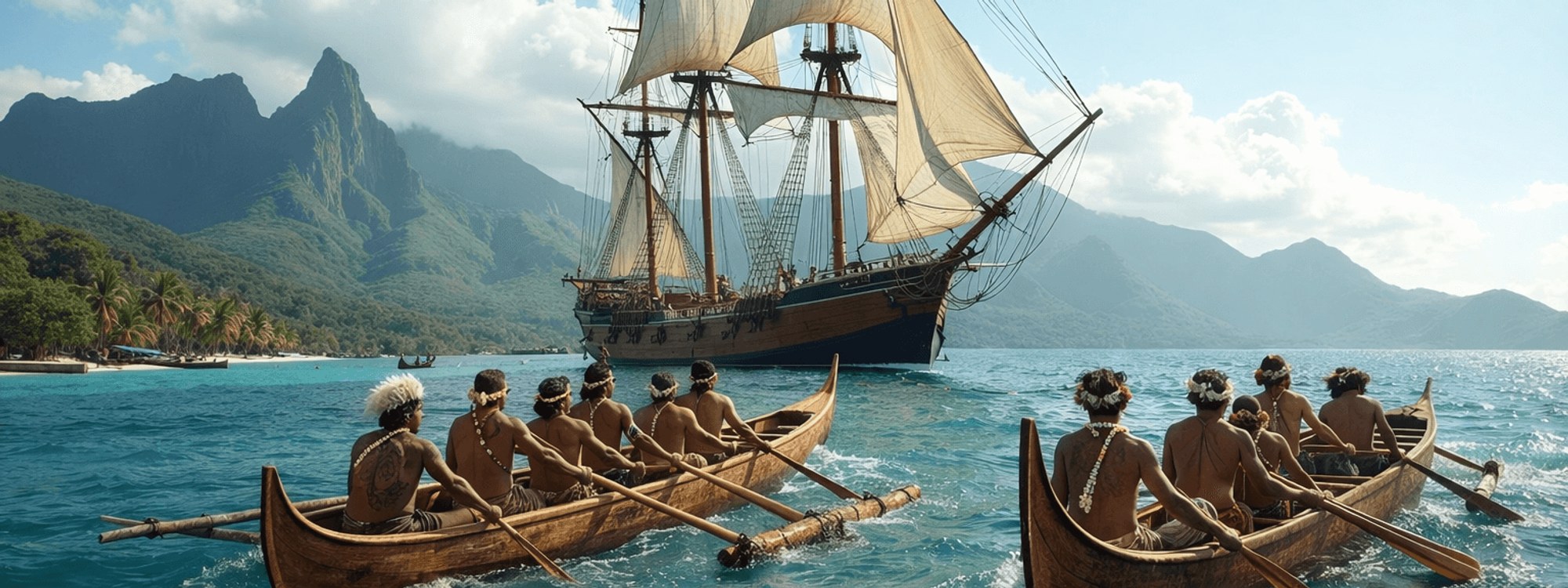
Each scene opens with a short summary. Under Read more is our retelling, then the words of the journals it is built from, and a note on what the records can and cannot tell us. The retelling is written by TLC Stories from James Cook’s journal, in W. J. L. Wharton’s edition of 1893, and the journal of Joseph Banks. It invents no words, thoughts or feelings: where it says what someone felt, it says whose journal reports it. Pictures marked AI-generated were made with AI.

This is a first look at chapters 1 to 3.

Follow one person:

  1. AI-generated

    Ch 1 · Green

    The quadrant is gone

    In this scene: 2 May 1769, Tahiti. The astronomical quadrant, brought ashore for the observatory only the day before, was missing from the fort. Charles Green and Joseph Banks followed the thief’s trail east through the woods and came back at sunset with the instrument.

    Charles Green was the astronomer sent out by the Royal Society to observe the Transit of Venus. The point of the observation, as Cook’s editor W. J. L. Wharton later explained, was to find the distance of the earth from the sun, which was then “very imperfectly known”.

    By 1 May the fort on the beach was finished, with banks of earth, a ditch, two four-pounders and six swivel guns. That afternoon the observatory was set up inside it, and the astronomical quadrant came ashore for the first time. It had never been taken out of its packing case since it came from Mr. Bird, its maker.

    The next morning, when Green and Cook went to set it up, the case was gone. A sentry had stood all night within five yards of the tent door, and nothing else was missing. Banks wrote that the loss “alarmd us all very much”.

    Banks went into the woods for news, and Tubourai, the Tahitian whom Cook called Toobouratomita, met him crossing the river. With three straws he made the shape of a triangle: the thief had opened the case. Green, Banks, a midshipman and Tubourai set off to the east, asking after the thief at every house. It was very hot; the thermometer at the tents had read 91 before they left. At the top of a hill about four miles out, Tubourai pointed to a place three miles further on.

    Their only arms were a pair of pocket pistols that Banks always carried. They sent the midshipman back to ask Cook for a party of men, and went on. At the place Tubourai had named, one of his own people came towards them with part of the quadrant in his hand, and some hundreds of people gathered round. The box was brought, and Green went over the instrument to see what was wanting. Several small things were, and the stand had been left behind, but nothing, Banks wrote, that could not easily be repaired. They packed it in grass and set off home, and about two miles on they met Cook coming after them with a party of marines.

    At the fort they found Tootaha, a chief, held in custody. Cook had left orders that he was not to be detained, for he had had no hand in the theft, and Cook had him set free at once.

    From the journals

    Cook’s Journal (Wharton), May 1769:

    “Tuesday, 2nd. This morning, about 9 o’Clock, when Mr. Green and I went to set up the Quadrant, it was not to be found. It had never been taken out of the Packing Case (which was about 18 Inches square) since it came from Mr. Bird, the Maker; and the whole was pretty heavy, so that it was a matter of Astonishment to us all how it could be taken away, as a Centinal stood the whole night within 5 Yards of the door of the Tent, where it was put, together with several other Instruments; but none of them was missing but this. However, it was not long before we got information that one of the Natives had taken it away and carried it to the Eastward. Immediately a resolution was taken to detain all the large Canoes that were in the Bay, and to seize upon Tootaha and some others of the principal people, and keep them in Custody until the Quadrant was produced; but this last we did not think proper immediately to put in Execution, as we had only Oberiea in our power, and the detaining of her by force would have alarm’d all the rest. In the meantime, Mr. Banks (who is always very alert upon all occasions wherein the Natives are concern’d) and Mr. Green went into the Woods to enquire of Toobouratomita which way and where the Quadrant was gone. I very soon was inform’d that these 3 was gone to the Eastward in quest of it, and some time after I followed myself with a small party of Men; but before I went away I gave orders that if Tootaha came either to the Ship or the Fort he was not to be detain’d, for I found he had no hand in taking away the Quadrant, and that there was almost a Certainty of getting it again. I met Mr. Banks and Mr. Green about 4 miles from the Fort, returning with the Quadrant.”

    Banks’s Journal, May 2, 1769:

    “About 10 this morn the astronomical quadrant which had been brought ashore yesterday was miss’d, a circumstance which alarmd us all very much. It had been laid in Captn Cook’s birth where no one slept, the telescopes were in my tent safe. Every place was searchd aboard and ashore but no such thing to be found. It appeard very improbable that the Indians could have carried so large a thing out of the tents without being observd by the sentries, our people might have stole [it] as it was packd up in a deal case and might by them be suppos’d to contain nails or some kind of traffick; a large reward was therefore offerd to any one who could find it and all hands sent out to search round the fort, upon a supposition that the Indians would immediately quit a prize that could be of so little use to them. In about an hour all returnd, no news of the Quadrant. I now went into the woods to get intelligence no longer doubting but that it was in the hands of the Indians. Tubourai met me crossing the river and immediately made with 3 straws in his hand the figure of a triangle: the Indians had opend the cases. No time was now to be lost; I made signs to him that he must instantly go with me to the place where it was, he agreed and out we set acompanied by a midshipman and Mr Green, we went to the Eastward. At every house we went past Tubourai enquird after the theif by name, the people readily told him which way he had gone and how long ago it was since he pass’d by, a circumstance which gave great hopes of coming up with him. The weather was excessive hot, the Thermometer before we left the tents up at 91 made our journey very tiresome. Sometimes we walk’d sometimes we ran when we imagind (which we sometimes did) that the chase was just before us till we arrivd at the top of a hill about 4 miles from the tents: from this place Tubourai shew’d us a point about 3 miles off and made us understand that we were not to expect the instrument till we got there. We now considerd our situation, no arms among us but a pair of pocket pistols which I always carried, going at least 7 miles from our fort where the Indians might not be quite so submissive as at home, going also to take from them a prize for which they had venturd their lives. All this considerd we thought it proper that while Mr Green and myself proceeded the midshipman should return and desire captn Cooke to send a party of men after us, telling him at the same time that it was impossible we could return till dark night. This done we proceeded and in the very spot Tubourai had mentiond were met by one of his own people bringing part of the Quadrant in his hand. We now stop’d and many Indians gatherd about us rather rudely, the sight of one of my pistols however instantly checkd them and they behav’d with all the order imaginable, tho we quickly had some hundreds surrounding a ring we had markd out on the grass. The box was now brought to us and some of the small matters such as reading glasses etc. which in their hurry they had put into a pistol case, this I knew belongd to me, it had been stole out of the tents with a horse pistol in it which I immediately demanded and had immediately restord. Mr Green began to overlook the Instrument to see if any part or parts were wanting, several small things were, and people were sent out in search of them some of which returnd and others did not; the stand was not there but that we were informd had been left behind by the theif and we should have it on our return, and answer which coming from Tubourai satisfied us very well; nothing else was wanting but what could easily be repaird so we pack’d all up in grass as well as we could and proceeded homewards. After walking about 2 miles we met Captn Cooke with a party of marines coming after us, all were you may imagine not a little pleasd at the event of our excursion.”

    What the records tell us

    No journal by Green is among our sources, so this scene rests on Cook’s and Banks’s journals; neither tells us what Green himself thought or said. The two accounts differ in small ways. Cook says he and Green went to set up the quadrant about 9 o’clock; Banks says it was missed about 10. Cook says he met the party about 4 miles from the fort; Banks, about 2 miles into their walk home.

  2. AI-generated

    Ch 1 · Cook

    Three places to watch from

    In this scene: 30 May to 2 June 1769, Tahiti. In case cloud hid the sun at the fort, Cook sent observers to two more places: Lieutenant Gore’s party, with Banks, to York Island, and Lieutenant Hicks’s party to the east of Tahiti.

    The transit was due on 3 June. Since they had come to the island, Banks noted, there had been as much cloudy weather as clear, and that made them all “not a little anxious for success”.

    Cook did not trust everything to one sky. On 30 May, he wrote, they were very busy preparing the instruments and teaching the gentlemen he meant to send to other places how to use them, “for fear we should fail here”. Banks says the plan followed hints from Lord Morton.

    The carpenters worked hard on the longboat. Banks wrote that her bottom had been eaten until it was like a honeycomb, some of the holes an eighth of an inch across, in six weeks. Late on 31 May they finished her.

    On 1 June Cook sent Lieutenant Gore off in her to York Island, with Dr. Monkhouse and Mr. Sporing, a gentleman of Banks’s party. Green had given them instruments. Banks and some of the Tahitians went too. Very early the next morning Lieutenant Hicks, Mr. Clark, Mr. Pickersgill and Mr. Saunders left in the pinnace for the east of the island, with orders to find a convenient place there and watch with their own instruments.

    Cook, Green and Dr. Solander would watch from the fort. If the sky failed them there, it might hold at one of the other places.

    From the journals

    Cook’s Journal (Wharton), May and June 1769:

    “Tuesday, 30th. We are now very buisey in preparing our Instruments, etc., for the Observations, and Instructing such Gentlemen in the use of them, as I intend to send to other parts to observe, for fear we should fail here.

    Wednesday, 31st. Late this Evening the Carpenters finished the Long boat.

    Thursday, June 1st. This day I sent Lieutenant Gore in the Long boat to York Island with Dr. Monkhouse and Mr. Sporing (a Gentleman belonging to Mr. Banks) to Observe the Transit of Venus, Mr. Green having furnished them with Instruments for that purpose. Mr. Banks and some of the Natives of this Island went along with them.

    Friday, 2nd. Very early this morning Lieutenant Hicks, Mr. Clark, Mr. Pickersgill and Mr. Saunders went away in the Pinnace to the Eastward, with orders to fix upon some Convenient situation upon this Island, and there to Observe the Transit of Venus, they being likewise provided with Instruments for that purpose.”

    Banks’s Journal, May 31, 1769:

    “The day of Observation now aproaches. The weather has been for some days fine, tho in general since we have been upon the Island we have had as much cloudy as clear weather, which makes us all not a little anxious for success. In consequence of hints from Lord Morton the Captn resolves to send a party to the eastward, and another to Imáo, an Island in sight of us, thinking that in case of thick weather one or the other might be more successfull than the observatory. The Carpenters work very hard to finish the long boat. I resolve to go on the Imáo expedition.”

    What the records tell us

    This scene rests on Cook’s journal, with Banks’s. Cook gives the reason for the extra parties in his own words; Banks adds that the idea followed hints from Lord Morton, and describes the longboat. Neither journal says where on the east of Tahiti Hicks’s party set up.

  3. AI-generated

    Ch 1 · Green

    A dusky shade

    In this scene: 3 June 1769, Tahiti. Not a cloud all day. Cook, Green and Solander watched Venus cross the sun from the fort, but a dusky shade around the planet blurred the moments of contact, and their times differed more than expected.

    On 3 June the day was as good as anyone could have wished. Not a cloud was to be seen the whole day, the air was perfectly clear, and it was nearly calm. In the middle of the day a thermometer set out in the sun rose to a heat they had not met before.

    Green, Cook and Dr. Solander each watched through a telescope. Green’s and Cook’s magnified the same amount; Solander’s magnified more. Their task was to time the moments of contact, when the planet met the edge of the sun.

    They saw the whole passage of Venus across the sun. But they also saw, very distinctly, what Cook called “an Atmosphere or Dusky shade” round the body of the planet. It disturbed the times of the contacts, the two inner ones most of all, and when the three compared their times they differed from one another much more than could be expected.

    So Green’s long-awaited day ended with a perfect sky, and times that did not agree as closely as the observers had hoped. When Banks came back from York Island the next evening, he heard that the observation had been attended “with as much success as Mr Green and the Captn could wish”.

    From the journals

    Cook’s Journal (Wharton), June 1769:

    “Saturday, 3rd. This day proved as favourable to our purpose as we could wish. Not a Cloud was to be seen the whole day, and the Air was perfectly Clear, so that we had every advantage we could desire in observing the whole of the Passage of the planet Venus over the Sun’s Disk. We very distinctly saw an Atmosphere or Dusky shade round the body of the planet, which very much disturbed the times of the Contact, particularly the two internal ones. Dr. Solander observed as well as Mr. Green and myself, and we differ’d from one another in Observing the times of the Contact much more than could be expected. Mr. Green’s Telescope and mine where of the same Magnifying power, but that of the Doctor was greater than ours. It was nearly calm the whole day, and the Thermometer Exposed to the Sun about the Middle of the day rose to a degree of heat we have not before met with.”

    Banks’s Journal, June 4, 1769:

    “This done we put off and before night arrivd at the tents, where we had the great satisfaction that the observation there had been attended with as much success as Mr Green and the Captn could wish, the day having been perfectly clear not so much as a cloud interveining.”

    What the records tell us

    No account by Green himself is among our sources: this scene rests on Cook’s journal, with one line from Banks. Cook does not say which of the three observers’ times was the best, and neither does Banks.

  4. AI-generated

    Ch 1 · Cook

    While everyone watched the sky

    In this scene: 3 and 4 June 1769, Tahiti. While the officers were ashore for the transit, some of the ship’s company broke into a storeroom and stole a large part of the spike nails. Archibald Wolf was caught with a few and given two dozen lashes.

    The transit day had a second story. While Cook, Green and Solander were at their telescopes, and, as Banks put it, every one with any degree of command was ashore, some of the ship’s company broke into one of the storerooms and carried off a large quantity of spike nails.

    Nails were what the voyage traded with. Cook bought fruit with beads and nails, never smaller than forty-penny ones, for a smaller nail was of no value to the islanders. Banks called iron “our staple commodity”, and he set down the danger plainly: nails passed round the island by the crew would much lessen its value.

    One thief was found, Archibald Wolf. On 4 June Cook had him punished with two dozen lashes. Some few nails were found on him; Banks says seven, out of a hundredweight, and that Wolf bore his punishment without naming any of his accomplices.

    That evening the gentlemen sent to watch the transit from the other places came back with success. Those who had gone to York Island had been well received by its people.

    From the journals

    Cook’s Journal (Wharton), June 1769:

    “Sunday, 4th. Punished Archd. Wolf with 2 Dozen lashes for Theft, having broken into one of the Storerooms and stol’n from thence a large quantity of Spike Nails; some few of them where found upon him. This evening the Gentlemen that were sent to observe the Transit of Venus, return’d with success; those that were sent to York Island were well received by the Natives. That Island appear’d to them not to be very fruitful.”

    Banks’s Journal, June 4, 1769:

    “We also heard the melancholy news that a large part of our stock of Nails had been purloind by some of the ships company during the time of the Observation, when every body was ashore who had any degree of comand. One of the theives was detected but only 7 nails were found upon him our of 100 Wt and he bore his punishment without impeaching any of his acomplices. This loss is of a very serious nature as these nails if circulated by the people among the Indians will much lessen the value of Iron, our staple commodity.”

    Cook’s Journal (Wharton), on leaving Tahiti, July 1769:

    “All sorts of Fruits we purchased with Beads and Nails, not less than 40-penny, for a nail under that size was of no value; …”

    What the records tell us

    This scene rests on Cook’s and Banks’s journals. Cook records the theft and the punishment, and that some few nails were found on Wolf. How many were found, how much was taken, and the fear for the value of iron come from Banks. Cook’s journal gives the name as “Archd. Wolf”.

  5. AI-generated

    Ch 2 · Banks

    Across to Imáo

    In this scene: 1 and 2 June 1769. Banks went with Lieutenant Gore’s party to Imáo, the island Cook called York Island. They rowed most of the night, chose a coral rock for their observatory, and by nightfall had the telescopes set up.

    Banks chose his own part in the transit. When Cook resolved to send a party to Imáo, an island in sight of Tahiti, Banks wrote: “I resolve to go on the Imáo expedition.”

    The boat could not be got ready until after dinner on 1 June. They rowed most of the night and came to a grapnel just under the land.

    Soon after daybreak they hailed a canoe, whose people showed them an inlet through the reef. Inside it they found a coral rock about 150 yards from the shore, some 80 yards long and 60 broad, with a bed of white sand in the middle large enough for their tents. It was, Banks thought, a very proper place for an observatory.

    While the second lieutenant, Mr. Gore, and the men set about it, Banks went over to the main island to trade, and soon bought a sufficient supply of food. Before night the observatory was in order, with the telescopes set up and tried. The evening had been very fine, and they went to rest, in Banks’s words, “anxious for the events of tomorrow”.

    From the journals

    Banks’s Journal, May 31, 1769:

    “In consequence of hints from Lord Morton the Captn resolves to send a party to the eastward, and another to Imáo, an Island in sight of us, thinking that in case of thick weather one or the other might be more successfull than the observatory. The Carpenters work very hard to finish the long boat. I resolve to go on the Imáo expedition.”

    Banks’s Journal, June 1 and 2, 1769:

    “The boat could not be got ready till after dinner when we set out; we rowd most of the night and came to a grapling just under the land of Imáo.

    Soon after day break we saw an Indian canoe and upon hailing her she shewed us an inlet through the reef, into [which] we pulld and soon fixd upon a Coral rock about 150 yards from the shore as a very proper situation for our Observatory; it was about 80 yards long and 60 broad and had in the middle of it a bed of white sand large enough for our tents to stand upon. The 2nd Lieutent and people therefore immediately set about it while I went upon the main Island to trade with the inhabitants for provisions, of which I soon bought a sufficient supply. Before night our observatory was in order, telescopes all set up and tried etc. and we went to rest anxious for the events of tomorrow; the evening having been very fine gave us however great hopes of success.”

    What the records tell us

    This chapter rests on Banks’s journal. Cook calls the island York Island; Banks uses its own name, Imáo. Cook’s editor Wharton notes it as Eimeo; today it is Moorea. The observers here were Mr. Gore and Dr. Monkhouse, whose own records are not among our sources.

  6. AI-generated

    Ch 2 · Banks

    A seat made from a turban

    In this scene: 3 June 1769, Imáo. While Mr. Gore and Dr. Monkhouse watched the transit, Banks traded on the island and received its king, Tarroa, and his sister Nuna. He seated them on his own turban, then took them to the observatory to see Venus on the sun.

    Through the night one or another of them got up every half hour to report on the sky, clear or hazy. At daybreak they rose and saw the sun come up, Banks wrote, “as clear and bright as we could wish him”.

    Banks wished success to the observers, Mr. Gore and Dr. Monkhouse, and went over to the island, where he could do what he called “the double service”: examining what the island produced, and buying food for his companions.

    About eight o’clock two boats came towards the place where he traded. They belonged to Tarroa, the king of the island, who was coming to visit him. The people formed a lane, and Tarroa landed with his sister Nuna. Banks went out and met them and brought them very formally into a circle he had made, which he had let none of the islanders enter before. Standing was not the fashion among these people, so he had to find them a seat: he unwrapped the turban of Indian cloth he wore instead of a hat, spread it on the ground, and they all sat down on it.

    The king’s present was a hog, a dog and a quantity of breadfruit and coconuts. Banks sent to the observatory for his own: an adze, a shirt and some beads, with which the king seemed well satisfied.

    After the first internal contact, Banks took Tarroa, Nuna and some of their chief attendants to the observatory. There, he wrote, “we shewd the planet upon the sun and made them understand that we came on purpose to see it.”

    He spent the rest of the day on the island. Its produce was very like Tahiti’s, and among its people he saw many of the very same faces he had often seen there.

    From the journals

    Banks’s Journal, June 3, 1769:

    “Various were the Changes observd in the weather during the course of last night, some one or other of us was up every half hour who constantly informd the rest that it was either clear or Hazey, at day break we rose and soon after had the satisfaction of seeing the sun rise as clear and bright as we could wish him. I then wishd success to the observers Msrs Gore and Monkhouse and repaird to the Island, where I could do the double service of examining the natural produce and buying provisions for my companions who were engagd in so usefull a work. About eight a large quantity of provisions were procurd when I saw two boats coming towards the place where I traded; these I was told belongd to Tarróa the King of the Island who was coming to pay me a visit. As soon as the boats came near the shore the people formd a lane; he landed bringing with him his sister Nuna and both came towards the tree under which I stood. I went out and met them and brought them very formaly into a circle I had made, into which I had before sufferd none of the natives to come. Standing is not the fashion among these people, I must provide them a seat,, which I did by unwrapping a turban of Indian cloth which I wore instead of a hat and spreading it upon the ground; upon which we all sat down and the kings present was brought Consisting of a hog, a dog and a quantity of Bread fruit Cocoa nuts etc. I immediately sent a canoe to the Observatory to fetch my present, an adze a shirt and some beads with which his majesty seemd well satisfied. Tubourai and Tamio who came with us now came from the observatory; she said that she was related to Tarroa and brought him a present, a long nail and a shirt, which she gave to Nuna. After the first Internal contact was over I went to my Companions at the observatory carrying with me Tarroa, Nuna and some of their cheif atendants; to them we shewd the planet upon the sun and made them understand that we came on purpose to see it. After this they went back and myself with them. I spent the rest of the day in examining the produce etc. of the Island and found it very nearly similar to that of Otahite, the people exactly the same, indeed we saw many of the Identical same people as we had often seen at Otahite, and every one knew well every kind of trade we had and the value it bore in that Island.”

    What the records tell us

    This scene rests on Banks’s journal. Banks does not say what Tarroa and Nuna made of the sight of Venus on the sun, only that they were shown it and made to understand why the visitors had come. The picture shows an adze of the kind Banks gave; it was made with AI.

  7. AI-generated

    Ch 2 · Banks

    News at the tents

    In this scene: 4 June 1769. Banks’s party gave away the food they could not use and returned to Tahiti. At the tents they heard the news: the observation at the fort had gone as well as anyone could wish, and nails had been stolen while it was made.

    On 4 June they prepared to leave. What with presents and trade, they had so much food that they had to give a large quantity away. Before night they were back at the tents on Tahiti.

    There Banks heard the news from the fort. The observation had gone as well as Mr. Green and the captain could wish: the day had been perfectly clear, without so much as a cloud.

    The other news was bad. During the observation, while every one with any degree of command was ashore, some of the ship’s company had stolen a large part of the stock of nails. Banks set down why it mattered: passed round among the islanders, the nails would much lessen the value of iron.

    Three parties had watched the same sky from three places. Banks had spent his day with a king and his sister, a turban for a seat, and, at sunset, another hog bought from the king.

    From the journals

    Banks’s Journal, June 4, 1769:

    “What with presents and trade our stock of Provisions was so large that we were obligd to give away a large quantity. This done we put off and before night arrivd at the tents, where we had the great satisfaction that the observation there had been attended with as much success as Mr Green and the Captn could wish, the day having been perfectly clear not so much as a cloud interveining. We also heard the melancholy news that a large part of our stock of Nails had been purloind by some of the ships company during the time of the Observation, when every body was ashore who had any degree of comand. One of the theives was detected but only 7 nails were found upon him our of 100 Wt and he bore his punishment without impeaching any of his acomplices. This loss is of a very serious nature as these nails if circulated by the people among the Indians will much lessen the value of Iron, our staple commodity.”

    What the records tell us

    This scene rests on Banks’s journal. Cook records the same evening in one line: the parties came back with success, and those at York Island were well received by the islanders.

  8. AI-generated

    Ch 3 · Banks

    Banks takes Tupia

    In this scene: 12 July 1769, Tahiti. Tupia, a chief and priest who knew the islands and how to sail among them, came aboard resolved to go to England. Banks wrote that Cook would not take him on his own account, so Banks resolved to take him himself.

    Tupia had been with the English for most of their three months on Tahiti. On 12 July he came on board, Banks wrote, having renewed his resolve to go with them to England.

    Banks thought him “a most proper man”: well born, a chief priest of the island, and skilled in the mysteries of its religion. What made him most desirable, Banks wrote, was his experience in the navigation of his people and his knowledge of the islands in these seas. He had told them the names of more than seventy islands, and had been to most of them himself.

    The captain, Banks wrote, refused to take Tupia on his own account, sensibly enough in Banks’s opinion, since the government would in all probability never take any notice of him. So Banks resolved to take him. He had the means, he wrote, and put his reasons this way: “I do not know why I may not keep him as a curiosity, as well as some of my neighbours do lions and tygers at a larger expence than he will probably ever put me to”. He also looked forward to Tupia’s conversation, and to the benefit he would be to the ship.

    Tupia went ashore to say goodbye to his friends, taking a miniature picture of Banks to show them and small parting presents. In the evening he came back in the boat with Banks’s party and took up his lodging on board for the first time.

    From the journals

    Banks’s Journal, July 12, 1769:

    “This morn Tupia came on board, he had renewd his resolves of going with us to England, a circumstance which gives me much satisfaction. He is certainly a most proper man, well born, cheif Tahowa or preist of this Island, consequently skilld in the mysteries of their religion; but what makes him more than any thing else desireable is his experience in the navigation of these people and knowledge of the Islands in these seas; he has told us the names of above 70, the most of which he has himself been at. The Captn refuses to take him on his own account, in my opinion sensibly enough, the goverment will never in all human probability take any notice of him; I therefore have resolvd to take him. Thank heaven I have a sufficiency and I do not know why I may not keep him as a curiosity, as well as some of my neighbours do lions and tygers at a larger expence than he will probably ever put me to; the amusement I shall have in his future conversation and the benefit he will be of to this ship, as well as what he may be if another should be sent into these seas, will I think fully repay me. As soon as he had made his mind known he said that he would go ashore and return in the evening, when he would make a signal for a boat to be sent off for him; he took with him a miniature picture of mine to shew his freinds and several little things to give them as parting presents. After dinner we went ashore to the Marai no Dootahah of which I was desirous to have a drawing made and had not yet done it. We no sooner landed than several of our freinds, those who were not totaly afronted at the imprisonment of the day before yesterday, came to meet us; we proceeded with them to Dootahahs house where was Oborea etc. They were glad to see us and a perfect reconciliation ensued, in consequence of which they promisd to visit us tomorrow morning to take their leave of us, as we told them that we should sail before noon. With them was Tupia who most willingly returnd in the boat with us aboard the ship where he took up his lodgins for the first time.”

    What the records tell us

    This scene rests on Banks’s journal, and the words about keeping Tupia “as a curiosity” are Banks’s own. Cook tells the decision differently (see the next scene). Tupia left no written account, so his own reasons for going are known only through what Banks reports.

  9. AI-generated

    Ch 3 · Cook

    The likeliest person

    In this scene: 13 July 1769. As the Endeavour left Tahiti, Cook set down in his journal why Tupia was on board: he knew more about the islands, their people and their customs than anyone they had met.

    Cook closed his account of Tahiti on 13 July, the day they sailed after a stay of just three months. In it he set down why Tupia was coming with them.

    For some time, he wrote, several of the islanders had been offering every day to go away with the ship, and it was thought they would be of use in future discoveries. The one chosen was Tupia, a chief and a priest. He had been with them most of their time on the island, and Cook found him “a very intelligent person”, who knew more of the geography of the islands in these seas, their produce, and the religion, laws and customs of their people than anyone they had met. He was “the likeliest person to answer our Purpose”.

    So, Cook wrote, “For these reasons, and at the request of Mr. Banks”, he received Tupia on board, together with a young boy, his servant.

    Cook had already begun to learn from him. Tupia and several others had given an account of more than seventy islands, but their positions were so vague that Cook put off listing them until he had learnt from Tupia where each one lay. Four of them, they were told, Huaheine, Ulietea, Otaha and Bolabola, lay only one or two days’ sail to the west, where hogs, fowls and other food could be had. The ship sailed for them, partly to give a crew in poor health a little time to recover.

    From the journals

    Cook’s Journal (Wharton), July 1769:

    “For some time before we left this Island several of the Natives were daily offering themselves to go away with us; and as it was thought they must be of use to us in our future discoveries we resolved to bring away one whose name is Tupia, a Chief and a Priest. This man had been with us most part of the time we had been upon the Island, which gave us an opportunity to know something of him. We found him to be a very intelligent person, and to know more of the Geography of the Islands situated in these Seas, their produce, and the religion, laws, and Customs of the inhabitants, than any one we had met with, and was the likeliest person to answer our Purpose. For these reasons, and at the request of Mr. Banks, I received him on board, together with a young Boy, his Servant.”

    Cook’s Journal (Wharton), on Tahiti, July 1769:

    “I have before hinted that these People have an Extensive knowledge of the Islands situated in these Seas. Tupia, as well as several others, hath given us an account of upwards of 70; but, as the account they have given of their situation is so Vague and uncertain, I shall refer giving a list of them until I have learnt from Tupia the Situation of each island with a little more certainty. Four of these islands—viz., Huaheine, Ulietea, Otaha, and Bolabola—we were informed, lay only one or two days’ sail to the Westward of George’s Island, and that we might there procure Hogs, Fowls, and other refreshments, Articles that we have been very sparingly supply’d with at this last Island, as the Ship’s Company (what from the Constant hard duty they have had at this place, and the two free use of Woman) were in a worse state of health than they were on our first arrival, for by this Time full half of them had got the Venerial disease, in which Situation I thought they would be ill able to stand the Cold weather we might expect to meet with to the Southward at this Season of the Year, and therefore resolved to give them a little time to recover while we ran down to and explored the Islands before-mentioned.”

    What the records tell us

    This scene rests on Cook’s journal. Banks remembers the decision differently: he says Cook refused to take Tupia on his own account, and that Banks took him. The journals do not settle which account is right. Cook’s editor Wharton adds that Tupia later proved of the utmost service as an interpreter in New Zealand.

  10. AI-generated

    Ch 3 · Tupia

    From the topmast head

    In this scene: 13 July 1769. The Endeavour sailed from Tahiti with friends weeping alongside. Tupia held to his decision; Banks saw him shed a few tears he tried to hide. Then he and Banks climbed to the topmast head to wave to the canoes.

    About ten in the morning on 13 July the Endeavour sailed from Tahiti. Many of their nearest friends came on board at the last, Oborea among them, and took their leave, Banks wrote, “tenderly enough”, with plenty of tears. Around the ship, canoes full of people shouted out their lamentations.

    Tupia, after all his struggles, stood firm in his resolve to go with them. Banks saw him part with a few tears, and judged them to be heartfelt by the efforts he saw Tupia make to hide them. Tupia sent a last present ashore, a shirt for Potamai, Dootahah’s favourite mistress. Then he and Banks went up to the topmast head and stood there a long time, waving to the canoes as they went off. When he came down, Banks wrote, he showed no further signs of seriousness or concern.

    In the evening the island of Tethuroa came into sight. Tupia said that no one lived there for good, only people from Tahiti who went there for a few days to fish, so they did not stop. Instead they stood on in search of Urietea, which Tupia described as a well peopled island as large as Tahiti.

    From the journals

    Banks’s Journal, July 13, 1769:

    “About 10 this morn saild From Otahite leaving our freinds Some of them at least I realy beleive personaly sorry for our departure, notwisthstanding the confinement of the day before yesterday had frigh[t]ned and affronted them as much as possible, yet our nearest freinds came on board at this Critical time except only Tubourai and Tamio. We had Oborea, Otheothea, Tayoa, Nuna, Tuanna Matte, Potattou, Polotheara etc. on board when the anchor was weighd; they took their leaves tenderly enough, not without plenty of tears tho intirely without that clamourous weeping made use of by the other Indians, several boats of whoom were about the ship shouting out their lamentations, as vyeing with each other not who should cry most but who should cry loudest—a custom we had often condemned in conversation with our particular freinds as savouring more of affected than real greif.

    Tupia who after all his struggles stood firm at last in his resolution of acompanying us parted with a few heartfelt tears, so I judge them to have been by the Efforts I saw him make use of to hide them. He sent by Otheothea his last present, a shirt to Potamai, Dootahah’s favourite mistress. He and I went then to the topmast head where we stood a long time waving to the Canoes as they went off, after which he came down and shewd no farther signs of seriousness or concern.

    In the Evening Tethuroa in sight; before night it appears clearly to be a very low Island and but small, which with Tupias declaring that there were no fixd inhabitants upon it only the people of Otahite who went there for a few days to fish, determind us to content ourselves with what we had seen and stand on in search of Urietea, which he describd to be a well peopled Island as large as Otahite.”

    What the records tell us

    Tupia left no account of his own. Every feeling in this scene is Banks’s reading of him, and Banks says so: he judged the tears heartfelt from the efforts he saw Tupia make to hide them.

  11. AI-generated

    Ch 3 · Tupia

    A prayer for wind

    In this scene: 14 and 15 July 1769. Tupia named the islands coming into view, Huahine and Ulhietea. Becalmed, he prayed to Tane for wind. Banks, watching, believed he waited until he saw a breeze coming before he began.

    Before noon on 14 July two islands came into sight ahead, high and large. Tupia named them: Huahine and Ulhietea.

    Then the wind failed. It was calm all night, and the next morning so hazy that no land could be seen, with light breezes and calms following each other.

    Tupia often prayed to Tane for a wind, and as often boasted to Banks of the success of his prayers. Banks was not convinced. He wrote that he “plainly saw” Tupia never began a prayer until he saw a breeze so near the ship that it generally reached her before the prayer was finished.

    At sunset a pleasant breeze came, and both islands could be seen very plainly.

    From the journals

    Banks’s Journal, July 14 and 15, 1769:

    “Before Noon today two Islands are in sight which Tupia calls Huahine and Ulhietea, both of them make high and large.

    Calm all last night, this morn hazey so that no land is seen; light breezes and calms succeeding each other all morn. Our Indian often prayd to Tane for a wind and as often boasted to me of the success of his prayers, which I plainly saw he never began till he saw a breeze so near the ship that it generaly reachd her before his prayer was finishd. At sunset a pleasant breeze. Owahine and Ulhietea very plainly seen.”

    What the records tell us

    This scene rests on Banks’s journal, and the view that Tupia timed his prayers to the breeze is Banks’s own. What the prayers meant to Tupia is not in any of our sources. Banks spells the islands Huahine and Ulhietea; Cook writes Huaheine and Ulietea.

  12. AI-generated

    Ch 3 · Tupia

    Making peace at Huaheine

    In this scene: 16 July 1769, Huaheine. The islanders were shy until they saw Tupia, then came aboard. Ashore, Tupia stripped to the waist and made a long prayer with gifts, two chiefs answered him, and the people gave the visitors a hog for their god.

    On 16 July the Endeavour came close in to Huaheine. Some of the people came off in canoes but were very shy of coming near, Cook wrote, until they saw Tupia; after that they came on board without hesitation. Among them was the king of the island, Oree, who soon exchanged names with Cook.

    That afternoon the ship anchored in a small harbour the people called Owarhe, and Cook went ashore with Banks, Solander, Monkhouse, Tupia, Oree and others. The moment they landed, Tupia stripped himself to the waist and asked Mr. Monkhouse to do the same. He sat down before a great number of people gathered in a large shed, with the rest of the visitors standing behind him at his own wish, and began a long speech or prayer that lasted nearly a quarter of an hour.

    As he spoke he presented two handkerchiefs, a black silk neckcloth, some beads and two very small bunches of feathers, which he had got ready for the purpose. Two chiefs answered him from the other side and gave young plantain plants and two small bunches of feathers in return. Cook understood that Tupia’s gifts were for the god of this people, for in return they gave the visitors a hog and some coconuts for their own god.

    Then everyone was free to go where they pleased, and the first thing Tupia did was to make his offerings at one of the Mories. Cook took it to be the custom whenever one of these peoples landed peacefully in another’s territory. As for the hog, Cook wrote that the islanders had “drawn us in to commit sacriledge”: it was already sentenced to death, and was to be dissected the next day.

    From the journals

    Cook’s Journal (Wharton), July 1769:

    “Sunday, 16th. Winds at South and South-South-East. A Gentle Breeze, with some few showers of rain. At 6 p.m. the Island of Huaheine West 1/2 South, distant 7 or 8 leagues. At 8 a.m., being close in with the North-West part of the Island, sounded, but had no ground with 80 fathoms. Some of the Natives came off to the Ship, but they were very shy of coming near until they discover’d Tupia; but after that they came on board without hesitation. Among those who came on board was the King of the Island, whose name is Oree. He had not been long on board before he and I exchanged Names, and we afterwards address’d each other accordingly.”

    Cook’s Journal (Wharton), July 1769:

    “Monday, 17th. Winds Southerly, fine pleasant weather. At 3 p.m. anchored in a small Harbour on the West side of the Island called by the Natives Owarhe, in 18 fathoms water, clear ground, and secure from all winds. Soon after, I went on shore, accompanied by Mr. Banks, Dr. Solander, and Dr. Monkhouse, Tupia, the King of the Island, and some others of the Natives, who had been on board since the morning. The Moment we landed Tupia stripped himself as low as his waist, and desir’d Mr. Monkhouse to do the same. He then sat down before a great number of the Natives that were collected together in a large Shed or House, the rest of us, by his own desire, standing behind; he then begun a long speach or prayer, which lasted near a Quarter of an Hour, and in the Course of this Speech presented to the People two Handkerchiefs, a black silk Neckcloth, some beads, and two very small bunches of Feathers. These things he had before provided for that purpose. At the same time two Chiefs spoke on the other side in answer to Tupia, as I suppose, in behalf of the People, and presented us with some young Plantains plants, and 2 small bunches of Feathers. These were by Tupia order’d to be carried on board the Ship. After the Peace was thus concluded and ratified, every one was at liberty to go where he pleased, and the first thing Tupia did was to go and pay his Oblations at one of the Mories. This seem’d to be a common ceremony with this people, and I suppose always perform’d upon landing on each other’s Territories in a peaceable manner. It further appear’d that the things which Tupia gave away was for the God of this People, as they gave us a Hog and some Cocoanuts for our God, and thus they have certainly drawn us in to commit sacriledge, for the Hog hath already received sentence of Death, and is to be dissected to-morrow.”

    Banks’s Journal, July 16, 1769:

    “Soon after dinner we came to an anchor in a very fine bay calld by the natives Owalla and immediately went ashore. As soon as we landed Tupia squatted down on the ground and ranging us on one side and the Indians on the other began to pray, our cheif who stood opposite to him answering him in kind of responses. This lasted about a quarter of an hour in which time he sent at different intervals two hankercheifs and some beads he had prepard for the purpose as presents to Eatua; these were sent among many messages which pass’d backwards and forwards with plantains, malapoides etc. In return for this present to the gods which it seems was very acceptable we had a hog given for our Eatua, which in this case will certainly be our bellys.”

    What the records tell us

    This scene rests on Cook’s journal, with Banks’s. Banks dates the landing 16 July, and so does the inscribed plate Cook gave Oree before sailing; Cook’s journal enters it under Monday, 17th. Tupia left no account, so what his prayer said is not known. Cook supposed the two chiefs who answered were speaking for the people.

  13. AI-generated

    Ch 3 · Tupia

    Ulietea (Raiatea)

    In this scene: 20 July 1769, Ulietea. Tupia warned that the warriors of Bolabola, who had conquered the island, would come to fight the next day, so the party went ashore at once. Tupia repeated his ceremony, and Cook raised an English jack and took possession.

    Tupia had described this island to them before they ever saw it, as a well peopled island as large as Tahiti. When they found an opening in the reef, it was Tupia who said there was a good harbour inside, and on 20 July the ship anchored there.

    Some people came off in two canoes, showing signs of fear, each canoe bringing a woman and a pig as a present. Tupia had a warning. He had always shown much fear of the men of Bolabola, Banks wrote, and he now said that they had conquered this island and would come down the next day to fight. So the party lost no time in going ashore while the day was still their own.

    On landing, Tupia repeated his ceremony of prayer, as at Huaheine. Then Cook hoisted an English jack and took possession of this island and those near it in the name of His Britannick Majesty, calling them by the same names as their people did. Banks names them: Ulhietea, Huahine, Otahah and Bola Bola.

    Afterwards they walked together to a great marai called Tapodeboatea, its walls about eight feet high and built of coral stones, some of immense size. Near it stood an altar with the last sacrifice upon it, a hog of about 80 pounds roasted whole. In a long house nearby was the model of a canoe with eight human jawbones tied to it. Tupia told them it was the custom of these islanders to cut off the jawbones of those they had killed in war, and that these were the jawbones of Ulietea people. How they came to be there, Banks wrote, they could not understand.

    Banks also put his hand into one of the god houses that were carried on poles, and tore at the mats inside until he could go no further. What he had already done, he admitted, gave much offence to their new friends.

    From the journals

    Banks’s Journal, July 20, 1769:

    “At noon today come to an anchor at Ulhietea in a bay Calld by the natives Oapoa, the entrance of which is very near a small Islet Calld Owhattera. Some Indians soon came on board expressing signs of fear, they were two Canoes each of which brought a woman, I suppose as a mark of confidence, and a pig as a present. To each of these ladies was given a spike nail and some beads with which they seemd much pleasd. Tupia who has always expressd much fear of the men of Bola Bola says that they have conquerd this Island and will tomorrow come down and fight with us, we therefore lose no time in going ashore as we are to have today to ourselves. On landing Tupia repeated the ceremony of praying as at Huahine after which an English Jack was set up on shore and Captn Cooke took possession of this and the other three Islands in sight viz. Huahine Otahah and Bola Bola for the use of his Britannick majesty. After this we walk together to a great Marai calld Tapodeboatea whatever that may signifie; it is different from those of Otahite being no more than walls about 8 feet high of Coral Stones (some of an immense size) filld up with smaller ones, the whole ornamented with many planks set upon their ends and carvd their whole lengh. In the neighbourhood of this we found the altar or ewhatta upon which lay the last sacrafice, a hog of about 80 pounds weight which had been put up there whole and very nicely roasted. Here were also 4 or 5 Ewharre no Eatua or god houses which were made to be carried on poles. One of these I examind by putting my hand into it: within was a parsel about 5 feet long and one thick wrappd up in matts, these I tore with my fingers till I came to a covering of mat made of platted Cocoa nut fibres which it was impossible to get through so I was obligd to desist, especialy as what I had already done gave much offence to our new freinds.”

    Cook’s Journal (Wharton), July 1769:

    “At 1 p.m. I landed in Company with Mr. Banks and the other gentlemen. The first thing done was the performing of Tupia’s ceremony in all respects as at Huaheine. I then hoisted an English jack, and took possession of the Island and those adjacent in the name of His Britannick Majesty, calling them by the same names as the natives do.”

    What the records tell us

    This scene rests on Banks’s and Cook’s journals. Banks dates the landing 20 July; Cook enters it under Friday, 21st, at 1 p.m. Tupia left no account of the day, so his fear of the men of Bolabola is known only through Banks. Ulietea is Cook’s spelling; today the island is Raiatea.