
Skip to content

Warplanes Through Time

Dated timeline · 128 events

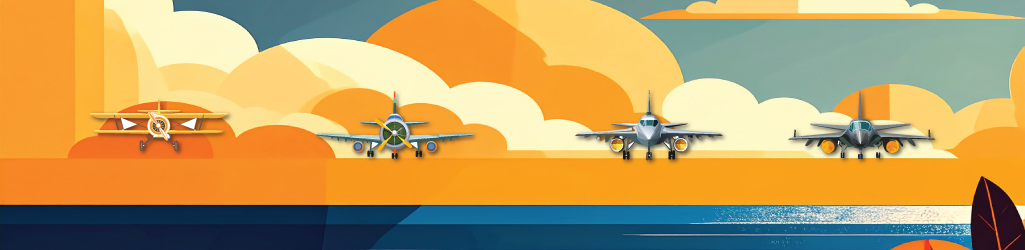
From the fragile biplanes of World War I to today’s supersonic stealth jets, Warplanes Through Time traces the dramatic evolution of military aviation. This timeline explores the technological innovations, pivotal conflicts, and iconic aircraft that reshaped the skies—and the course of history. Follow the journey of air power as it transforms from canvas and wood to radar-defying machines of modern warfare.

Order:
  1. April 1914

    The Morane-Saulnier Type N

    First Flight: April 1914

    Country of Origin: France

    The Morane-Saulnier Type N was one of the earliest attempts at designing a purpose-built fighter aircraft. Nicknamed the “Bullet” for its streamlined, cigar-shaped fuselage, it was fast and agile but difficult to fly, especially for inexperienced pilots. Armed with a forward-firing machine gun and metal deflectors on the propeller, it represented France’s effort to counter the threat of the German Eindecker. Though never deployed in large numbers, it marked a bold step in the evolution of fighter design.

    Note: Its advanced aerodynamics made it one of the fastest fighters of its day — but its tricky handling earned it a reputation as unforgiving in combat. []

  2. May 1914

    The Morane-Saulnier Type L

    First Flight: May 1914

    Country of Origin: France

    The Morane-Saulnier Type L was a pioneering parasol-wing monoplane used in the early stages of World War I. Though designed as a reconnaissance aircraft, it became one of the first to carry a forward-firing machine gun. This innovation marked a turning point in aerial combat, as it introduced the concept of the fighter plane. Its simplicity and speed made it a valuable asset for the French and British forces.

    Note: French pilot Roland Garros famously mounted a machine gun on a Type L with metal deflectors on the propeller — a crude but historic step toward synchronized gunfire. []

  3. May 1914

    The Royal Aircraft Factory B.E.2c

    First Flight: May 1914

    Country of Origin: United Kingdom

    The B.E.2c was a stable, two-seat reconnaissance biplane designed for observation and artillery spotting. Though praised early in the war for its steady flight characteristics, it was poorly suited to the evolving demands of air combat. By 1915–1916, it became dangerously outdated, especially when faced with faster, more agile German fighters. Its continued use during the “Fokker Scourge” period made it a symbol of British vulnerability in the air.

    Note: German pilots nicknamed it “Fokker Fodder” due to its sluggish handling and lack of effective armament — a grim reflection of how quickly aerial warfare was evolving. []

  4. June 1914

    The Nieuport 10

    Country of Origin: France

    First Flight: Mid-1914

    The Nieuport 10 was a sesquiplane developed just before World War I. Originally built for reconnaissance with two seats, its performance quickly led to a conversion into a single-seat fighter. Its agility and lightweight design gave Allied pilots an edge in early dogfights and influenced future fighter aircraft.

    Note: The success of the Nieuport 10 led to the creation of the legendary Nieuport 11 “Bébé,” a key player in regaining air superiority. []

  5. 1915

    The SPAD A.2

    First Flight: 1915

    Country of Origin: France

    The SPAD A.2 was a strange and short-lived attempt at solving the problem of forward-firing guns before interrupter gear existed. It featured a nacelle-mounted gunner placed in front of the propeller on a strut-supported pod, making for a truly precarious position. While the concept allowed a clear field of fire, the design had poor aerodynamics and made communication between pilot and gunner nearly impossible.

    Note: The aircraft’s odd appearance and awkward configuration earned it the unofficial title “the world’s first flying coffin” — and not without reason. []

  6. May 1915

    The Fokker Eindecker III (E.III)

    First Flight: May 1915

    Country of Origin: German Empire

    The Fokker Eindecker E.III was the most refined version of the first true fighter aircraft to enter service: a monoplane equipped with a synchronized machine gun that could fire through the propeller arc. Its arrival gave the German air force temporary air superiority during what became known as the “Fokker Scourge.” While its performance was modest by later standards, its revolutionary armament and role in shaping aerial warfare were unmatched in its time.

    Note: The E.III’s synchronized machine gun, controlled by an interrupter gear, allowed pilots to aim and shoot simply by pointing the aircraft — a revolutionary leap in air combat. []

  7. June 1915

    The Airco DH.2

    First Flight: June 1915

    Country of Origin: United Kingdom

    The Airco DH.2 was a single-seat pusher biplane designed to restore air superiority to the Allies in response to the Fokker Eindecker. Its rear-mounted engine allowed a forward-firing machine gun without the need for synchronization gear. Although its open framework and pusher configuration made it vulnerable and eventually outdated, the DH.2 was instrumental in ending the Fokker Scourge and shifting the balance of power in the air during early 1916.

    Note: The DH.2 was the aircraft flown by ace Lanoe Hawker, Britain’s first Victoria Cross recipient for aerial combat — he was later shot down by the Red Baron himself. []

  8. December 1915

    The Halberstadt D.II/D.III

    First Flight: Late 1915

    Country of Origin: German Empire

    The Halberstadt D.II, and its closely related D.III variant, were among the first German biplanes specifically built as single-seat fighters. Entering service in early 1916, they were a major improvement over earlier monoplane designs, offering better climb rate, maneuverability, and structural reliability. Though soon overshadowed by more advanced fighters, the Halberstadt biplanes marked a critical step in Germany’s shift to purpose-built fighter aircraft during World War I.

    Note: The Halberstadt fighters were the first to be issued in significant numbers to the newly formed Jagdstaffeln (fighter squadrons), laying the groundwork for Germany’s famed air combat units. []

  9. December 1915

    The Sopwith 1½ Strutter

    First Flight: December 1915

    Country of Origin: United Kingdom

    The Sopwith 1½ Strutter was a British two-seat biplane that served in a variety of roles including fighter, bomber, and reconnaissance. It was the first British aircraft equipped with a synchronized forward-firing machine gun, and its name came from its distinctive “one-and-a-half” set of cabane struts. The Strutter was also notable for being the first British plane designed with a rear gunner position, giving it a defensive edge. It served with the Royal Flying Corps, Royal Naval Air Service, and even in French squadrons.

    Note: The Sopwith 1½ Strutter was the first British aircraft to feature a synchronized machine gun — a major step forward in aerial armament. []

  10. 1916

    The Nieuport 17

    First Flight: January 1916

    Country of Origin: France

    The Nieuport 17 was a highly successful French sesquiplane fighter, admired for its superb agility, climb rate, and visibility. A development of the earlier Nieuport 11, it quickly became a favorite among Allied aces and was used by France, Britain, Belgium, Italy, and even Russia. It was armed with a synchronized Vickers machine gun and featured excellent handling, making it a dominant force in the air during 1916–1917. Its design would go on to influence fighter development well into the war.

    Note: Famous aces like Albert Ball and Charles Nungesser flew the Nieuport 17 — and it inspired German engineers to develop their own superior fighters in response. []

  11. 1916

    The Anatra Anasal

    First Flight: 1916

    Country of Origin: Russian Empire

    The Anatra Anasal, also known as the Anatra D, was a two-seat reconnaissance and light bomber biplane developed during World War I. Built in Odessa by the Anatra company, it featured a wooden structure and a Salmson radial engine — giving rise to the name “Anasal.” Though not produced in large numbers, it played a role in reconnaissance, artillery spotting, and occasional bombing missions. Its performance was modest, but it filled a much-needed gap in Russia’s limited aviation capabilities during the war.

    Note: The Anasal was one of the few domestically produced Russian aircraft to see frontline use — a significant feat considering Russia’s reliance on foreign aircraft imports at the time. []

  12. April 1916

    The Spad S.VII

    First Flight: April 1916

    Country of Origin: France

    The SPAD S.VII was a rugged, fast, and reliable fighter that marked France’s shift from lightweight maneuverable aircraft to sturdier, high-performance machines. Powered by the Hispano-Suiza V8 engine, it could dive and climb better than many of its contemporaries, though it sacrificed some agility. It was adopted widely by French, British, Italian, Belgian, and even American forces, becoming the mount of several top-scoring Allied aces.

    Note: French ace Georges Guynemer made his name flying the SPAD S.VII, famously saying, “If one should fall, another will take its place.” []

  13. May 1916

    The Sopwith Triplane

    First Flight: May 1916

    Country of Origin: United Kingdom

    The Sopwith Triplane was a bold experiment that featured three narrow-chord wings stacked vertically, offering exceptional climb rate and maneuverability. Though lightly armed with just a single machine gun, it astonished German pilots with its agility and rapid ascent — so much so that it directly inspired the famous Fokker Dr.I. The “Tripehound,” as it was affectionately nicknamed by British pilots, had a relatively short frontline career but left a lasting impression on air combat design.

    Note: Canadian ace Raymond Collishaw led the famous “Black Flight” squadron of Sopwith Triplanes, claiming over 80 victories in just a few months of 1917. []

  14. June 1916

    The Hanriot HD.1

    First Flight: June 1916

    Country of Origin: France

    The Hanriot HD.1 was a lightweight, agile fighter that never saw widespread use in the French air service but found great success with Belgium and Italy. Featuring a sturdy airframe and smooth handling, it was often praised for its maneuverability and forgiving flight characteristics. While other aircraft carried heavier armament, the HD.1 made up for it with reliability and ease of control — key advantages in dogfights.

    Note: Italian ace Francesco Baracca, one of Italy’s top WWI pilots, flew the Hanriot HD.1 — his personal emblem, a prancing horse, would later inspire the Ferrari logo. []

  15. August 1916

    The Airco DH.5

    First Flight: August 1916

    Country of Origin: United Kingdom

    The Airco DH.5 was a British single-seat fighter known for its unusual “back-staggered” wing design, where the upper wing was positioned behind the lower. This allowed the pilot excellent forward visibility, but the design compromised speed and climb performance. Intended as a replacement for the DH.2, it arrived too late and was quickly outclassed by faster, more heavily armed German fighters. Still, it found limited success in ground-attack roles, where its sturdiness and visibility were assets.

    Note: Despite being obsolete almost upon arrival, the DH.5 was used effectively at the Battle of Cambrai in 1917 for low-level strafing and bombing runs. []

  16. September 1916

    The Bristol Type 22 (F.2B)

    First Flight: September 1916

    Country of Origin: United Kingdom

    The Bristol F.2B, also known as the “Bristol Fighter,” shattered the notion that two-seat aircraft were only for observation or light bombing. Agile, fast, and heavily armed, it performed as well in dogfights as many single-seat fighters. With a forward-firing Vickers gun and a rear-mounted Lewis gun, the F.2B allowed pilot and observer to work as an effective combat team. It was flown by British, Australian, and New Zealand forces and remained in service well after the war.

    Note: Pilots quickly learned the F.2B wasn’t to be flown defensively like other two-seaters — used aggressively, it could outfight even German scouts. []

  17. November 1916

    The Royal Aircraft Factory S.E.5

    First Flight: November 1916

    Country of Origin: United Kingdom

    The S.E.5 (Scout Experimental 5) was a high-performance British fighter designed for speed, stability, and power. It featured a strong airframe, a geared Hispano-Suiza engine, and excellent visibility from the cockpit. Though initially plagued by engine issues, the improved S.E.5a variant became one of the most effective Allied fighters of the war. Pilots praised its ease of handling, and it was well suited to both novice and experienced aviators alike. It served alongside the SPAD S.XIII and Sopwith Camel as one of the key fighters of 1917–1918.

    Note: Top British ace Edward “Mick” Mannock and American ace Billy Bishop both flew the S.E.5a — a testament to its elite reputation. []

  18. December 1916

    The Nieuport 24

    First Flight: Late 1916

    Country of Origin: France

    The Nieuport 24 was a refinement of the Nieuport 17, featuring aerodynamic improvements such as a rounded tail and enhanced control surfaces. It retained the sesquiplane layout and nimble flight characteristics but was introduced just as newer German fighters like the Albatros D.III were gaining superiority. While still used effectively in frontline service, the Nieuport 24’s performance lagged behind the rapidly advancing technology of late-war aircraft, and it was gradually phased out in favor of more modern designs.

    Note: Although overshadowed by later models, the Nieuport 24 remained in training and secondary roles well into the postwar years due to its solid handling and reliability. []

  19. December 1916

    The Sopwith Camel

    First Flight: December 1916

    Country of Origin: United Kingdom

    The Sopwith Camel was the most iconic British fighter of World War I, famed for its tight turning ability and formidable firepower. Equipped with twin synchronized Vickers machine guns and a powerful rotary engine, the Camel was incredibly agile — but its sensitive controls and torque-heavy engine made it treacherous for novice pilots. In the hands of skilled aces, however, it was a lethal adversary and became the highest-scoring Allied fighter of the war.

    Note: The Sopwith Camel was credited with more aerial victories than any other Allied aircraft in WWI — over 1,200 kills. []

  20. 1917

    The Caproni CA.4

    First Flight: 1917

    Country of Origin: Italy

    The Caproni Ca.4 was a large, tri-motor heavy bomber developed by Italy during World War I. Featuring a unique twin-boom structure and three engines — one tractor and two pushers — it was designed to carry substantial bomb loads over long distances. Though production numbers were limited and handling could be difficult, it represented one of the earliest true attempts at a long-range strategic bomber. Used primarily by Italian forces, the Ca.4 highlighted the growing role of air power in deep-strike operations.

    Note: The Ca.4’s massive size and triple-engine layout made it one of the most distinctive and ambitious bombers of WWI — a rare sight that left a lasting impression. []

  21. 1917

    The LFG Roland D.III

    First Flight: 1917

    Country of Origin: German Empire

    The LFG Roland D.III was a German single-seat fighter known for its sleek, streamlined fuselage built using the innovative “Wickelrumpf” (wrapped fuselage) technique. This monocoque design gave the aircraft a smooth, aerodynamic profile, reducing drag and improving speed. Though it was structurally advanced, the D.III suffered from poor visibility and limited maneuverability compared to its rivals. As a result, it was produced in small numbers and used mostly in second-line or training roles rather than frontline combat.

    Note: The D.III’s advanced construction method foreshadowed techniques that would become standard in later aircraft design — well ahead of its time structurally, if not tactically. []

  22. April 1917

    The Spad S.XIII

    First Flight: April 1917

    Country of Origin: France

    The SPAD S.XIII was a powerful and fast fighter aircraft, building on the success of the earlier S.VII. With a more powerful engine and twin Vickers machine guns, it was capable of diving at high speed and delivering heavy firepower, though it required a skilled pilot due to its heavier handling. It became the standard fighter for the French, American, and Italian air services, and was flown by many of the most successful Allied aces of the war.

    Note: American ace Eddie Rickenbacker scored most of his 26 victories in a SPAD S.XIII, making it an enduring symbol of U.S. air power in WWI. []

  23. April 1917

    The Albatros D.V

    First Flight: April 1917

    Country of Origin: German Empire

    The Albatros D.V was a refinement of the successful D.III, featuring a more streamlined fuselage and rounded rudder. It was fast, well-armed, and visually striking, but plagued by structural weaknesses — especially in its lower wings. Despite these flaws, it remained the most numerous fighter in German service through late 1917 and was favored by many aces for its firepower and diving ability. However, its vulnerability in hard maneuvers made it a dangerous aircraft to push too far.

    Note: Manfred von Richthofen, the “Red Baron,” flew the Albatros D.V in several of his early victories before transitioning to the more advanced Fokker Dr.I. []

  24. April 1917

    The Salmson 2

    First Flight: April 1917

    Country of Origin: France

    The Salmson 2 was a two-seat reconnaissance and bomber aircraft built for long-range missions with durability and stability in mind. Equipped with a water-cooled radial engine, it offered dependable performance and good protection for its crew, with both forward- and rear-facing machine guns. Though less glamorous than frontline fighters, it played a crucial role in supporting ground operations and gathering intelligence. It was used extensively by French and American forces on the Western Front.

    Note: The U.S. Army Air Service adopted the Salmson 2 as its primary observation aircraft — and kept it in service well into the postwar years. []

  25. July 1917

    The Fokker DR.I

    First Flight: July 1917

    Country of Origin: Germany

    The Fokker Dr.I triplane became legendary thanks to Manfred von Richthofen, the “Red Baron,” who scored many of his final victories in it. Though not especially fast, its exceptional maneuverability made it deadly in a turning dogfight. The triplane’s distinctive silhouette and agility made it a feared and iconic fighter of the late war period, even if it was outperformed in other areas by newer biplanes.

    Note: The Dr.I’s fame far outlasted its operational life — it was in combat for less than a year before being replaced by more advanced designs. []

  26. August 1917

    The Gotha G.V.

    First Flight: August 1917

    Country of Origin: German Empire

    The Gotha G.V was a heavy, twin-engine bomber designed for long-range missions over enemy territory, including the first sustained bombing campaign against London. With its wooden frame and wide wingspan, it carried a bomb load of up to 500 kg and featured multiple machine guns for defense. Though vulnerable to fighters and anti-aircraft fire, the Gotha was fast for a bomber and flew at altitudes that initially made interception difficult. It marked a shift in warfare, introducing the psychological impact of aerial bombing on civilians.

    Note: The term “Gotha raids” became synonymous with Germany’s strategic bombing of Britain — events that would influence air defense policy for decades to come. []

  27. September 1917

    The Handley Page O/400

    First Flight: September 1917

    Country of Origin: United Kingdom

    The Handley Page O/400 was the Royal Flying Corps’ most advanced heavy bomber of World War I. With its twin-engine design and massive wingspan, it could carry up to 2,000 pounds of bombs — more than any previous British aircraft. It featured a crew of up to four, multiple machine guns for defense, and long range for deep penetration missions over German territory. Though vulnerable to fighters, its sheer size and payload made it a formidable presence in the night skies over Europe.

    Note: The O/400 was the first aircraft to drop bombs on industrial targets in the Ruhr Valley — setting the stage for strategic bombing campaigns in future conflicts. []

  28. October 1917

    The Sopwith Snipe

    First Flight: October 1917

    Country of Origin: United Kingdom

    The Sopwith Snipe was developed as a next-generation fighter to replace the famed Sopwith Camel. It featured a more powerful Bentley BR2 rotary engine, a stronger airframe, and improved visibility from the cockpit. While not as nimble as the Camel, the Snipe offered better high-altitude performance, easier handling, and solid all-around capabilities. Entering service late in the war, it saw limited combat but quickly proved its worth, with several units active during the final offensives of 1918.

    Note: British ace Major William George Barker famously flew a Sopwith Snipe in a legendary solo dogfight against multiple German aircraft — earning the Victoria Cross. []

  29. December 1917

    The Siemens-Schuckert D.III

    First Flight: Late 1917

    Country of Origin: German Empire

    The Siemens-Schuckert D.III was a compact, rotary-engined fighter designed for climbing quickly and intercepting enemy aircraft at high altitudes. Its short, stubby design gave it excellent maneuverability and a rapid climb rate, making it a favorite among home-defense units. However, early models suffered engine reliability issues that grounded many aircraft until improvements were made. Once upgraded, the D.III proved to be one of the finest interceptors of the war, though it saw limited frontline deployment due to its late arrival.

    Note: Pilots praised the D.III’s ability to climb to 6,000 meters in under 15 minutes — a crucial edge in battling Allied bombers and reconnaissance planes. []

  30. 17 May 1927

    The Bristol Bulldog

    First Flight: May 17, 1927

    Country of Origin: United Kingdom

    The Bristol Bulldog was a single-seat biplane fighter that became the backbone of the Royal Air Force in the late 1920s and early 1930s. Fast, sturdy, and highly maneuverable for its time, it featured an all-metal structure with fabric covering and was powered by a reliable radial engine. Though it never saw major combat, the Bulldog was widely exported and served as a key training and deterrent asset during a period of rising international tensions. Its presence projected airpower in the twilight of the biplane era.

    Note: The Bulldog was one of the most iconic RAF aircraft of the interwar period — often seen in air shows and military demonstrations across the British Empire. []

  31. 25 June 1928

    The Boeing P-12

    First Flight: June 25, 1928

    Country of Origin: United States

    The Boeing P-12 was a rugged, dependable biplane fighter used by the U.S. Army Air Corps and U.S. Navy during the late 1920s and early 1930s. Featuring a fabric-covered metal frame, fixed landing gear, and an air-cooled radial engine, it was agile and well-liked by pilots for its handling and durability. Though still a biplane, it marked a key point in the evolution toward faster, more powerful monoplane fighters. The P-12 remained in service throughout the interwar period and trained a generation of American aviators.

    Note: The Navy’s version of the P-12 was designated F4B, and it became one of the most photographed and widely recognized American aircraft of its era. []

  32. 25 March 1931

    The Hawker Fury

    First Flight: March 25, 1931

    Country of Origin: United Kingdom

    The Hawker Fury was the Royal Air Force’s first operational fighter capable of exceeding 200 mph in level flight — a major leap in performance. With its beautifully streamlined biplane design, powerful Rolls-Royce Kestrel engine, and superb handling, the Fury represented the pinnacle of interwar biplane fighters. It served primarily in the early to mid-1930s and, though obsolete by WWII, it influenced the design of later Hawker aircraft, including the famous Hurricane.

    Note: The Fury wasn’t just fast — it was a pilot’s dream to fly, often praised for its elegance and responsiveness during peacetime aerial displays. []

  33. 13 April 1931

    The Boeing B-9

    First Flight: April 13, 1931

    Country of Origin: United States

    The Boeing B-9 was one of the first all-metal monoplane bombers produced by the U.S. and marked a significant advance in bomber design. With retractable landing gear, internal bomb bays, and a top speed higher than many contemporary fighters, the B-9 shocked military planners and exposed the obsolescence of biplane bombers. Though it saw limited service, it directly influenced the design of the iconic B-17 Flying Fortress.

    Note: The B-9’s speed helped highlight the need for faster interceptor aircraft — a wake-up call to fighter designers of the 1930s. []

  34. 28 April 1933

    The Fiat CR.32

    First Flight: April 28, 1933

    Country of Origin: Italy

    The Fiat CR.32 was one of the most successful Italian fighters of the 1930s, renowned for its superb agility and robust construction. Powered by a V-12 engine and equipped with twin machine guns, it excelled in dogfights and saw extensive combat in the Spanish Civil War, where it proved superior to many contemporary biplanes. Though rapidly outclassed by newer monoplanes before WWII, the CR.32 remained in service in various roles well into the early 1940s.

    Note: Nicknamed “Freccia” (Arrow), the CR.32 was favored by Italy’s elite pilots and became a symbol of Fascist air power in the prewar years. []

  35. October 1933

    The Polikarpov I-15

    First Flight: October 1933

    Country of Origin: Soviet Union

    The Polikarpov I-15 was a compact, highly maneuverable biplane fighter that featured a distinctive gull-shaped upper wing. It was powered by a radial engine and armed with four machine guns, making it a formidable dogfighter in its time. Though entering service just as monoplanes were starting to dominate, the I-15 proved effective in the Spanish Civil War and early stages of World War II. It helped establish Soviet aerial doctrine and pilot training at a crucial time of modernization.

    Note: Known as the “Chato” (“Snub-Nose”) by Spanish Republican forces, the I-15 became a symbol of resistance during the Spanish Civil War. []

  36. 12 September 1934

    The Gloster Gladiator

    First Flight: September 12, 1934

    Country of Origin: United Kingdom

    The Gloster Gladiator was the Royal Air Force’s final biplane fighter, bridging the gap between the vintage designs of WWI and the sleek monoplanes of WWII. Fast and heavily armed for a biplane — with four machine guns — it offered excellent maneuverability and a fully enclosed cockpit, a first for British fighters. Though quickly outclassed by modern aircraft like the Bf 109 and Spitfire, the Gladiator fought valiantly in early WWII campaigns from Norway to North Africa, often in desperate conditions.

    Note: A handful of Gladiators formed the legendary “Faith, Hope, and Charity” flight that defended Malta against overwhelming odds in 1940. []

  37. 4 February 1935

    The Mitsubishi A5M

    First Flight: February 4, 1935

    Country of Origin: Empire of Japan

    The Mitsubishi A5M, known to the Allies as “Claude,” was the world’s first carrier-based monoplane fighter to see operational service. Featuring an all-metal construction, fixed landing gear, and excellent speed and agility, it represented a major leap forward for naval aviation. Used extensively during the Second Sino-Japanese War, the A5M gave Japan a clear air superiority advantage over outdated Chinese aircraft and helped refine the Imperial Navy’s air combat tactics leading into World War II.

    Note: The A5M’s design directly influenced its legendary successor — the A6M Zero — making it a vital stepping stone in Japanese military aviation. []

  38. 24 February 1935

    The Heinkel HE 111

    First Flight: February 24, 1935

    Country of Origin: Germany

    The Heinkel He 111 was the Luftwaffe’s primary medium bomber during the early stages of WWII. With its sleek, glazed nose and internal bomb bay, it was initially fast and effective, though increasingly vulnerable as Allied defenses improved. It played a key role in the Blitz and supported campaigns across Europe and North Africa.

    Note: Despite its dated performance by mid-war, it continued to serve in secondary roles and was even used to launch early V-1 flying bombs. []

  39. 20 March 1935

    The Grumman F3F

    First Flight: March 20, 1935

    Country of Origin: United States

    The Grumman F3F was the final biplane fighter to serve with the U.S. Navy and Marine Corps before the transition to monoplanes. With its iconic barrel-shaped fuselage, robust construction, and retractable landing gear, it combined classic biplane agility with emerging modern features. Though never tested in combat, the F3F served as an important stepping stone in naval aviation, helping to prepare pilots for more advanced aircraft like the F4F Wildcat that would soon take its place.

    Note: The F3F’s signature “tubby” silhouette made it a favorite subject for model builders and aviation enthusiasts long after its retirement. []

  40. 6 May 1935

    The Curtiss P-36 Hawk

    First Flight: May 6, 1935

    Country of Origin: United States

    The Curtiss P-36 Hawk was one of the first all-metal monoplane fighters adopted by the U.S. Army Air Corps. With retractable landing gear, a radial engine, and improved aerodynamics, it was a major departure from the biplanes that came before. Though quickly overshadowed by faster and better-armed designs like the P-40, the P-36 still saw combat in the early years of WWII with several Allied air forces, including during the Battle of France and the defense of Pearl Harbor.

    Note: While only scoring a few kills at Pearl Harbor, the P-36 was one of the few U.S. fighters to get airborne during the surprise attack — a testament to its enduring usefulness under pressure. []

  41. 29 May 1935

    The Messerschmitt BF 109


  42. 5 March 1936

    The Supermarine Spitfire

    First Flight: March 5, 1936

    Country of Origin: United Kingdom

    The Supermarine Spitfire was a British single-seat fighter that combined speed, agility, and beauty in a design that became iconic. Its elliptical wings gave it exceptional maneuverability, while its Rolls-Royce Merlin engine provided high performance at altitude. Entering service just in time for World War II, the Spitfire became the backbone of RAF Fighter Command and played a decisive role in the Battle of Britain. Continuously upgraded throughout the war, it served on every major front and earned a reputation as one of the finest fighters of all time.

    Note: Beloved by pilots and the public alike, the Spitfire remains one of the most celebrated aircraft in aviation history — a national treasure in both form and function. []

  43. 1938

    The Messerschmitt BF 109E

    First Flight: 1938 (Bf 109E-1 variant)

    Country of Origin: German Reich

    The Messerschmitt Bf 109E, nicknamed “Emil,” was the definitive early-war variant of the Bf 109 series and the Luftwaffe’s primary frontline fighter during the invasion of Poland, the Battle of France, and the Battle of Britain. Upgraded with a more powerful Daimler-Benz DB 601 engine and heavier armament, including wing-mounted 20mm cannons in later versions, the Bf 109E combined deadly firepower with excellent climb performance. It clashed fiercely with Spitfires and Hurricanes over Britain, setting the tone for air combat in the early years of WWII.

    Note: Although faster than the Hurricane and evenly matched with early Spitfires, the Bf 109E’s limited range was a major handicap during the Battle of Britain. []

  44. 6 April 1938

    The Bell P-39 Airacobra

    First Flight: April 6, 1938

    Country of Origin: United States

    The Bell P-39 Airacobra was a unique fighter, notable for its mid-engine layout, tricycle landing gear, and heavy nose-mounted armament — including a 37mm cannon firing through the propeller hub. While it lacked a turbo-supercharger, which limited its high-altitude performance, it excelled at low-level combat and ground-attack missions. Though not well-suited for the European air war, it became a favorite of Soviet pilots on the Eastern Front, who used it with great success in close-range dogfights and strafing runs.

    Note: Soviet ace Aleksandr Pokryshkin scored dozens of victories flying the P-39, proving its worth in the brutal, low-altitude battles over the Eastern Front. []

  45. 6 April 1938

    Event 48

  46. 18 June 1938

    The Dewoitine D.500

    First Flight: June 18, 1932

    Country of Origin: France

    The Dewoitine D.500 marked a leap forward in fighter design as France’s first all-metal monoplane fighter. With sleek lines, an enclosed cockpit (in later variants), and fixed landing gear, it represented the transition from WWI-style biplanes to modern 20th-century fighters. Though quickly outclassed, it influenced aircraft development across Europe and helped lay the groundwork for later French aircraft like the D.520.

    Note: Despite its modern look, the D.500 was still armed with just two rifle-caliber machine guns — a sign of how slowly doctrine kept pace with design. []

  47. 14 October 1938

    The Curtiss P-36 Hawk

    First Flight: October 14, 1938

    Country of Origin: United States

    The Curtiss P-40 Warhawk was America’s most important fighter in the early years of World War II. Based on the P-36 airframe and fitted with an inline Allison engine, it was rugged, reliable, and capable of taking punishment. Though outclassed at high altitudes, the P-40 proved formidable in low-to-medium altitude combat, especially in the hands of skilled pilots. It became famous as the aircraft of the Flying Tigers — the American Volunteer Group that defended China with deadly effectiveness before the U.S. officially entered the war.

    Note: The shark-mouth nose art on Flying Tigers P-40s became one of the most iconic and enduring images of World War II aviation. []

  48. 1939

    The Nakajima Ki-43 “Oscar”

    First Flight: 1939

    Country of Origin: Japan

    The Ki-43 “Oscar” was the Imperial Japanese Army’s most numerous fighter of WWII. Lightweight and exceptionally maneuverable, it resembled the Zero in flight characteristics but was even more agile. It had light armament and poor protection, but early in the war it proved deadly in skilled hands. As the Allies introduced more powerful aircraft, the Oscar became increasingly outmatched.

    Note: Many Allied pilots initially mistook the Ki-43 for a Zero due to its similar design and dogfighting style. []

  49. April 1939

    The Mitsubishi A6M Zero

    First Flight: April 1, 1939

    Country of Origin: Empire of Japan

    The Mitsubishi A6M Zero was Japan’s premier naval fighter during the early years of World War II. Light, fast, and extraordinarily agile, the Zero could out-turn almost any opponent and boasted an impressive combat radius, giving it unmatched range for a carrier-based aircraft. Its dominance during the early Pacific campaigns — including Pearl Harbor, the Philippines, and the Dutch East Indies — made it a symbol of Japanese air superiority. However, its lack of armor and self-sealing fuel tanks made it vulnerable as Allied tactics and aircraft evolved.

    Note: In the early war months, Allied pilots were shocked by the Zero’s performance — it forced an urgent rethinking of air combat tactics across the Pacific. []

  50. June 1939

    The Focke-Wulf FW 190

    First Flight: June 1, 1939

    Country of Origin: Germany

    The Focke-Wulf Fw 190 was one of Germany’s best fighters of the war — rugged, fast, and heavily armed. Designed as a complement to the Bf 109, it excelled at low and medium altitudes and became a favorite of Luftwaffe aces. With variants ranging from interceptor to fighter-bomber, the Fw 190 was a highly versatile platform that challenged Allied air superiority throughout the conflict.

    Note: The Fw 190’s debut shocked RAF pilots — it was so superior to the Spitfire Mk.V that Britain rushed to develop the Mk.IX to counter it. []

  51. 27 August 1939

    The Heinkel HE 178

    First Flight: August 27, 1939

    Country of Origin: Germany

    The Heinkel He 178 was the world’s first aircraft to fly using turbojet power. Developed by German engineer Hans von Ohain and the Heinkel company, the He 178 was a private experimental venture that proved jet propulsion was viable for flight. The compact, single-engine plane was never armed or mass-produced, but it marked the dawn of a new age in aviation — just days before the outbreak of World War II.

    Note: Though revolutionary, the He 178 remained a testbed. Its true legacy was opening the door to operational jets like the Me 262. []

  52. 13 January 1940

    The Yakovlev YAK-1

    First Flight: January 13, 1940

    Country of Origin: Soviet Union

    The Yakovlev Yak-1 was one of the first modern monoplane fighters developed by the Soviet Union in response to German aerial dominance. Built from a mix of wood and metal, it featured a streamlined design, excellent speed, and powerful armament. The Yak-1 was reliable, easy to handle, and well-suited for the harsh conditions of the Eastern Front. Though initially outclassed by the Bf 109, continual improvements helped it hold its own in combat and formed the foundation for later Yak variants that would serve throughout the war.

    Note: The Yak-1 was flown by Lydia Litvyak, the “White Rose of Stalingrad,” one of the most successful female fighter pilots in history. []

  53. 24 February 1940

    The Hawker Typhoon

    First Flight: February 24, 1940

    Country of Origin: United Kingdom

    Originally designed as a high-altitude interceptor, the Hawker Typhoon struggled early in its career due to engine troubles and poor high-altitude performance. However, its powerful Napier Sabre engine and rugged airframe made it ideal for low-level ground attack missions. Armed with four 20mm cannons and capable of carrying rockets or bombs, the Typhoon became a devastating force against German armor and transport during the Normandy campaign and beyond. Its speed at low altitudes and punchy firepower earned it a fearsome reputation on the Western Front.

    Note: Typhoon pilots were so effective at busting tanks and columns that German troops nicknamed them “Jabos” — short for “Jagdbomber” (fighter-bomber) — and feared their howl. []

  54. March 1940

    The Lavochkin LaGG-3

    First Flight: March 1940

    Country of Origin: Soviet Union

    The Lavochkin LaGG-3 was one of the Soviet Union’s early attempts at building a modern, all-wood monoplane fighter. Designed to be fast and durable, it unfortunately suffered from underpowered engines and poor climb performance, especially when compared to German aircraft like the Bf 109. Despite its shortcomings, it was produced in large numbers and served across many fronts, providing valuable experience and battlefield presence. Importantly, the LaGG-3’s development laid the groundwork for later, far more effective Lavochkin designs, including the La-5 and La-7.

    Note: Soviet pilots sometimes joked that “LaGG” stood for “Lakirovanny Garantirovanny Grob” — “Guaranteed Painted Coffin” — a grim reflection of its early combat reputation. []

  55. 29 May 1940

    The Vought F4U Corsair

    First Flight: May 29, 1940

    Country of Origin: United States

    With its distinct inverted gull wings and powerful Pratt & Whitney engine, the F4U Corsair was a high-performance naval fighter that also excelled in ground attack. Though initially tricky for carrier landings, it became a favorite of Marine pilots in the Pacific. Its speed, climb rate, and heavy armament made it a formidable opponent against Japanese aircraft. It remained in front-line service into the Korean War.

    Note: Japanese pilots nicknamed it the “Whistling Death” because of the terrifying sound it made during diving attacks. []

  56. 10 September 1940

    The Macchi C.202 Folgore

    First Flight: August 10, 1940

    Country of Origin: Kingdom of Italy

    The Macchi C.202 Folgore (“Thunderbolt”) was Italy’s finest fighter of World War II, combining elegant design with impressive performance. Powered by a license-built Daimler-Benz DB 601 engine, the Folgore was fast, agile, and well-balanced, holding its own against contemporary Allied fighters like the Spitfire Mk.V and P-40. Unlike many earlier Italian aircraft, it featured a fully enclosed cockpit and modern construction. Its only drawback was relatively light armament, but in skilled hands, the C.202 was a formidable opponent, especially in North African and Mediterranean skies.

    Note: Many Allied pilots considered the C.202 the best Axis fighter after the Bf 109 and Fw 190 — high praise in a crowded battlefield of legends. []

  57. 26 October 1940

    The North American P-51 Mustang

    First Flight: October 26, 1940

    Country of Origin: United States

    The P-51 Mustang was one of the most effective and iconic fighters of World War II. Initially underwhelming with an Allison engine, it came into its own when fitted with the Rolls-Royce Merlin, becoming a fast, high-altitude escort fighter. With long range, powerful armament, and outstanding performance, the Mustang escorted bombers deep into enemy territory and claimed thousands of air-to-air victories. Its impact on the air war over Europe was transformative.

    Note: The Mustang’s range and speed broke the Luftwaffe’s stranglehold on daytime bombing, shifting the balance of air power in the Allies’ favor. []

  58. 25 November 1940

    The de Havilland Mosquito

    First Flight: November 25, 1940

    Country of Origin: United Kingdom

    Nicknamed the “Wooden Wonder,” the Mosquito was a fast, versatile aircraft constructed largely of wood — a strategic choice during material shortages. It served as a bomber, fighter, reconnaissance plane, and night fighter. Its twin Merlin engines gave it exceptional speed, often allowing it to outrun enemies rather than outfight them. The Mosquito’s precision strike capability and adaptability made it one of the most valuable Allied aircraft of the war.

    Note: The Mosquito’s speed allowed it to outrun interceptors even when fully loaded, leading to missions that rivaled the accuracy of the era’s best bombers. []

  59. 1941

    The Supermarine Spitfire MK.V

    First Flight: January 1941

    Country of Origin: United Kingdom

    The Spitfire Mk.V was the most widely produced variant of the iconic British fighter during World War II. Upgraded with a more powerful Rolls-Royce Merlin 45 engine and available in several wing configurations (including cannon-armed versions), the Mk.V was developed in response to new German aircraft like the Focke-Wulf Fw 190. Though it struggled against the Fw 190 initially, the Mk.V performed well in a wide range of theaters — from the Western Front to North Africa — and remained a vital part of the RAF’s fighter force during the mid-war years.

    Note: The Mk.V introduced the “clipped wing” version, which sacrificed some high-altitude performance for better low-level roll rate — a popular mod for desert and tactical operations. []

  60. 9 January 1941

    The Avro Lancaster

    First Flight: January 9, 1941

    Country of Origin: United Kingdom

    The Avro Lancaster was Britain’s premier heavy bomber during WWII. With a large payload capacity and long range, it carried out thousands of night raids over Nazi-occupied Europe. Its four-engine design gave it excellent performance and versatility, enabling legendary missions such as the “Dambuster” raids using bouncing bombs. The Lancaster symbolized the RAF’s strategic bombing campaign.

    Note: The Lancaster could carry the massive 22,000-lb “Grand Slam” bomb — the largest conventional bomb of the war. []

  61. 2 April 1941

    The Heinkel HE 280

    First Flight: April 2, 1941

    Country of Origin: Germany

    The He 280 was the world’s first jet fighter prototype, predating the Me 262. Though it never entered production, it was the first twin-jet aircraft to fly and perform fighter maneuvers. It was outclassed by the Me 262 and eventually canceled.

    Note: The He 280 also pioneered the use of an ejection seat, the first aircraft to do so successfully. []

  62. 18 April 1941

    The Messerschmitt ME 262

    First Flight: April 18, 1941 (jet-powered)

    Country of Origin: Germany

    The Me 262 was the world’s first operational jet fighter — a revolutionary leap in aviation. With twin jet engines and swept wings, it could outrun any Allied aircraft and was deadly in combat. Used as an interceptor and fighter-bomber, its impact was limited only by Germany’s dwindling resources and strategic mismanagement. Had it been introduced earlier, the air war might have looked very different.

    Note: Me 262s claimed over 500 kills, though introduced too late to change the war’s outcome. Pilots described it as “flying the future.” []

  63. 6 May 1941

    The Republic P-47 Thunderbolt

    First Flight: May 6, 1941

    Country of Origin: United States

    The Republic P-47 Thunderbolt, affectionately known as the “Jug,” was one of the largest and heaviest single-engine fighters of World War II. Powered by a massive Pratt & Whitney R-2800 Double Wasp engine and equipped with a turbo-supercharger, it excelled at high-altitude escort and low-level ground attack. With eight .50 caliber machine guns, the P-47 could shred enemy aircraft and strafe armored columns with equal ease. Its rugged construction allowed it to absorb incredible damage and still bring pilots home, earning the admiration of the U.S. Army Air Forces.

    Note: The P-47 flew over 746,000 combat sorties — more than any other U.S. fighter in the war — and dropped over 130,000 tons of bombs. []

  64. 15 May 1941

    The Gloster E.28/39

    First Flight: May 15, 1941

    Country of Origin: United Kingdom

    The Gloster E.28/39 was the UK’s first jet aircraft and the second jet ever to fly after the He 178. Powered by Frank Whittle’s pioneering turbojet, it was a compact experimental platform that led directly to Britain’s first operational jet fighters.

    Note: Its performance validated Whittle’s jet engine and paved the way for the Gloster Meteor. []

  65. 26 June 1942

    The Grumman F6F Hellcat

    First Flight: June 26, 1942

    Country of Origin: United States

    The F6F Hellcat was designed as a direct answer to the Japanese Zero, combining durability, speed, and firepower with excellent handling. It quickly became the backbone of the U.S. Navy’s carrier-based fighter force, dominating Pacific air battles. Rugged and easy to fly, it boasted an impressive kill ratio and played a key role in turning the tide of air superiority in favor of the Allies.

    Note: Hellcats were credited with over 5,000 enemy aircraft destroyed — more than any other Allied naval aircraft in WWII. []

  66. 18 July 1942

    The Messerschmitt ME 262

    First Flight (jet-powered): July 18, 1942

    Country of Origin: Germany

    The Me 262 was the world’s first operational jet fighter. It was faster than any Allied aircraft, heavily armed, and deadly in combat. Used primarily as an interceptor, it came too late in the war and in too few numbers to shift Germany’s fate.

    Note: Pilots reported the Me 262 felt like flying a machine from the future — smooth, fast, and powerful beyond comparison. []

  67. 21 September 1942

    The Boeing B-29 Superfortress

    First Flight: September 21, 1942

    Country of Origin: United States

    The B-29 Superfortress was the most advanced heavy bomber of World War II, equipped with pressurized crew compartments, remote-controlled defensive turrets, and a long operational range. Designed for strategic bombing missions over Japan, the B-29 enabled high-altitude, long-range precision attacks that shaped the endgame of the Pacific War.

    Note: On August 9, 1945, a B-29 named Bockscar dropped the atomic bomb “Fat Man” on Nagasaki, three days after Enola Gay dropped “Little Boy” on Hiroshima. These remain the only uses of nuclear weapons in combat. []

  68. October 1942

    The Bell P-59 Airacomet

    First Flight: October 1, 1942

    Country of Origin: United States

    The P-59 was America’s first jet aircraft, developed in secret with help from British jet engine designs. It never saw combat, and its performance was underwhelming compared to propeller-driven fighters of the time. Still, it provided vital experience for U.S. engineers and pilots.

    Note: Though slow, the P-59 laid the foundation for the far more capable jets that followed. []

  69. 5 March 1943

    The Gloster Meteor

    First Flight: March 5, 1943

    Country of Origin: United Kingdom

    The Gloster Meteor was the Allies’ first operational jet fighter. It entered RAF service in 1944 and saw limited action against German V-1 flying bombs and in ground attack missions. While not as advanced as the Me 262, it was reliable and proved jet fighters could be fielded in combat conditions.

    Note: The Meteor is the only Allied jet to see combat during WWII. []

  70. 20 September 1943

    The de Havilland Vampire

    First Flight: September 20, 1943

    Country of Origin: United Kingdom

    The Vampire was Britain’s second operational jet and the first to enter widespread postwar service. With its twin-boom tail and compact fuselage, it had excellent performance for the era. It saw global export and remained in service with many nations into the 1960s.

    Note: It was the first jet to cross the Atlantic Ocean and the first to land on an aircraft carrier. []

  71. 8 January 1944

    The Lockheed P-80 Shooting Star

    First Flight: January 8, 1944

    Country of Origin: United States

    The P-80 was the first operational jet fighter for the U.S. Air Force. It just missed WWII but became a key frontline jet during the early Cold War and Korean War. Sleek, fast, and agile, it marked the beginning of America’s modern jet fighter lineage.

    Note: Designed in just 143 days by Lockheed’s “Skunk Works” team led by Kelly Johnson. []

  72. 28 February 1946

    The Republic F-84 Thunderjet

    First Flight: February 28, 1946

    Country of Origin: United States

    A straight-wing jet designed for long-range missions and ground attack, the F-84 served with distinction during the Korean War. It was fast, rugged, and capable of carrying nuclear weapons — a clear sign of evolving Cold War doctrine.

    Note: It later evolved into the swept-wing F-84F Thunderstreak. []

  73. April 1946

    The Yakovlev Yak-15

    First Flight: April 1946

    Country of Origin: Soviet Union

    The Yak-15 was one of the simplest early Soviet jets, essentially a Yak-3 propeller fighter with a jet engine strapped under the fuselage. Crude but effective, it helped transition Soviet pilots into jet-powered flight.

    Note: The Yak-15 could still outmaneuver some early Western jets in dogfights despite its odd design. []

  74. 24 April 1946

    The Mikoyan-Gurevich MiG-9

    First Flight: April 24, 1946

    Country of Origin: Soviet Union

    The MiG-9 was the USSR’s first turbojet fighter, developed shortly after WWII using captured German technology. It wasn’t particularly advanced or reliable, but it marked the Soviet Union’s entry into the jet age.

    Note: The MiG-9 served as a stepping stone to the much more famous MiG-15. []

  75. 2 September 1947

    The Hawker Sea Hawk

    First Flight: September 2, 1947

    Country of Origin: United Kingdom

    The Sea Hawk was one of Britain’s first carrier-based jets. Though conservative in design with straight wings and a split rear fuselage for engine access, it served well with the Royal Navy and several NATO allies through the 1950s.

    Note: Sea Hawks saw combat during the Suez Crisis of 1956, flying ground-attack missions from Royal Navy carriers. []

  76. October 1947

    The North American F-86 Sabre

    First Flight: October 1, 1947

    Country of Origin: United States

    The F-86 Sabre was America’s answer to the MiG-15 — and one of the most iconic jet fighters of all time. Featuring swept wings, excellent handling, and radar gun sights, it became a top performer in the Korean War, earning a strong kill-to-loss ratio against MiGs in “MiG Alley.”

    Note: The F-86 and MiG-15 marked the first true jet-versus-jet dogfights in history. []

  77. 21 November 1947

    The Grumman F9F Panther

    First Flight: November 21, 1947

    Country of Origin: United States

    The F9F Panther was one of the U.S. Navy’s first successful carrier-based jets. It served heavily in the Korean War and was known for its stable handling and reliability. Panthers often flew ground-attack and escort missions from carriers just off the Korean coast.

    Note: Famed for being flown by the “Blue Angels” and by future astronaut John Glenn. []

  78. 17 December 1947

    The Boeing B-47 Stratojet

    First Flight: December 17, 1947

    Country of Origin: United States

    The B-47 was a revolutionary long-range jet bomber featuring swept wings and podded engines. It formed the backbone of the U.S. Strategic Air Command through the 1950s, embodying the Cold War strategy of nuclear deterrence via airborne alert.

    Note: Its design directly influenced later aircraft like the B-52 and KC-135. []

  79. 30 December 1947

    The Mikoyan-Gurevich MiG-15

    First Flight: December 30, 1947

    Country of Origin: Soviet Union

    The MiG-15 was one of the most influential jet fighters in history. With swept wings and a powerful engine derived from British designs, it shocked the West during the Korean War by outperforming many early NATO jets. Fast, heavily armed, and built in huge numbers, it set the standard for postwar Soviet fighters.

    Note: Its sudden dominance in Korea prompted the U.S. to rush its own swept-wing fighter — the F-86 Sabre — into combat. []

  80. 13 May 1949

    The English Electric Canberra

    First Flight: May 13, 1949

    Country of Origin: United Kingdom

    The Canberra was the first successful jet-powered bomber. Fast, high-flying, and with a clean design, it served with numerous air forces worldwide. It could outrun many early jet fighters and proved adaptable for roles ranging from bombing to reconnaissance.

    Note: The U.S. manufactured it under license as the Martin B-57. []

  81. 14 January 1950

    The Mikoyan-Gurevich MiG-17

    First Flight: January 14, 1950

    Country of Origin: Soviet Union

    An evolution of the MiG-15, the MiG-17 featured improved aerodynamics and afterburning engines, enabling supersonic performance in a dive. Though similar in appearance to its predecessor, it proved far more maneuverable and deadly, especially during the Vietnam War.

    Note: Despite its 1950s origin, it held its own against modern U.S. jets over Vietnam in the 1960s. []

  82. 26 November 1951

    The Gloster Javelin

    First Flight: November 26, 1951

    Country of Origin: United Kingdom

    The Gloster Javelin was a twin-engine, all-weather interceptor designed to defend British skies during the Cold War. It featured a distinctive delta tail and radar-equipped nose. While never used in combat, it represented a major leap in radar-guided interception.

    Note: One of the first jets designed from the ground up for all-weather night interception. []

  83. 15 April 1952

    The Boeing B-52 Stratofortress

    First Flight: April 15, 1952

    Country of Origin: United States

    The B-52 is the quintessential Cold War bomber. Built to deliver nuclear weapons deep into Soviet territory, it could fly intercontinental distances without refueling. With upgrades, it remains in service to this day — a staggering legacy of adaptability and engineering.

    Note: The B-52 has flown in every major U.S. conflict since Vietnam, including Afghanistan and Iraq. []

  84. 28 September 1952

    The Sud-Aviation Mystère IV

    First Flight: September 28, 1952

    Country of Origin: France

    France’s first transonic jet fighter to enter mass production, the Mystère IV marked the rebirth of French aerospace after WWII. It was exported widely and served in combat with the Indian Air Force during conflicts with Pakistan.

    Note: An Israeli Mystère IV shot down a MiG-15 in 1956 — one of the earliest jet-on-jet kills in Middle East air combat. []

  85. 25 May 1953

    The North American F-100 Super Sabre

    First Flight: May 25, 1953

    Country of Origin: United States

    The F-100 was the first U.S. jet fighter capable of sustained supersonic flight in level flight. It was part of the famous “Century Series” and served as both an air superiority fighter and a ground-attack aircraft in Vietnam.

    Note: Nicknamed the “Hun” (short for “Hundred”), it had a reputation for being tricky to fly but devastatingly fast. []

  86. 24 September 1953

    The Mikoyan-Gurevich MiG-19

    First Flight: September 24, 1953

    Country of Origin: Soviet Union

    The MiG-19 was the USSR’s first supersonic fighter in level flight. It was heavily armed, agile, and fast, though it suffered from design flaws. It saw combat in Southeast Asia and the Middle East, often facing off against Western jets like the F-100 and F-4.

    Note: In Vietnam, MiG-19s were rare but respected for their tight turning performance. []

  87. 7 February 1954

    The Lockheed F-104 Starfighter

    First Flight: February 7, 1954

    Country of Origin: United States

    Nicknamed the “Missile with a Man in It,” the F-104 was designed for sheer speed and altitude. It broke multiple records and featured a razor-thin fuselage with stubby wings. While fast, it was notoriously difficult to fly and had a mixed safety record.

    Note: Served widely with NATO allies and was license-built in several countries including Germany and Italy. []

  88. 22 June 1954

    The Douglas A-4 Skyhawk

    First Flight: June 22, 1954

    Country of Origin: United States

    The A-4 Skyhawk was a compact, carrier-based light attack aircraft. Small but tough, it flew extensively in Vietnam and beyond. Its small size meant it could carry nuclear bombs — something that belied its unassuming look.

    Note: Skyhawks were used by the Israeli Air Force, Blue Angels, and even as enemy aircraft in Top Gun training. []

  89. 29 September 1954

    The McDonnell F-101 Voodoo

    First Flight: September 29, 1954

    Country of Origin: United States

    Originally conceived as a long-range escort fighter, the F-101 was later adapted for reconnaissance and nuclear strike roles. With sleek lines and blistering speed, it bridged the gap between early jets and modern Mach 2 fighters.

    Note: The RF-101 variant flew high-risk photo-recon missions over Cuba during the Cuban Missile Crisis. []

  90. 25 March 1955

    The Chance Vought F-8 Crusader

    First Flight: March 25, 1955

    Country of Origin: United States

    The F-8 Crusader was the U.S. Navy’s first supersonic fighter and the last American jet fighter designed with guns as its primary weapon. Pilots loved its agility, calling it “The Last of the Gunfighters.”

    Note: F-8s scored more air-to-air kills over Vietnam than any other Navy fighter. []

  91. 16 June 1955

    The Mikoyan-Gurevich MiG-21

    First Flight: June 16, 1955

    Country of Origin: Soviet Union

    The MiG-21 is one of the most produced and widely exported supersonic fighters in history. Small, fast, and simple to maintain, it served in over 60 countries and played a major role in numerous Cold War conflicts.

    Note: Nicknamed “Fishbed” by NATO, it was a favorite of Soviet-aligned nations and remains in limited service even today. []

  92. 17 November 1956

    The Dassault Mirage III

    First Flight: November 17, 1956

    Country of Origin: France

    One of the most iconic jet fighters of the Cold War, the Mirage III was France’s first Mach 2 aircraft. Sleek, delta-winged, and deadly, it became a favorite among export customers and dominated Middle Eastern skies in Israeli service.

    Note: The Mirage III gave France a world-class fighter while solidifying its independent aerospace industry. []

  93. 27 May 1958

    The McDonnell Douglas F-4 Phantom II

    First Flight: May 27, 1958

    Country of Origin: United States

    A true legend, the F-4 Phantom II was a twin-engine, all-weather, long-range supersonic jet that served across the U.S. Navy, Air Force, and Marine Corps. Capable of air superiority, ground attack, and reconnaissance, it became the backbone of U.S. air power during Vietnam.

    Note: The F-4 was the first aircraft used by both the Blue Angels and the Thunderbirds — and scored more air-to-air kills in Vietnam than any other U.S. jet. []

  94. 21 December 1964

    The General Dynamics F-111 Aardvark

    First Flight: December 21, 1964

    Country of Origin: United States

    Designed as a tactical bomber and deep-penetration strike aircraft, the F-111 featured variable-sweep wings and terrain-following radar. It was controversial in development but later praised for its combat performance, especially in precision bombing.

    Note: In 1986, F-111s flew the longest fighter-bomber mission to date during Operation El Dorado Canyon, striking Libya. []

  95. 23 December 1966

    The Mirage F1

    First Flight: December 23, 1966

    Country of Origin: France

    A successor to the Mirage III, the Mirage F1 dropped the delta wing in favor of a swept-wing design for better agility and performance. It became a major export success and saw combat across Africa, the Middle East, and South America.

    Note: Iraqi Mirage F1s famously engaged U.S. Navy aircraft in the 1980s and ’90s. []

  96. 10 June 1967

    The Mikoyan-Gurevich MiG-23 "Flogger"

    First Flight: June 10, 1967

    Country of Origin: Soviet Union

    The MiG-23 introduced variable-geometry (swing) wings to Soviet fighters. It was fast, heavily armed, and designed to counter U.S. jets like the F-4. While tricky to fly, it had a powerful radar and long-range missiles for beyond-visual-range combat.

    Note: The MiG-23 was exported to over 30 countries, often clashing with Western jets in the Middle East and Africa. []

  97. 21 December 1970

    The Grumman F-14 Tomcat

    First Flight: December 21, 1970

    Country of Origin: United States

    The F-14 was a naval interceptor with swing wings, built to defend aircraft carriers against long-range threats. With its AWG-9 radar and AIM-54 Phoenix missiles, it could track and kill targets over 100 miles away. Made iconic by Top Gun, it symbolized 1970s–’80s naval air power.

    Note: Iran remains the only other country to operate the F-14, and used them effectively during the Iran-Iraq War. []

  98. 27 July 1972

    The McDonnell Douglas F-15 EAGLE

    First Flight: July 27, 1972

    Country of Origin: United States

    The F-15 was designed as the ultimate air superiority fighter. With powerful engines, advanced radar, and unmatched maneuverability, it earned a reputation for air combat dominance. It boasts a near-perfect combat record, especially in Israeli and U.S. service.

    Note: The F-15 has over 100 aerial victories with zero air-to-air losses in combat. []

  99. 20 January 1974

    The General Dynamics F-16 Fighting Falcon

    First Flight: January 20, 1974

    Country of Origin: United States

    Lightweight, agile, and affordable, the F-16 introduced fly-by-wire control and bubble canopies for unmatched pilot visibility. It became one of the most exported and versatile multi-role fighters ever built.

    Note: Known as the “Viper” by pilots, it serves with over 25 nations and is still in frontline use. []

  100. 6 October 1977

    The Mikoyan MiG-29 "Fulcrum"

    First Flight: October 6, 1977

    Country of Origin: Soviet Union

    The MiG-29 was developed to match Western fighters like the F-16 and F/A-18. With excellent agility, strong acceleration, and infrared search-and-track (IRST), it was deadly in close combat.

    Note: The MiG-29’s helmet-mounted sight and off-boresight missile pairing was ahead of its time, influencing later Western designs. []

  101. 18 June 1981

    The Lockheed F-117 Nighthawk

    First Flight: June 18, 1981

    Country of Origin: United States

    The world’s first operational stealth aircraft, the F-117 was designed for deep strike missions without being seen. Its angular “faceted” shape scattered radar waves, giving it near invisibility. It played a key role in Operation Desert Storm and Operation Allied Force.

    Note: Though called a “fighter,” the F-117 was purely a stealth strike aircraft with no air-to-air capability. []

  102. 17 July 1989

    The Northrop Grumman B-2 Spirit

    First Flight: July 17, 1989

    Country of Origin: United States

    The B-2 was a revolutionary stealth bomber capable of penetrating deep into defended enemy territory. With its flying wing design and low radar cross-section, it could carry both nuclear and conventional weapons.

    Note: Each B-2 cost over $2 billion, making it one of the most expensive aircraft ever built. []

  103. 3 July 1994

    The MQ-1 Predator - Unmanned Combat Aerial Vehicle (UCAV)

    First Flight: July 3, 1994

    Country of Origin: United States

    Operator: USAF, CIA (retired in 2018)

    The MQ-1 Predator pioneered the concept of remotely piloted armed drones. It carried Hellfire missiles and was used extensively in Afghanistan, Iraq, and counterterrorism strikes. It blended ISR (intelligence, surveillance, reconnaissance) with lethal precision.

    Note: The Predator was the first UCAV to fire a missile in combat (2001, Afghanistan). []

  104. 7 September 1997

    The Lockheed Martin F-22 RAPTOR

    First Flight: September 7, 1997

    Country of Origin: United States

    The F-22 is the world’s first true fifth-generation fighter — combining stealth, supercruise, advanced avionics, and unmatched maneuverability. It was built to dominate air-to-air combat and remains nearly untouchable in a dogfight.

    Note: The U.S. banned export of the F-22, keeping it exclusive to the Air Force. []

  105. 2 February 2001

    The MQ-9 Reaper - Unmanned Combat Aerial Vehicle (UCAV)

    First Flight: February 2, 2001

    Country of Origin: United States

    Operator: USAF, UK, Italy, France, others

    A direct evolution of the Predator, the Reaper is larger, faster, and more heavily armed. It can carry up to 3,800 lbs of ordnance including Hellfires, JDAMs, and GBU-12s. It remains the world’s most combat-tested UCAV.

    Note: Still in widespread use — it’s flown over 4 million hours, mostly in combat. []

  106. 2004

    IAI Heron TP (EITAN) - Unmanned Combat Aerial Vehicle (UCAV)

    First Flight: 2004

    Country of Origin: Israel

    Operator: Israeli Air Force, India, Germany (leased), others

    The Heron TP is Israel’s largest UAV, capable of long-range strategic reconnaissance and precision strikes. It can be armed and offers satellite link for global coverage.

    Note: Herons are part of Israel’s deeply integrated drone doctrine, often working alongside manned aircraft. []

  107. 2004

    The MQ-1C Gray Eagle - Unmanned Combat Aerial Vehicle (UCAV)

    First Flight: 2004 (IOC in 2009)

    Country of Origin: United States

    Operator: U.S. Army

    Based on the Predator, the Gray Eagle is optimized for Army use with longer endurance and upgraded sensors. It carries Hellfires and provides real-time support for ground units.

    Note: Tailored for ground force integration, unlike Air Force-centric Reaper missions. []

  108. 15 December 2006

    The Lockheed Martin F-35 Lightning II

    First Flight: December 15, 2006

    Country of Origin: United States

    The F-35 is a multi-role, stealth fighter designed to operate in contested environments. It has three variants: conventional (F-35A), carrier-based (F-35C), and vertical takeoff/landing (F-35B). It fuses data from all sensors and allies, turning the pilot into a battlefield commander.

    Note: It’s being adopted by over 17 allied countries, making it the most widely deployed fifth-gen fighter. []

  109. 2007

    The Shaanxi Wing Loong I/II

    First Flight: Wing Loong I in 2007; Wing Loong II in 2015

    Country of Origin: China

    Operator: Saudi Arabia, UAE, Egypt, Kazakhstan, others

    Another Reaper-style UCAV that’s widely exported. Used in combat in Libya, Yemen, and by various Gulf states. Wing Loong II can carry multiple smart weapons and perform ISR.

    Note: Backbone of China’s drone diplomacy in Africa and the Middle East. []

  110. 29 January 2010

    The Sukhoi SU-57 "Felon"

    First Flight: January 29, 2010

    Country of Origin: Russia

    Russia’s fifth-generation multirole fighter, the Su-57 combines stealth shaping, supermaneuverability, and long-range sensors. It retains traditional Russian design philosophy with an emphasis on dogfighting prowess.

    Note: Entered limited production and deployment as of the early 2020s. []

  111. 30 December 2010

    The Tai Anka - Unmanned Combat Aerial Vehicle (UCAV)

    First Flight: December 30, 2010

    Country of Origin: Turkey

    Operator: Turkish Armed Forces, Pakistan, others

    A medium-altitude long-endurance (MALE) UCAV used in Syria, Iraq, and Libya. Armed variants (ANKA-S) carry smart munitions and perform both ISR and attack missions.

    Note: Reflects Turkey’s rapid development into a top-tier drone power. []

  112. 2011

    The CH-4 / CH-5 Rainbow Series - Unmanned Combat Aerial Vehicle (UCAV)

    First Flight: CH-4 in 2011

    Country of Origin: China

    Operator: Iraq, Saudi Arabia, Egypt, UAE, others

    China’s answer to the MQ-9 Reaper, widely exported to countries that couldn’t acquire U.S. drones. CH-4 and CH-5 carry laser-guided bombs and missiles.

    Note: Often seen in conflicts where Western drones are restricted — particularly in the Middle East and Africa. []

  113. 11 January 2011

    The Chengdu J-20 "Mighty Dragon"

    First Flight: January 11, 2011

    Country of Origin: China

    China’s first operational stealth fighter, the J-20 was developed for long-range interception and air superiority. Its design blends stealth with long legs and advanced radar, meant to challenge U.S. dominance in the Indo-Pacific.

    Note: The J-20 is the first non-Western stealth fighter to enter full operational service. []


  114. 2014

    The Bayraktar TB2 - Unmanned Combat Aerial Vehicle (UCAV)

    First Flight: 2014

    Country of Origin: Turkey

    Operator: Ukraine, Azerbaijan, Poland, Qatar, others

    The TB2 gained global fame for its low cost, reliability, and battlefield effectiveness — particularly during the 2020 Nagorno-Karabakh war and the Ukraine conflict.

    Note: A symbol of drone warfare democratization — the TB2 is small but deadly, and mass-producible. []

  115. September 2014

    The Voisin III

    First Flight: 1914

    Country of Origin: France

    The Voisin III was one of the very first aircraft used in combat during World War I and is widely considered one of the first dedicated bombers. It was a pusher biplane with a rear-mounted engine and a front-mounted machine gun — a common layout in the war’s early days. Though slow and vulnerable, it played a major role in early air reconnaissance and bombing raids, especially during 1914–1915.

    Note: In September 1914, a Voisin III conducted the world’s first recorded strategic bombing mission, dropping grenades on a German Zeppelin hangar. []

  116. 2017

    The Qods Mohajer-6 - Unmanned Combat Aerial Vehicle (UCAV)

    First Flight: ~2017

    Country of Origin: Iran

    Operator: IRGC, various proxy groups

    Iran’s Mohajer-6 is a tactical UCAV used in Syria, Iraq, and recently in support of Russian forces in Ukraine. It carries two precision-guided munitions and is part of Iran’s growing asymmetric drone arsenal.

    Note: Several units were reportedly shot down or captured by Ukraine. []

  117. 2 February 2021

    The Boeing F-15EX Eagle II

    First Flight: February 2, 2021

    Country of Origin: United States

    The F-15EX Eagle II is the most advanced version of the long-serving F-15 air superiority fighter. Designed as a cost-effective, heavily armed, and digitally modernized platform, it features upgraded avionics, AESA radar, fly-by-wire controls, and the ability to carry up to 22 air-to-air missiles. The F-15EX is tailored for roles requiring payload and range over stealth, making it a powerful complement to fifth-generation fighters like the F-35.

    Note: The first operational F-15EX was delivered to the U.S. Air Force in July 2024, marking the first new F-15 airframe introduced in over 20 years. []

  118. 19 July 2022

    The KF-21 Borame (Korea)

    First Flight: July 19, 2022

    Country of Origin: South Korea

    A 4.5-gen stealth-capable fighter, the

    KF-21 aims to bridge the gap between legacy jets and full fifth-gen stealth aircraft. It shows South Korea’s rapid emergence as a high-tech defense power.

    Note: Designed for export as well, especially to Southeast Asia. []

  119. 2 December 2022

    NGAD Crewed Fighter (United States)

    Model: Unrevealed NGAD crewed fighter

    Status: Flown (classified prototype)

    On December 2, 2022, the U.S. Air Force confirmed that a full-scale prototype of its sixth-generation crewed fighter under the Next Generation Air Dominance effort had already flown in secret. While the aircraft has not been publicly shown or named, officials described it as embodying next-generation stealth, adaptive propulsion, and AI-enabled systems.

  120. 19 June 2023

    FCAS Next Generation Fighter (Europe)

    Model: FCAS Next Generation Fighter

    Status: Unveiled (not flown)

    On June 19, 2023, France, Germany, and Spain unveiled updated designs for the Next Generation Fighter (NGF) component of Europe’s sixth-generation effort. The aircraft concept featured stealth shaping, AI-assisted operations, and seamless integration with unmanned combat systems.

  121. 10 November 2023

    B-21 Raider (United States)

    Model: B-21 Raider

    Status: Flown (operational development)

    On November 10, 2023, the B-21 Raider completed its first flight, becoming the first flying warplane built around sixth-generation design principles. Although classified as a bomber rather than a fighter, the B-21 incorporates hallmarks of sixth-gen architecture: extreme low observability, digital-first design, open-architecture software, and deep integration into networked combat systems.

  122. 22 July 2024

    GCAP Sixth-Generation Fighter Concept (UK / Japan / Italy)

    Model: GCAP Fighter

    Status: Unveiled (not flown)

    On July 22, 2024, the UK, Japan, and Italy jointly unveiled a full-scale conceptual design of their sixth-generation fighter under the Global Combat Air Programme. The aircraft emphasized AI copilots, adaptive engines, sensor fusion, and control of uncrewed systems.

  123. 26 December 2024

    Unnamed Chinese Sixth-Generation Fighter Prototype (China)

    Model: Unofficially referred to by analysts as “J-36”

    Status: Flown (prototype)

    On December 26, 2024, multiple videos and images surfaced showing China flying a large, tailless stealth combat aircraft, widely assessed as a sixth-generation fighter prototype. The aircraft featured a blended wing-body design, no vertical stabilizers, and a large internal volume consistent with long-range operations, advanced sensors, and cooperative unmanned control.

  124. 26 December 2024

    Shenyang J-50 / J-XD Prototype Revealed (China)

    On the same day as the J-36 sighting, a second, distinct stealth fighter prototype emerged from Shenyang Aircraft Corporation facilities. This aircraft, often referred to as the J-50 or J-XD, featured a different aerodynamic approach, including a cranked-arrow wing and a more traditional twin-engine layout. The simultaneous appearance of two advanced prototypes indicated China may be pursuing parallel development paths, testing multiple configurations before selecting a final sixth-generation design.

    Reference: https://en.wikipedia.org/wiki/Shenyang_J-50

  125. 17 June 2025

    The North American B-45 Tornado

    First Flight: March 17, 1947

    Country of Origin: United States

    The B-45 was America’s first operational jet bomber. It was capable of carrying nuclear weapons and served primarily as a stopgap until more advanced designs like the B-47 arrived. It also played reconnaissance roles during the Cold War.

    Note: The B-45 flew high-risk spy missions over the USSR before the U-2 was developed. []

  126. September 2025

    Boeing F-47 Production Revealed (United States)

    The U.S. Air Force formally selected Boeing to lead development of its Next Generation Air Dominance (NGAD) fighter, assigning the designation F-47. Unlike previous fighter programs, the F-47 is intended to operate as the centerpiece of a broader combat ecosystem, coordinating with unmanned aircraft and leveraging advanced networking, artificial intelligence, and stealth technologies. The announcement marked a major milestone in the U.S. effort to maintain air superiority in an increasingly contested global environment.

    Reference: https://en.wikipedia.org/wiki/Boeing_F-47

  127. 9 December 2025

    GCAP (Tempest) Enters Full Development Phase (UK, Japan, Italy)

    The Global Combat Air Programme (GCAP), merging the UK-led Tempest project with Japan and Italy’s efforts, officially transitioned into full-scale development. The program aims to deliver a sixth-generation fighter by the mid-2030s, emphasizing advanced sensors, data fusion, and human-machine teaming. This milestone demonstrated growing international collaboration in next-generation defense projects and positioned GCAP as a major competitor to U.S. and Chinese initiatives.

    Reference: https://en.wikipedia.org/wiki/Boeing_F-47

  128. 5 February 2026

    F/A-XX Naval Sixth-Generation Program Advances (United States Navy)

    The U.S. Navy’s F/A-XX program continued its development trajectory, focusing on a carrier-capable sixth-generation fighter designed to replace the F/A-18E/F Super Hornet. While less public than the Air Force’s NGAD effort, F/A-XX is expected to incorporate many of the same advanced features, including extended range, stealth, and integration with unmanned systems. Its progress underscores the Navy’s commitment to maintaining air superiority in maritime environments.

    Reference: https://en.wikipedia.org/wiki/F/A-XX_program